Airbnb House Rules Template Guests Read
A practical Airbnb house rules template for hosts with 1 to 10 units. Includes copyable wording, online check in acceptance, a printable sign and breach scripts.
The short version
- Put the real rules in the Airbnb listing before booking, then use signs and messages only as reminders.
- Keep rules to 10 to 15 clear points, with plain language, a reason and the place where the rule matters.
- Avoid surprise fines, excessive checkout chores, undisclosed contracts and rules that contradict your listing.
- Use online check in to confirm the lead guest, guest count and rule acceptance before access details are released.
- Keep one master rule set and sync it across Airbnb, Vrbo, direct bookings, messages, guidebooks, QR codes and signs.
An airbnb house rules template should be short, specific and accepted before arrival, not hidden in a welcome binder. This guide gives you a practical 15 rule set, Airbnb house rules examples, a printable sign and scripts for awkward moments.
The important update for 2026 is simple: the sign on the fridge is only a reminder. For Airbnb, rules and requests need to be disclosed in the designated listing section at booking, and for direct or managed short let stays you should use online check in with a timestamped confirmation.
Airbnb house rules template guests will actually read
Guests skim because they are travelling, messaging, parking, finding keys and keeping children or friends moving. A 40 point rule sheet feels like admin. A short set of Airbnb house rules for guests works better because it answers the main question: what do I need to do to avoid causing a problem?
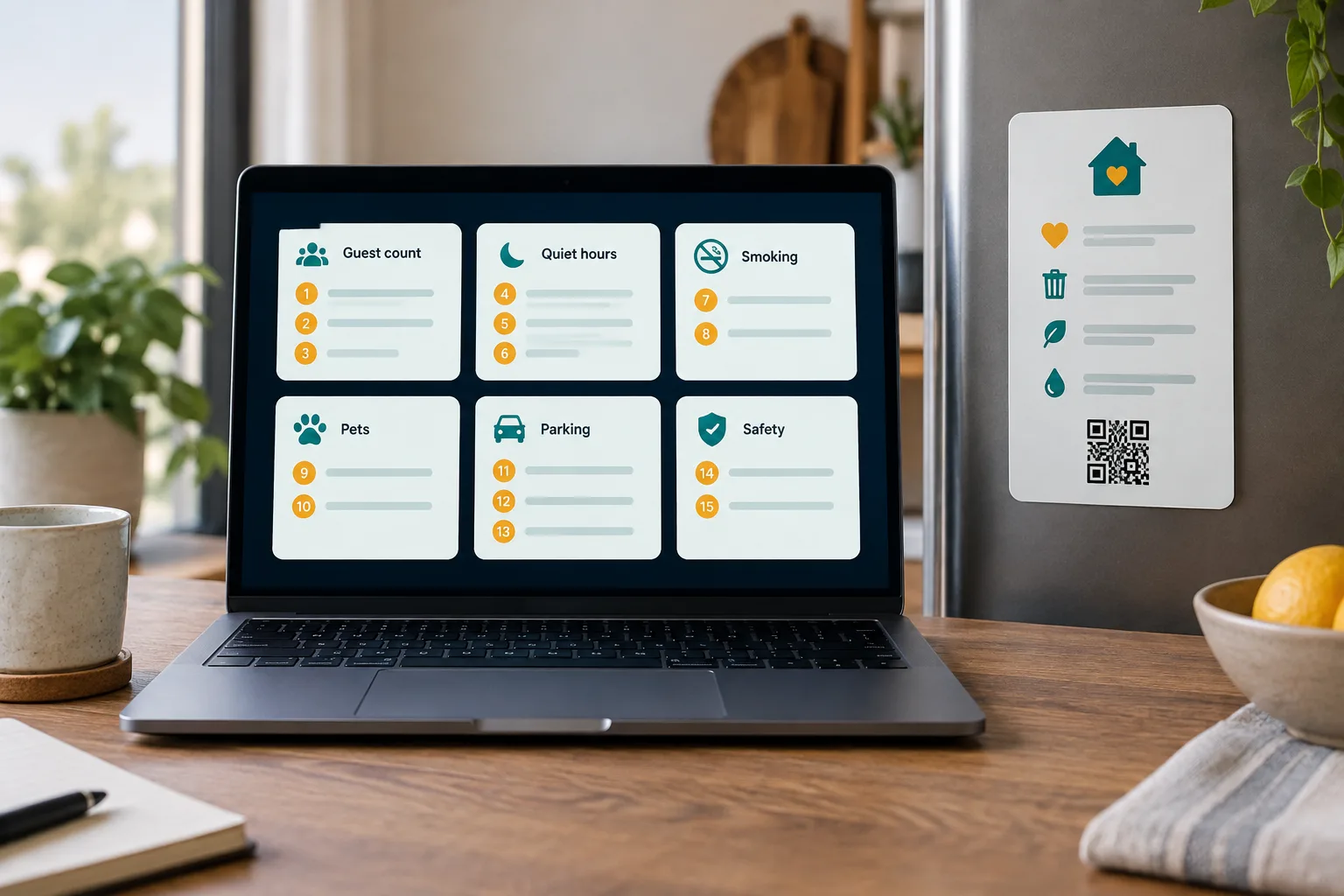
Use 10 to 15 rules. Put the strict items first: guest count, visitors, quiet hours, smoking, pets, parties and safety. Keep operational details such as WiFi, appliance notes and restaurant tips in the guidebook, not in the legal looking rule list.
The rule must be visible before booking. The sign is only a reminder.
Airbnb says house rules and requests for reservations booked on or after 20 November 2026 must be in the designated listing section at booking, and hosts generally cannot introduce new requirements later by message, signs in the home or in person. Airbnb also says rules and requests must be reasonable, consistent with the listing and comply with its policies. (airbnb.com)
A few simple rules help us protect {property name}, our neighbours and the next guest.

1. Maximum overnight guests: {maximum guests}. Only registered guests may stay overnight.
2. Visitors: Please ask before inviting visitors. Visitors must leave by {visitor end time}.
3. Quiet hours: {quiet hours}. Please keep music, voices and hallway noise low.
4. No parties or events: This home is not suitable for parties, gatherings or paid events.
5. Smoking and vaping: No smoking or vaping inside. Use {smoking area} if allowed.
6. Pets: {pet rule}. Service animals are handled under platform and local rules.
7. Parking: Use {parking space}. Do not block neighbours or shared access.
8. Check in: Check in is from {check in time} unless agreed in writing.
9. Checkout: Checkout is by {checkout time}. Please return keys to {key location}.
10. Lock up: Close windows and lock doors when leaving and at checkout.
11. Trash and recycling: Put rubbish and recycling in the marked indoor bins.
12. Damage: Please report damage or faults straight away so we can fix them.
13. Safety devices: Do not tamper with alarms, sensors, locks or safety equipment.
14. Pool or hot tub: Follow the posted safety rules before use.
15. Shared areas: Please respect neighbours, corridors, lifts, gardens and parking areas.
The 2026 Airbnb rule change hosts need to know
Airbnb announced changes to house rules on 20 October 2026, with a new policy taking effect for reservations booked on or after 20 November 2026. Airbnb says hosts can choose from 7 standard rule areas: maximum overnight guests, quiet hours, events, pets, smoking, commercial photography and lock up at checkout. (airbnb.com)
The practical point is not that every host must use the same words. It is that the rule must be in the right place before the guest books. If a guest only sees a new rule after booking, in a message, on a printed Airbnb house rules sign or when they arrive, it may be much weaker.
Airbnb also gives examples of requests that are usually not allowed, including asking guests to strip beds, wash and put away dishes, take rubbish away from the property or do tasks normally handled by a cleaner. It says guests can still be asked lighter things such as putting used dishes in the sink, gathering used towels and separating rubbish into designated indoor bins. (airbnb.com)
This is operational guidance, not legal advice. Local rules, HOA rules, building security rules, licensing conditions and fire safety duties may still matter. If those rules require ID, registration or a specific notice, Airbnb says extra contact or identity information may be allowed for legal or compliance reasons, but the requirement should be disclosed to guests before booking. (airbnb.com)
The 15 house rules to include
Use this table as your working set. Each line is short enough for the listing, online check in and a guest guidebook. You can make the wording warmer or stricter, but avoid vague phrases such as be respectful unless you say what that means.
| Rule | Friendly wording | Why it matters | Where to show it |
|---|---|---|---|
| Maximum overnight guests | The maximum overnight guest count is {number}. Please make sure the booking guest count is accurate. | Occupancy affects safety, insurance and neighbours. | Listing, online check in, reminder sign |
| Visitors | Visitors are welcome only with approval and must leave by {time}. | Stops extra overnight guests and noise. | Listing, online check in |
| Quiet hours | Quiet hours are {start} to {end}. Please keep voices, music and corridors quiet. | Sound carries in flats and shared streets. | Listing, message, sign |
| No parties | No parties, events or open gatherings. | Airbnb prohibits disruptive gatherings and open invite parties. (airbnb.com) | Listing, online check in |
| Smoking and vaping | No smoking or vaping inside. If allowed, use {area}. | Odour causes complaints and lost nights. | Listing, sign near door |
| Pets | {Number} approved pets are allowed. Please keep them off beds and clean the garden. | Sets clear pet limits. | Listing, online check in |
| Parking | Please use {space} only and do not block access. | Parking causes fast neighbour complaints. | Listing, arrival message, sign |
| Check in time | Check in is from {time} unless agreed in writing. | Prevents guests arriving during cleaning. | Listing, message |
| Checkout time | Checkout is by {time}. Please return keys to {place}. | Cleaners need reliable access. | Listing, checkout message |
| Lock up | Please close windows, lock doors and return keys before leaving. | Airbnb has a standard lock up rule area. (airbnb.com) | Listing, door sign |
| Trash and recycling | Please place rubbish and recycling in the marked indoor bins. | Keeps checkout light and clear. | Request section, bin sign |
| Damage reporting | Please tell us about damage or faults as soon as you notice them. | Faster repair, better evidence. | Listing, guidebook, message |
| Safety devices | Please do not cover, move or disable alarms, locks or safety devices. | Safety and policy issue. | Listing, guidebook |
| Pool or hot tub | No glass, supervise children and replace the cover after use. | Prevents injury and damage. | Listing, sign at amenity |
| Shared areas | Please keep corridors, lifts, gardens and entrances clear and quiet. | Protects neighbours and reviews. | Listing, sign |
Copy and paste Airbnb house rules template
This airbnb house rules template free version is written for a whole home or serviced apartment. Edit the placeholders, then put the final version in the designated rules and requests section. For Airbnb checkout wording, keep it light and consistent with Airbnb guidance. For a fuller checkout message, use this related Airbnb checkout instructions template.
Thanks for choosing {property name}. A few simple rules help us protect the home, our neighbours and the next guest.

Guest count and visitors
The maximum overnight guest count is {maximum overnight guests}. Only registered guests may stay overnight. Please ask before inviting visitors, and make sure approved visitors leave by {visitor end time}.

Quiet hours and neighbours
Quiet hours are {quiet hours}. Please keep music, voices, balconies, corridors and shared entrances quiet during these hours.

Parties and events
No parties, events, open gatherings or commercial events are allowed at the property.

Smoking and vaping
Smoking and vaping are not allowed inside the property. {Smoking area wording}.

Pets
{Pet policy}. Service animals are handled under platform rules and applicable law.

Parking
Please use {parking instructions}. Do not block neighbours, bins, garages, gates or shared access.

Check in and checkout
Check in is from {check in time}. Checkout is by {checkout time}. Please lock the property, return keys to {key return place} and let us know once you have left.

Light checkout requests
Before you leave, please put used dishes in the sink, place rubbish and recycling in the marked indoor bins, gather used towels in {towel place} and turn off lights and heating or air conditioning.

Damage and problems
Please report damage, missing items, leaks, faults or safety concerns straight away. We know accidents happen and early notice helps us fix things quickly.

Safety and amenities
Do not tamper with alarms, locks, cameras disclosed in the listing, noise monitors, pool equipment, hot tub equipment or fire safety items. Follow the posted safety rules for {pool hot tub fire pit other amenity}.

Emergency contact
For urgent property issues contact {emergency contact}. In an emergency, call local emergency services first.
Friendly wording versus strict wording examples
Friendly does not mean soft. The best Airbnb house rules examples sound calm, but they remove room for argument. Use reasons where they help guests comply: sound carries, cleaners arrive at a fixed time, smoking blocks the next arrival.
Avoid threatening fines in your normal wording. Airbnb says hosts are generally not allowed to impose fines or other penalties on guests under the new reasonable rules policy. If a guest causes damage, document it and use the platform process rather than inventing a surprise penalty. (airbnb.com)
Use stricter wording where safety, occupancy or parties are involved. Airbnb ground rules say guests should follow listing house rules, including quiet hours and restrictions on guest count, smoking and pets. Airbnb also says repeated or severe violations may lead to consequences for guests. (airbnb.com)
Vague: No noise. Better: Quiet hours are 10 pm to 8 am because sound carries to the flat below.
Vague: No extra people. Better: The booking is for {number} overnight guests. Visitors need approval and must leave by {time}.
Harsh: If you smoke you will be fined. Better: No smoking or vaping inside. Smoke odour can stop the next guest checking in, so please use {outside area} if smoking is allowed.
Harsh: Do not touch anything. Better: Please use the home normally, but do not move safety devices, locked cupboards or furniture between rooms.
What belongs in rules, requests and the guidebook
This is the distinction many hosts miss. A house rule is a booking condition. A request is a reasonable thing you would like the guest to do. A printed sign is a reminder. A guidebook note is an instruction. Some things should not be included at all.
| Item | Best category | Example |
|---|---|---|
| No smoking inside | Airbnb house rule | No smoking or vaping inside the property. |
| Maximum overnight guests | Airbnb house rule | Maximum overnight guests: {number}. |
| No parties or events | Airbnb house rule | No parties, events or open gatherings. |
| Put used dishes in sink | Reasonable request | Please place used dishes in the sink before checkout. |
| Gather used towels | Reasonable request | Please leave used towels in {place}. |
| WiFi code | Guidebook instruction | Network: {network}. Code: {code}. |
| Heating guide | Guidebook instruction | Press {button} to set the temperature. |
| Quiet hours on fridge | Printed sign reminder | Quiet hours are {hours}. Thank you for keeping voices low. |
| Hot tub no glass notice | Printed sign reminder | No glass near the hot tub. |
| Undisclosed charge for smoking | Do not include | Do not surprise guests with a new fine. |
| Strip beds and start laundry | Do not include | Usually cleaner style work under Airbnb examples. |
| Different rules for a protected group | Do not include | Airbnb prohibits different terms or house rules based on protected characteristics. (airbnb.com) |
| Hidden indoor camera note | Do not include | Airbnb does not allow cameras that monitor indoor spaces. (airbnb.com) |
For pets, remember that Airbnb says a service animal is not a pet and guests can generally be accompanied by one even where a home has a no pets rule. Airbnb also says hosts generally cannot charge extra pet or cleaning fees because of a service animal. (airbnb.com)
How to get guests to accept the rules during online check in
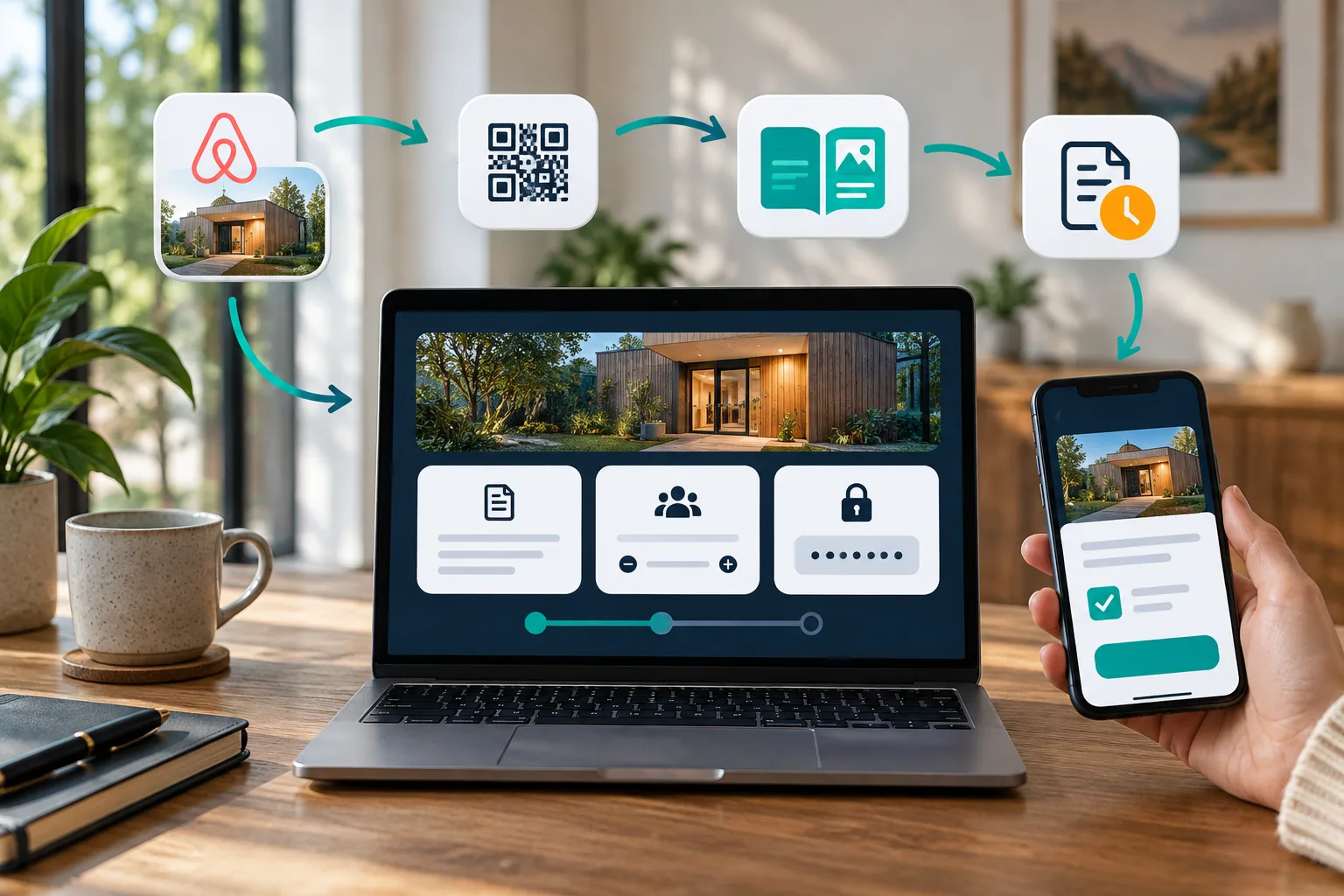
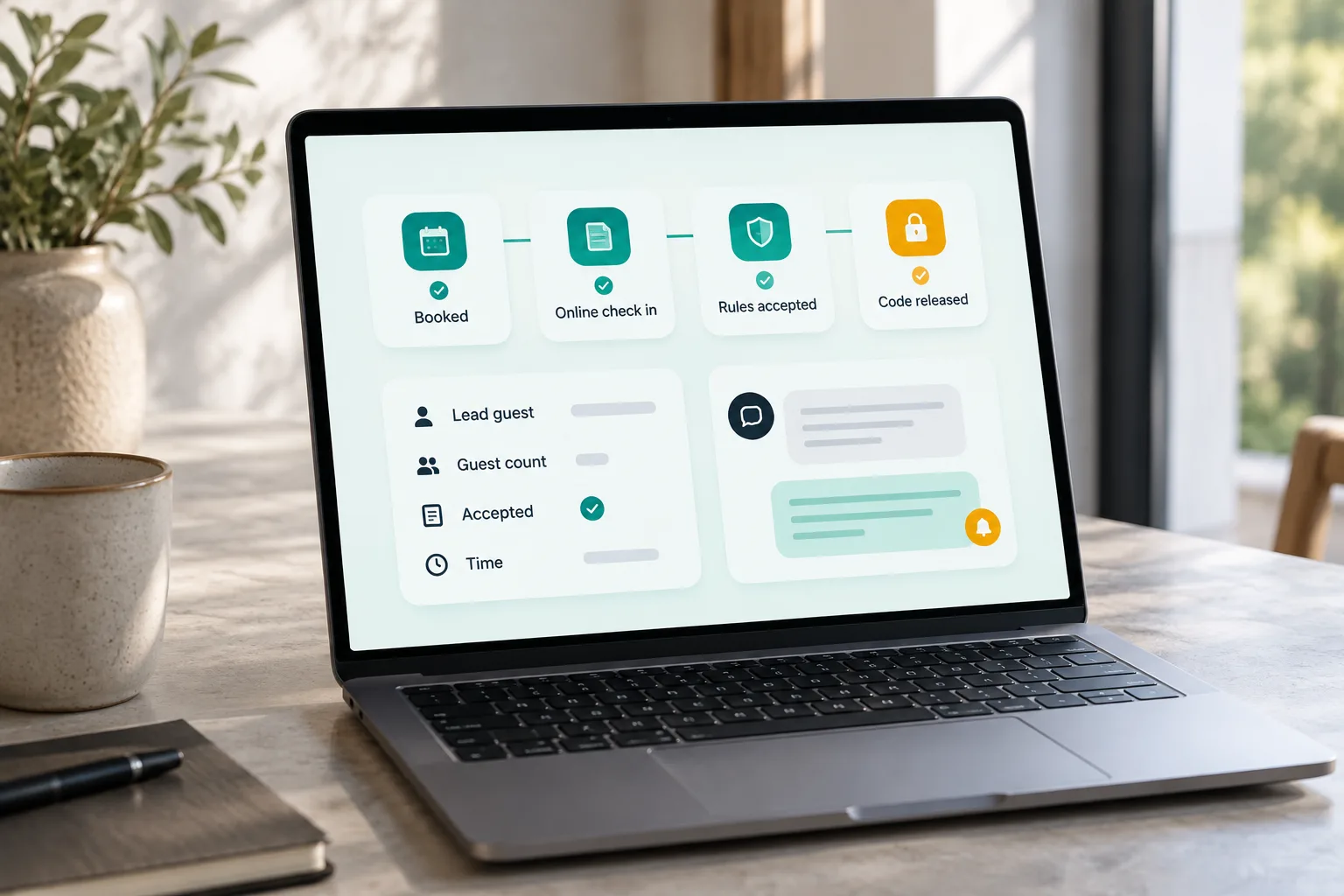
For a small host, the best workflow is simple. Booking confirmed, guest receives one online check in link, guest confirms their details and guest count, guest reviews the rules, then access details are released at the chosen time.
The acceptance should not be hidden. Put the full rules above the checkbox. Use one clear confirmation: I confirm I have read and agree to the house rules shown above, and the number of overnight guests is accurate. Store the lead guest name, booking reference, property, guest count, IP address where appropriate, timestamp, accepted rule version and any ID or local law notice.
Be careful with ID. Airbnb limits host imposed contracts and extra information, with exceptions such as legal, HOA or building security requirements that can be verified if Airbnb asks. For direct bookings, collect only what you need and keep it only as long as needed. The UK Information Commissioner’s Office describes data minimisation as personal data being adequate, relevant and limited to what is necessary. (airbnb.com)
YourFrontDesk fits here because arrivals use one link per stay for payment, ID and the guidebook. The door code is released at the chosen hour, only after payment and ID. If you are still sending rules manually, read how YourFrontDesk online check in works or see online check in for Airbnb hosts and short let managers.
A printable Airbnb house rules sign that does not get ignored
A printable Airbnb house rules sign should repeat the important rules guests already accepted. It should not introduce new restrictions. Keep it visual, short and placed where the behaviour happens: quiet hours near the door, smoking reminder near the exit, hot tub rules beside the tub, bin guide above the bins and parking reminder in the arrival message.
Welcome to {property name}

Quiet hours: {quiet hours}
Maximum overnight guests: {maximum guests}
No smoking or vaping inside
No parties or events
Parking: {parking place}
Checkout: {checkout time}
Emergency contact: {contact}

Scan the QR code for the full guidebook, WiFi and appliance notes.
A QR code is useful because it lets you keep the sign short while linking to a digital welcome book. Just make sure the QR code does not become the only place where a rule appears. If it matters, put it in the listing and online check in first.
For timing messages, pair the sign with a calm arrival note. This Airbnb check in message template gives you wording you can adapt without making the guest feel watched.
Worked examples by property type
City apartment: Put quiet hours, hallway noise, bin room access, balcony smoking and registered guests near the top. Make the reason obvious: sound carries through corridors and neighbours report problems quickly.
Pet friendly cottage: Say how many pets are approved, where they can sleep, whether they can be left alone, how to handle muddy paws and where to clean up the garden. If there is livestock, a shared lane or a neighbouring dog, say so before booking.
Family home with pool or hot tub: Keep the rules safety led. No glass near the water, children supervised at all times, cover replaced after use, no use after quiet hours and no changing settings unless instructed. Safety rules should appear in the listing, guidebook and at the amenity.
Multi unit building: Use one core rule set across every unit, then add property specific details for parking bay, bin store, entry code, lift, balcony and quiet areas. This matters when you have 1 to 10 units and no full time property manager checking every listing by hand.
To keep everything synced, keep a master document with rule version, last edited date and channel notes. Update Airbnb, Vrbo, direct booking, automated messages, guidebook, QR code and signs from that one source. Vrbo also says house rules should be published under rules and policies at the time a booking is made when relying on a guest rule breach for a cancellation waiver request. (help.vrbo.com)
How to handle rule breaches without escalating too fast
Start with evidence, not emotion. Airbnb asks hosts dealing with suspected or confirmed ground rule violations to communicate with the guest, document the issue, contact Airbnb where needed, request payment for damages through the Resolution Centre and leave an honest review. (airbnb.com)
Keep messages short and factual. Do not go to the property alone at night for a confrontation. Do not threaten surprise fines. Do not write a review while angry.
Hi {first name}, we have received a concern that there may be more people at {property name} than the {guest count} guests on the booking.

Please confirm the current number of people at the property and whether anyone not on the booking will be staying overnight.

As a reminder, the house rules allow a maximum of {maximum overnight guests} overnight guests and do not allow parties or events. Please correct this by {time} and reply in this thread so we can keep the stay on track.Hi {first name}, we have had a noise complaint from {source}. Quiet hours are {quiet hours}, and voices and music need to be kept low during that time.
Please reduce the noise now and keep balconies, corridors and shared entrances quiet. Reply once this is sorted so we can avoid further complaints.For smoking smell, ask the guest to stop immediately, ventilate if safe and keep all messages in the platform thread. For damage, ask for photos and a short explanation, then photograph the item, repair quote and cleaner notes after checkout. For late checkout, remind the guest of the agreed checkout time and the cleaner arrival. For pet issues, stick to the stated pet policy and platform rules on service animals.
What not to put in your rules
Do not put discriminatory conditions in your Airbnb house rules template. Airbnb says users may not deny service or impose different terms, conditions or house rules because of protected characteristics or perceived protected characteristics. (airbnb.com)
Do not add hidden fees, penalty charges or fines that guests did not see before booking. The US Federal Trade Commission rule on unfair or deceptive fees says short term lodging businesses that include pricing information in offers must tell people the total price up front, including mandatory fees. (ftc.gov)
Do not use rules to fix a bad listing. If the balcony is shared, say that in the listing. If the hot tub is seasonal, say that in the listing. If parking is tight, show the exact space. Rules that contradict your photos, amenities or description create complaints.
Do not use rules to disclose indoor cameras. Airbnb says hosts are not allowed to have security cameras or recording devices that monitor any part of a home’s interior, even if off or disconnected. Exterior cameras and certain monitoring devices have disclosure rules, so check the current policy before installing anything. (airbnb.com)
Final checklist before you publish your rules
Before you publish, check each item against the guest journey. Can the guest see it before booking? Is it in the right Airbnb section? Does online check in repeat the same wording? Does the sign remind rather than surprise?
Checklist:
- Rules match the listing, amenities and photos.
- Rules and requests are in the designated listing section.
- Online check in captures the lead guest, guest count and timestamped acceptance.
- Checkout requests are light, reasonable and not cleaner style tasks.
- Local rules, HOA rules and building rules are disclosed before booking.
- Pet wording allows for service animal rules and local law.
- No discriminatory wording, hidden fees, surprise contracts or undisclosed fines.
- Guidebook content is not pretending to be a booking rule.
- QR codes and signs repeat the accepted rules.
- Automated messages, direct booking text, Vrbo rules and printed signs all match.
If you manage several units, the boring system wins. One master rule set, one acceptance flow, one guidebook source and one review process will beat scattered notes in five different places.
Next steps
Copy the template, trim anything that does not apply and update your listing before relying on a sign or message. If you want one link per stay for payment, ID and the guidebook, with access details released only after the arrival steps are complete, see an instant demo of online guest check in.
What people ask next
What should Airbnb house rules include?
Include the rules that protect the stay: maximum overnight guests, visitors, quiet hours, parties, smoking, pets, parking, check in, checkout, lock up, rubbish, damage reporting, safety devices and any pool or hot tub rules. Keep guidebook details such as WiFi and appliance notes separate.
What are examples of good Airbnb house rules?
Good rules are clear and specific. For example, “Quiet hours are 10 pm to 8 am because sound carries to the flat below” is better than “No noise”. Another good example is “Only registered guests may stay overnight” instead of “No extra people”.
Can I make guests agree to house rules before check in?
Yes, but the rules should already be visible before booking on the platform or direct booking page. Online check in can then ask the lead guest to confirm they have read the rules, confirm the overnight guest count and accept responsibility for their group.
Are Airbnb house rules enforceable?
They are stronger when they are reasonable, visible before booking, in the designated listing section and consistent with the listing. If there is a breach, document it, message on the platform and contact support where needed rather than relying on surprise penalties.
Where should I put Airbnb house rules?
Put the formal rules in the Airbnb listing section for rules and requests. Then repeat the key points in online check in, automated messages, the digital guidebook and short signs placed where the behaviour happens.
Should I print Airbnb house rules as a sign?
Yes, but use the sign as a reminder, not as the first disclosure. A good sign covers quiet hours, smoking, guest limit, parking, checkout time, emergency contact and a QR code to the full guide.
Can I charge a fine if guests break house rules?
Avoid surprise fines. Use the platform process for damage, extra cleaning evidence or support requests, and make sure any local or building penalties are disclosed properly before booking.
Can Airbnb hosts ask guests to do chores before checkout?
Keep checkout requests light. Asking guests to put dishes in the sink, gather used towels and place rubbish in marked indoor bins is much safer than asking them to strip beds, wash dishes or do cleaner style work.