Airbnb Linens Per Bed Guide
Most small hosts do not need a hotel linen room, but they do need a simple par system. This guide shows how many sheets and towels to buy, where to store them, and how to keep cleaners moving on busy turnover days.
The short version
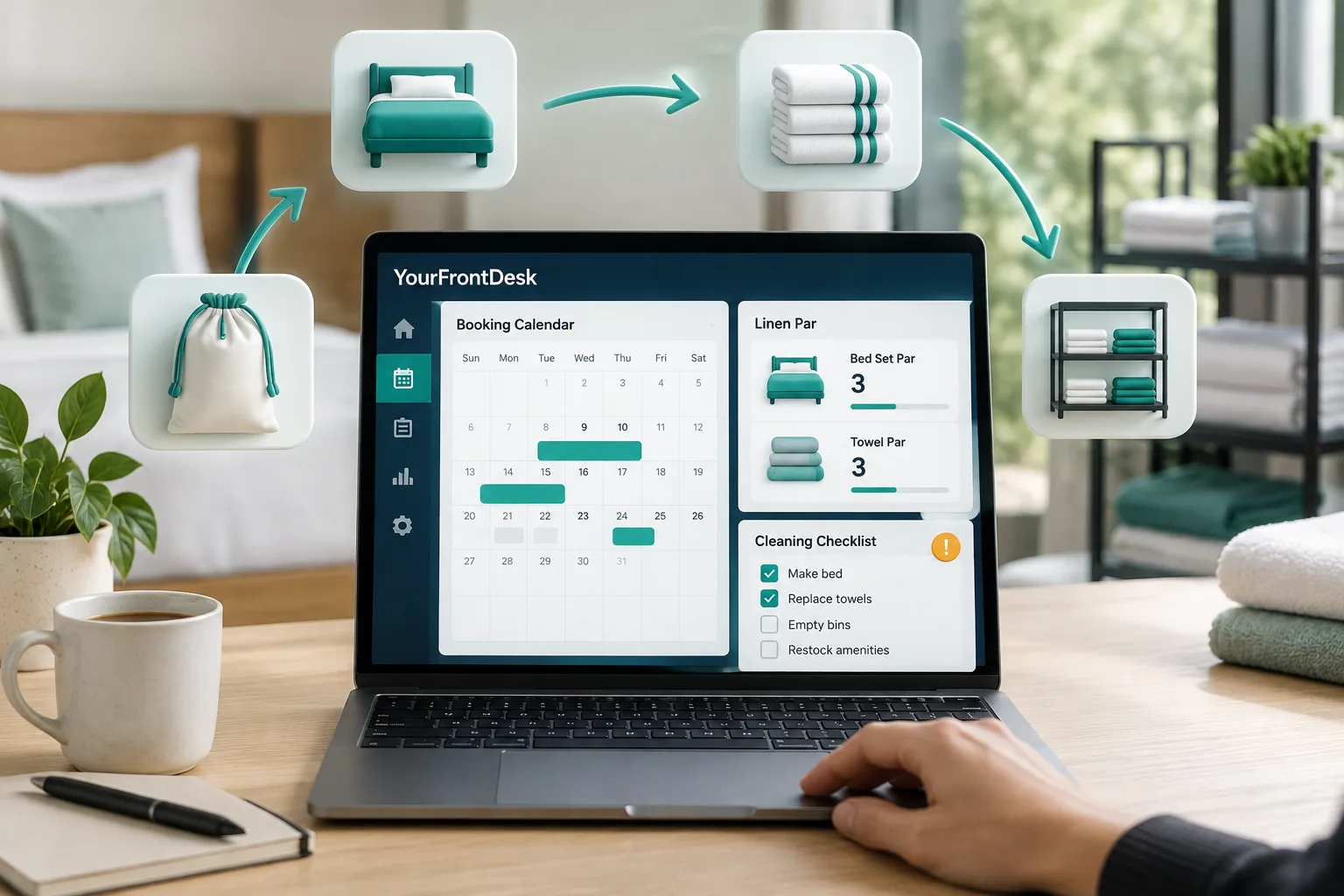
- Start most listings at 3 complete sheet sets per bed: one on the bed, one clean and one in wash or reserve.
- Move to 4 sets where you have one night stays, back to back bookings, slow laundry, off site laundry or frequent early check in risk.
- Count sheets by bed size, but count towels by maximum occupancy, bathroom count, amenities and length of stay.
- A useful linen closet is labelled by size and task, with guest extras separate from cleaner stock.
- Small hosts with 5 to 10 units need property level inventory, central reserve stock and a written cleaner handoff process.
Airbnb linens are not just a shopping list. For most short let hosts with 1 to 10 units, the right answer is 3 complete sheet sets per bed, then increase to 4 where laundry takes longer than your booking pattern allows.
Airbnb strongly encourages hosts to provide essentials, including one towel per guest, one pillow per guest and linens for each guest bed, but that is only the minimum guest standard, not a working turnover system. See Airbnb's own guidance on providing essential amenities for guests. (airbnb.com)
The short answer: most Airbnbs need 3 sets per bed
For a normal short let with reliable laundry, plan 3 complete sheet sets per bed:
- 1 set on the bed
- 1 clean set ready for the next turn
- 1 set in the wash, in transit or held as an emergency spare
That answer covers many studios, 1 bedroom flats and family houses where stays are usually 2 nights or longer. It lets the cleaner strip the bed, make it immediately from clean stock, then deal with laundry after the property is guest ready.
2 sets can work, but only when bookings are spaced out, laundry is done on site, the washer dryer is not slow, and stains are rare. If you take one night stays, run frequent same day turnover, or send laundry away, 2 sets is thin.
4 sets are safer when laundry returns 24 to 48 hours later, when cleaners take laundry off site, or when early check in and late checkout compress the day. HostPro Academy uses the same logic: one set on the bed, every set that can be away at laundry at the busiest point, then one spare. With a 2 day return and daily turns, that comes to 4 sets per bed. See its linen par section in the Airbnb amenities checklist. (hostproacademy.com)
Your linen count is right when the bed can be made before anyone starts a washing machine.
What counts as one complete linen set
Do not count only fitted sheets. A complete bed set is the whole bed reset:
- fitted sheet
- flat sheet or top sheet if you use one
- pillowcases for every sleeping pillow on that bed
- duvet cover or washable coverlet
- optional blanket layer where your climate needs it
The common failure is buying extra sheets but forgetting duvet covers and pillowcases. A stained duvet cover blocks the room just as surely as a stained fitted sheet.
Count bed sets by bed size: king, queen, full, twin, sofa bed, trundle, crib or travel cot. Do not mix queen and king stock in one unlabelled pile. It wastes cleaner time and causes wrong size beds when the turn is already tight.
Towels are a separate calculation. A towel set normally means a bath towel, hand towel and washcloth or face cloth. Add bath mats per bathroom, kitchen towels per stay, and separate pool or beach towels if guests have a hot tub, pool or beach access.
Airbnb says essentials include one towel and one pillow per guest, plus linens for each guest bed. That helps define the floor, but most hosts should exceed it for comfort and fewer messages. The Airbnb essentials page also warns that listings selecting essentials but not providing them may face penalties, including removal from Airbnb. (airbnb.com)
The par level formula for Airbnb sheets
Use this formula for every bed size in every unit:
Sheet sets needed per bed = 1 on bed + laundry cycle buffer + emergency spare
Laundry cycle buffer = maximum number of turns before dirty linen returns clean
Emergency spare = 1 complete set per bed
If dirty linen returns before the next checkout, the laundry cycle buffer is usually 1. That gives par 3. If dirty linen can be away for 2 turns, the buffer is 2. That gives par 4.
| Turnover pattern | Laundry setup | Sheet par | Best for | Risk level |
|---|---|---|---|---|
| 2 to 5 night stays | washer dryer in unit | 3 per bed | single unit hosts | low if machine works |
| same day weekend turns | cleaner washes on site | 3 to 4 per bed | 1 to 3 units | medium |
| one night stays | cleaner takes laundry away | 4 per bed | busy city units | low if labelled |
| daily turns with 2 day return | commercial laundry | 4 per bed | high volume units | medium without reserve |
| 5 to 10 units | central clean stock plus laundry service | 4 per bed plus reserve | small managers | low with audits |
Laura Maid Services gives the same operating principle for par stock: one on the bed, one clean and one in wash or transit, with 2 sets only working where turns are spaced out. Its guide also notes that towels dry more slowly than sheets, which matters when you are trying to finish inside the turnover window. See the Airbnb linen and restocking guide. (lauramaidservices.com)
Sheet par table for 1 to 10 Airbnb units
More units do not always mean more sheet sets per bed. They do mean tighter labels, stronger stock control and less tolerance for a cleaner guessing where things are.
For 1 unit with a washer dryer and average stays of 2 to 5 nights, start with par 3. Keep one full turnover kit accessible to the cleaner, not buried behind personal storage.
For 1 to 3 units with frequent same day turns, use par 3 where laundry is reliable and par 4 for beds that sell most often. If one bed size appears in every unit, such as queen, buy that line in bulk and label by size.
For 4 to 10 units with cleaner pickup or commercial laundry, use par 4 per bed and add central reserve. A practical reserve is one emergency set per bed size for every 3 to 5 units, plus spare towels equal to one full turn for your busiest unit. That reserve is not guest stock. It is the shelf that saves a Saturday.
For hosts growing from one flat into a small portfolio, linen planning belongs beside your cleaning process. If you are tightening your operations, pair this with an Airbnb cleaning checklist for cleaners and make the linen count part of every checkout task.
How many towels to buy per guest
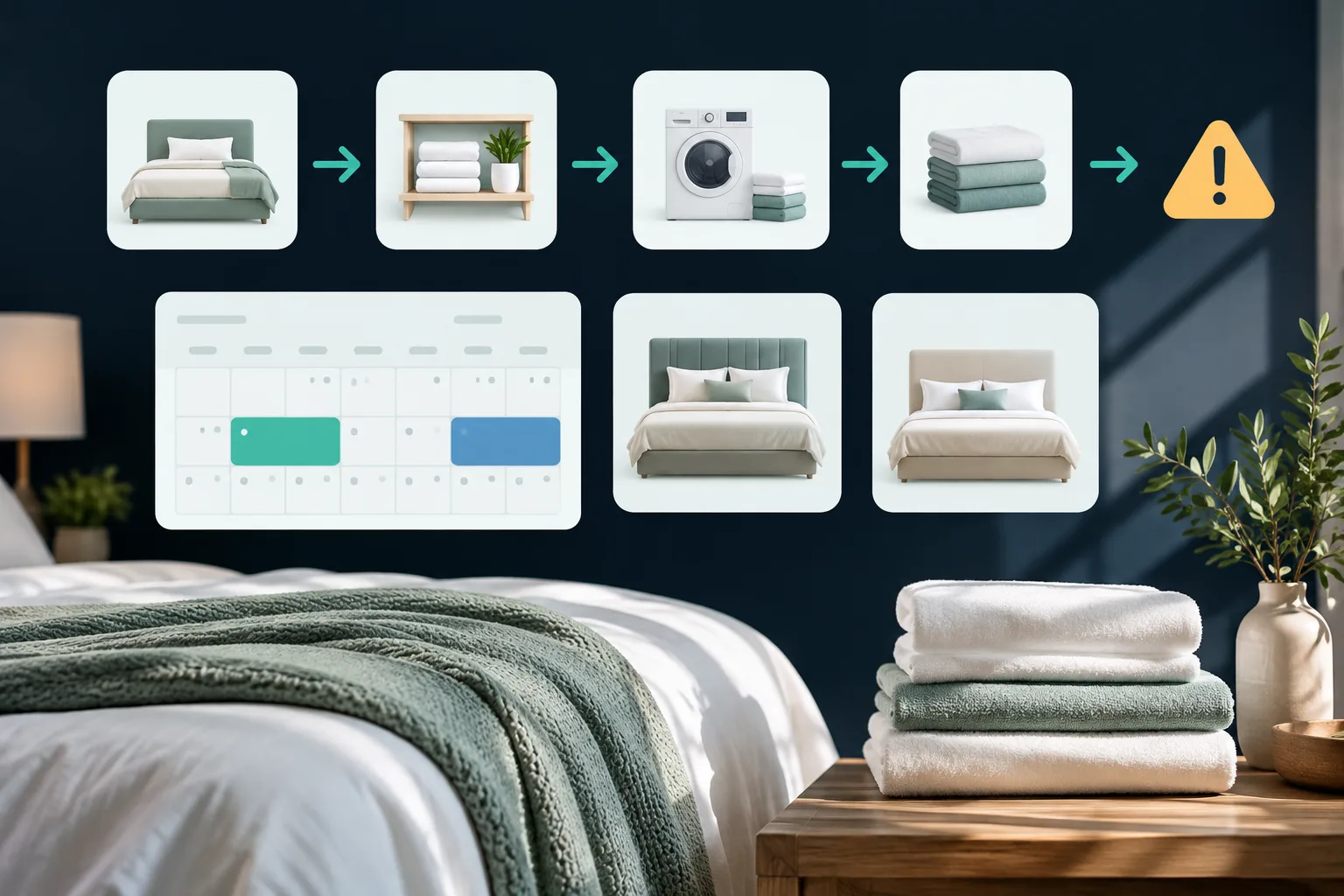
Sheets follow bed count. Towels follow maximum occupancy. A 2 bedroom apartment with 1 king, 1 queen and a sofa bed may have 3 sleep surfaces, but if it sleeps 6, towel stock should be based on 6 guests.
As a baseline, provide per guest per stay:
- 1 to 2 bath towels
- 1 hand towel
- 1 washcloth or face cloth
Then multiply by your towel par. For most hosts that is par 3, matching the sheet logic. For 4 guests, par 3 with 1 towel of each type per guest means 12 bath towels, 12 hand towels and 12 washcloths. If you provide 2 bath towels per guest, that becomes 24 bath towels.
Bath mats follow bathrooms, not guests. A 2 bathroom unit at par 3 needs 6 bath mats. Kitchen towels follow stays. If you use 2 kitchen towels per turn and par 3, hold 6.
For pools, hot tubs, lake houses and beach stays, add a separate towel category. If you do not, guests will take bath towels outside, and your bathroom stock will age faster.
Worked example: studio or 1 bedroom Airbnb
Assume 1 queen bed, sleeps 2, 1 bathroom, washer dryer on site and an average stay of 3 to 5 nights.
Recommended starting inventory:
- 3 queen fitted sheets
- 3 queen flat sheets, if used
- 3 duvet covers or washable coverlets
- 6 to 12 pillowcases, depending on pillow count
- 6 bath towels if using 1 per guest at par 3
- 6 hand towels
- 6 washcloths
- 3 bath mats
- 2 mattress protectors
- pillow protectors for every pillow, plus spares
After checkout, the cleaner strips the bed and bags dirty linen. The new bed is made from the clean queen set in the closet. The dirty set goes into the washer or dirty bag. One set remains as backup, unless it has just been used because of a stain.
Increase this studio to par 4 if you allow one night stays, have a slow dryer, rely on cleaner laundry at home, or regularly approve early check in. If early arrivals are part of your offer, your linen system must support them. Our Airbnb early check in fee guide explains how to price the extra pressure on cleaning time.
Worked example: 2 bedroom apartment that sleeps 4
Assume 1 king, 1 queen, sleeps 4, 2 bathrooms and regular back to back weekend stays. Use par 3 if laundry is done on site and returned to the closet before the next turn. Use par 4 if laundry leaves the property.
At par 3, buy:
- 3 king fitted sheets and 3 king flat sheets
- 3 queen fitted sheets and 3 queen flat sheets
- 3 king duvet covers and 3 queen duvet covers
- pillowcases for every pillow, multiplied by 3
- 12 bath towels if using 1 per guest per par
- 12 hand towels
- 12 washcloths
- 6 bath mats for 2 bathrooms
- 6 kitchen towels if using 2 per stay
At par 4, the same apartment needs 4 of each bed item, 16 bath towels, 16 hand towels and 16 washcloths, plus 8 bath mats.
The cleaner should not have to build a set from scattered piles. Put one full clean turnover kit where they can reach it: king set, queen set, towels, bath mats and kitchen towels. Keep guest extras separate so a guest does not use the entire next turn.
Worked example: small host with 5 to 10 units
At 5 to 10 units, you stop having a linen closet and start having a linen system. The system is simple, but it must be written down.
Standardise where you can. If 7 of your beds are queen, use the same white or near white line for all queen beds. Keep king, queen and twin stock in separate labelled areas. Use property labels when linen must stay with a particular unit.
A central reserve works well for small managers. Hold one emergency set per bed size for every 3 to 5 units, plus spare towels equal to a full turn for your highest occupancy unit. This is outside the par inside each property.
Use this cleaner handoff:
- Dirty bag out
- Clean bag in
- Made bed photos taken
- Stains logged before drying
- Damaged items moved to retire bin
- Reorder point updated
This is where YourFrontDesk can help indirectly. Its housekeeping list is built from checkouts, so the cleaning work starts from the real departure calendar across Airbnb, Booking.com, Expedia, Vrbo and direct bookings on one calendar. For hosts and small managers, see the short let tools for hosts and property managers.
On site laundry vs Airbnb linen service
There are four workable models. The right one depends on your unit count, equipment, cleaner agreement and turnover cadence.
Host washes between stays. This is cheap, but fragile once you have regular same day turns or more than 1 unit.
Cleaner washes on site. This works when the property has good machines and the cleaner has enough paid time. It fails when the whole turn waits for towels to dry.
Cleaner removes and returns laundry. This speeds up the clean, but needs more par stock and a clear rule for missing or damaged items.
Commercial laundry or rental linen service. LinenBNB describes a rental and laundry model where fresh linens and towels are delivered, used items are picked up and laundered, and hosts may avoid owning and managing linens themselves. See the LinenBNB linen and towel rental service. (linenbnb.com)
Outsourcing can save turnover time, but it often increases the number of sets needed because more items are away from the property. The trigger is simple: if laundry is delaying check in, or cleaners are billing extra hours to wait on machines, compare the service cost with cleaner time and review risk. If cleaning costs are changing, review how much to charge for an Airbnb cleaning fee.
Airbnb linen storage ideas that cleaners can actually use
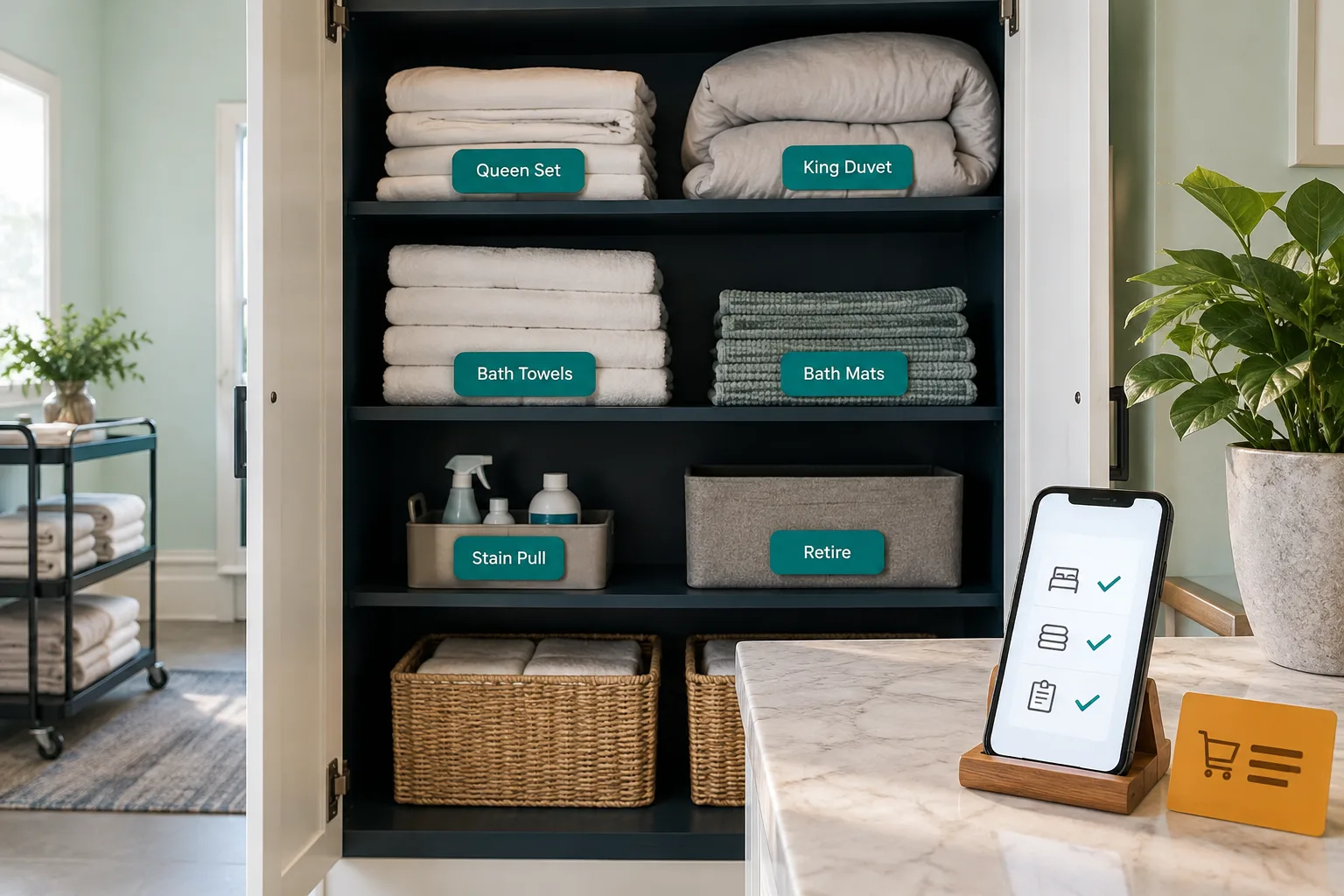
A good linen cupboard is designed for the cleaner on a busy day, not for a photo. Use labelled shelves by bed size, clear bins for towel types, sealed emergency sets, dirty linen bags and a stain treatment kit.
Separate guest access from cleaner stock. Guests can have a small visible supply: a couple of extra towels, spare blanket and maybe one pillow. Cleaner stock belongs in an owner closet, cleaner closet or locked cupboard.
Use labels such as:
- Queen Set 1
- Queen Set 2
- King Duvet
- Bath Towels
- Hand Towels
- Bath Mats
- Stain Pull
- Retire
Do not vacuum pack everyday turnover sets. It saves space but costs minutes. Use compression bags for seasonal blankets, spare duvets and items that do not need to move every turn.
Storage.com recommends a designated utility area, extra linens and towels stored out of view, over door organisers, labelled bins, vacuum sealed bags for space saving and seasonal rotation. See its Airbnb storage tips for hosts. (blog.storage.com)
Replacement, stains and reorder rules
Set the reorder point before you need it. My rule is this: when any bed size drops below one clean backup set after the bed is made, reorder, launder or move central reserve before the next turn.
Retire items for permanent stains, grey towels, pilling, frayed elastic, holes, makeup marks, bleach damage or guest visible wear. Clean but ugly is still a review risk.
White or near white stock is practical because it is easier to match across purchase dates, easier to inspect and easier to treat. Laura Maid Services also recommends buying white and multiples of the same product so items can be replaced piece by piece and pooled by size. See its par stock guide for Airbnb linens. (lauramaidservices.com)
Use this monthly cost template:
Property: {property name}
Month: {month}
Item: {item name}
Unit cost: {cost}
Quantity bought: {quantity}
Expected wash life: {wash count or months}
Turns this month: {turns}
Retired this month: {quantity and reason}
Cost per turnover: {linen spend divided by turns}
Reorder needed: {yes or no}
You do not need perfect accounting on day one. You need a visible damage allowance and a reorder trigger that stops emergency shopping.
Copy and paste templates for hosts and cleaners
Use a spreadsheet with one row per item type, not one row per property only. That lets you see the queen fitted sheet problem before the cleaner messages you at noon.
Property: {property name}
Room: {bedroom or bathroom}
Bed size: {king queen full twin sofa bed}
Item: {fitted sheet flat sheet duvet cover pillowcase bath towel hand towel washcloth bath mat kitchen towel}
Par target: {number}
Current clean: {number}
In laundry: {number}
Damaged: {number}
Reorder point: {number}
Order needed: {yes or no}
Notes: {size brand colour storage location}
Give the cleaner a turnover linen checklist that removes doubt.
Property: {property name}
Checkout date: {date}
Strip all used beds, including sofa bed if opened.
Check sheets, pillowcases, duvet covers and towels for stains before drying.
Make beds from clean stock, not from wet laundry.
Restock towels: {bath towels} bath, {hand towels} hand, {washcloths} washcloths.
Place dirty linen in {bag location}.
Move stained items to {stain location} and send photo.
Move retired items to {retire bin location}.
Send made bed photos and low stock note before marking complete.
If you use guest messaging to offer early check in or answer towel questions, make sure the answer matches the stock reality. YourFrontDesk can answer guests at any hour from that property's own information, and when unsure it drafts a reply for the host instead of guessing. Questions it could not answer are surfaced so the host can add the answer once.
Next steps
Start at par 3 for every bed. Move to par 4 where laundry return, one night stays or back to back bookings make par 3 risky. Count towels by maximum occupancy, store cleaner stock away from guest extras, and audit monthly.
If you want the housekeeping list, guest messages and booking calendar working from the same operating picture, try the YourFrontDesk instant demo.
What people ask next
How many sets of sheets do I need for an Airbnb?
Most Airbnb hosts should start with 3 complete sheet sets per bed: one on the bed, one clean and one in the wash or reserve. Use 4 sets when laundry takes 24 to 48 hours to return, when you accept one night stays, or when you often have back to back bookings.
How many towels should I provide per Airbnb guest?
Airbnb's minimum is one towel per guest, but most hosts should provide at least one bath towel, one hand towel and one washcloth per guest per stay. Multiply that by your laundry par, usually 3, then add bath mats by bathroom and separate pool or beach towels where needed.
Does Airbnb require hosts to provide linens?
Airbnb strongly encourages hosts to provide essentials, including linens for each guest bed, one towel per guest and one pillow per guest. If you select essentials in your listing, you should have those items available for guests.
Should Airbnb hosts use white sheets?
White or near white sheets are usually easiest to operate because they are simple to match, inspect, treat and replace across multiple purchase dates. Coloured sheets can work for a specific design, but fading and mismatched replacements become a problem as you scale.
Is it better to wash Airbnb linens on site or use a linen service?
On site laundry is cheaper and can work well for 1 unit with decent gaps between bookings. A linen service or off site laundry can save cleaner time on busy turnover days, but you usually need more stock because more linen is away from the property.
How do you store extra linens in an Airbnb?
Keep guest extras separate from cleaner stock. Use labelled shelves by bed size, clear bins for towel types, a sealed emergency set, dirty linen bags and a retire bin for damaged items.
What is par stock for vacation rental linens?
Par stock is the target number of complete linen sets you hold so the property can turn over without waiting for laundry. For sheets, a simple formula is one on the bed, every set that can be away at laundry, plus one spare.