How Much to Charge Airbnb Cleaning Fee
Set an Airbnb cleaning fee that covers the real turnover without making short stays look expensive. This guide gives small hosts a worksheet, calculator, examples and guest scripts.
The short version
- Start with the true per stay turnover cost, not a copied market average.
- A flat cleaning fee feels high on one and two night stays, so test a lower short stay fee, a minimum stay, or a nightly rate bundle.
- Airbnb shows guests the total price before taxes in search, so cleaning is part of your visible price competition.
- Gross up the fee if the Airbnb host service fee is deducted from the amount you receive.
- Keep checkout requests light, because a high cleaning fee plus a chore list is a fast route to value complaints.
If you are asking how much to charge airbnb cleaning fee, start with your true turnover cost, then check whether that number still fits your local comp set. For most small hosts, the right fee is the lower of your grossed up turnover cost and the upper end of similar listings, unless your home is clearly harder to clean than the market expects.
A cleaning fee is a per stay cost. That means it looks painful on a one night or two night stay and much more reasonable on a week. Your job is not to hide the cost. Your job is to cover a proper clean, pay people fairly and keep the guest visible total competitive.
Quick answer: what should you charge?
Charge enough to cover the clean, laundry, supplies, inspection and admin for one complete turnover. Then compare the guest total for a two night and five night search against 8 to 12 similar listings.
Airbnb allows a standard cleaning fee and a lower short stay cleaning fee for one and two night bookings, so you do not have to use one blunt number for every stay length. Airbnb describes the cleaning fee as set by the host, and says hosts can add a standard fee plus an optional lower fee for one and two night stays in Airbnb cleaning fee settings. (airbnb.com)
Use this as a starting sanity check, not as a national rule.
| Property size | Typical national benchmark | High risk fee level | Higher fee is easier to defend when |
|---|---|---|---|
| Studio or 1 bed | $0 to $120 | Above $150 | Laundry is external, pets are allowed, or the unit has premium linen |
| 2 bed | $140 to $155 | Above $200 | There are two bathrooms, sofa beds, parking time, or same day turns |
| 3 bed | Around $200 | Above $275 | Group stays create more linen, bins and kitchen reset time |
| 4 bed | Around $250 | Above $350 | It is a family house with multiple baths, garden, hot tub or pets |
| 5 bed plus | Around $300 and often more in resort markets | Above $425 | Large destination homes need linen teams, checks and longer changeovers |
AirDNA puts the average Airbnb cleaning fee in the United States at $161.10 in 2025 and gives a two bed example around $141.60, while Clean Casa reports a $185 median across 69,102 United States listings collected from April to September 2026, with bedroom medians of about $120 for a 1 bed, $152 for a 2 bed, $200 for a 3 bed and $250 for a 4 bed. GuestFavorites found a $174 median across 1.1 million United States entire home listings in October 2026. AirDNA cleaning fee data, Clean Casa cleaning fee report and GuestFavorites city data are useful benchmarks, but your own market still matters most. (airdna.co)
What the fee should cover
The Airbnb cleaning fee should cover standard turnover costs. That usually means cleaner labour, laundry, linen service, towels, consumables, restocking, a quality check, travel, parking, same day coordination and a small reserve for occasional re cleans.
It should not be a hidden profit line, routine maintenance recovery, damage deposit, or punishment for untidy guests. Airbnb says cleaning fees are meant to cover standard cleaning between reservations, such as laundry and vacuuming, and that hosts may not charge guest fees simply because a guest failed to perform a specific cleaning or checkout task. Airbnb also separates damage, missing items and unexpected cleaning from standard cleaning. See Airbnb ground rules for guests. (airbnb.com)
Think of the three common charges this way:
| Charge | Use it for | Do not use it for |
|---|---|---|
| Cleaning fee | Normal reset after every stay | Damage, punishment or routine repairs |
| Damage claim | Broken, missing or badly stained items beyond normal wear | Normal crumbs, ordinary linen washing or your own checklist gaps |
| Pet fee | Extra pet related cleaning and wear, if pets are allowed | Undisclosed damage or a general cleaning markup |
The fee is not judged by guests in isolation. It is judged inside the total price for their exact dates.
How guests see cleaning fees in search
The airbnb cleaning fee included in price question is now simple from a guest point of view. Airbnb says guests see the total price of the stay, including all fees before taxes, from the start of search. Airbnb also says its search ranking considers total price and how that price compares with similar listings for the selected dates. See Airbnb total price display and Airbnb search ranking factors. (news.airbnb.com)
So a $175 cleaning fee is not competing with other cleaning fees. It is competing inside the full guest total for a two night weekend, a three night break and a seven night stay.
Simple example, before taxes:
| Price structure | 2 nights | 3 nights | 7 nights |
|---|---|---|---|
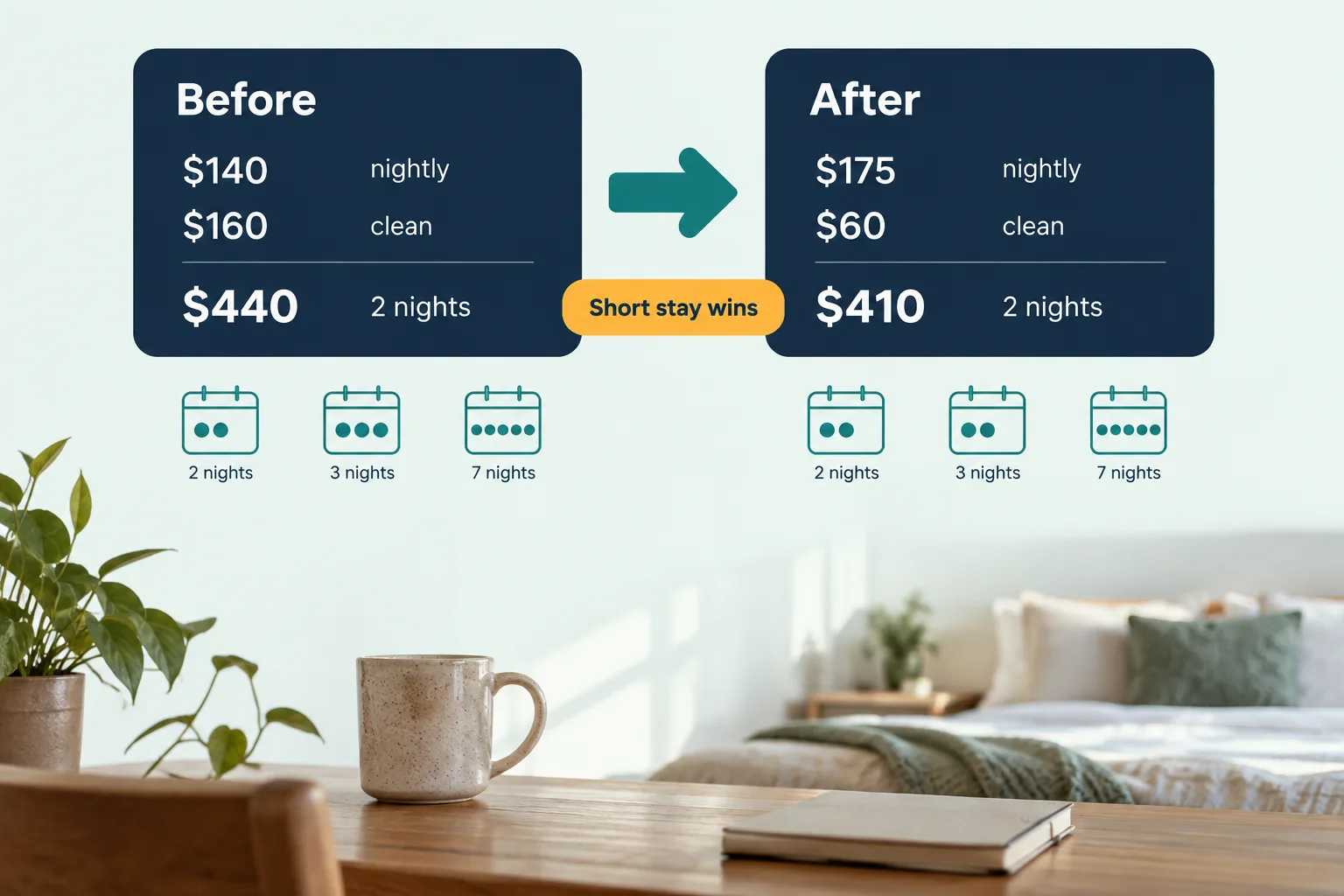
| $140 nightly plus $160 cleaning | $440 | $580 | $1,140 |
| $175 nightly plus $60 cleaning | $410 | $585 | $1,285 |
The second option wins the two night search, is almost level at three nights and loses the seven night stay. Same home, same cleaner, different presentation. That is why you should test by stay length, not by fee alone.
Build your true turnover cost first
Before you touch the listing, fill out one worksheet per property. This is where many 1 to 10 unit hosts underprice. They enter the cleaner invoice, forget linen, forget restocking, then resent every one night booking.
Use this worksheet:
| Cost line | Amount per turn |
|---|---|
| Cleaner invoice or cleaner labour | {amount} |
| Laundry or linen service | {amount} |
| Consumables, tea, coffee, soap, paper | {amount} |
| Restocking time | {amount} |
| Quality inspection | {amount} |
| Travel, parking, congestion or access time | {amount} |
| Small supplies replacement | {amount} |
| Deep clean reserve | {amount} |
| Manager coordination | {amount} |
| Owner time if you clean yourself | {amount} |
| True turnover cost | {total} |
If you clean yourself, price your time as if you had to replace yourself tomorrow. A host who values a three hour clean at zero has not found a cheap model. They have created a fragile one.
Airbnb says that under the split fee structure most hosts pay 3 per cent, and that the fee is calculated on the nightly price plus host charged fees, excluding guest service fee and taxes. Airbnb also says it is transitioning home hosts to a single fee structure, with most hosts paying 15.5 per cent. See Airbnb service fees. (airbnb.com)
Airbnb cleaning fee calculator: the formula
Use this airbnb cleaning fee calculator for each listing.
Fee to charge = target net turnover cost divided by 1 minus host service fee rate
Examples:
| Target net turnover cost | Host service fee rate | Fee to charge |
|---|---|---|
| $100 | 3 per cent | $103.09 |
| $100 | 15.5 per cent | $118.34 |
| $150 | 15.5 per cent | $177.51 |
Those figures are just maths from the Airbnb service fee basis above. If your cleaner costs $150 and your host fee is 15.5 per cent, charging $150 does not leave you $150 after fee deduction.
If you want to fold cleaning into the nightly rate, use this:
Nightly uplift = turnover cost divided by expected nights per booking
A $120 turnover cost over an average 3 night stay is a $40 nightly uplift. That works well if most stays are 3 nights. It can overcharge a 7 night guest unless your weekly discount corrects it, and it can still under recover a 1 night stay.
Worked examples for small hosts
One studio with a $75 clean and 2 night average stay. Under a 3 per cent host fee, the grossed up fee is about $77. If local studios often show no cleaning fee, try $40 to $50 as a short stay cleaning fee and add $15 to $20 to the nightly rate. If you have many one night gaps, a lower short stay fee is better than losing the gap entirely.
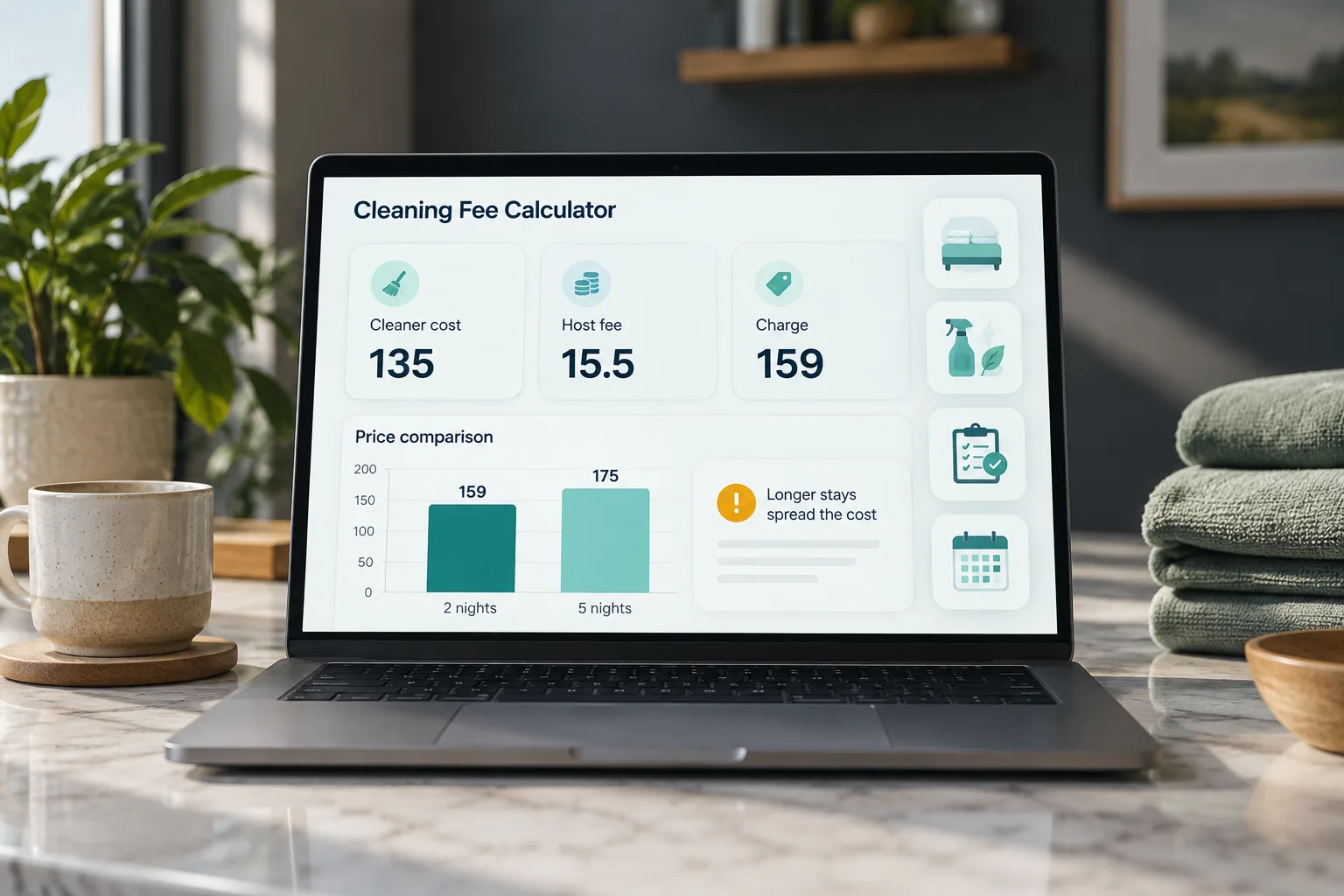
One 2 bed apartment with a $135 turnover cost and 3.2 night average stay. Under a 15.5 per cent host fee, the grossed up fee is about $159.76. If the nightly rate is $180 and you charge $160 cleaning, the guest subtotal is $520 for 2 nights, $700 for 3 nights and $1,060 for 5 nights. If you bundle $42 into the nightly rate and set no cleaning fee, those totals become $444, $666 and $1,110. Bundling helps 2 nights, is close at 3 nights and costs the longer guest more.
A 4 bed family house with $240 cleaner and linen cost. Under a 15.5 per cent host fee, the grossed up fee is about $284. A visible $284 fee may be fine for a week in a resort market, but poor for a 2 night weekend if comps sit near $250. Test a 3 night minimum in peak periods, then use a lower off season short stay fee only for gaps you truly want.
A 6 unit apartment host. Use the same worksheet across all six units, but do not force the same fee. A studio, a 1 bed and a 2 bed can share cleaner scheduling and linen standards while still having different fees.
A 10 unit mixed portfolio. Group by operational reality: studios, 2 beds and large houses. Set the fee from cost, then test presentation by guest stay length. Your pricing engine should be looking at pace and gap nights, not treating every cleaning fee problem as a nightly rate problem.
Separate fee or fold it into the nightly rate?
Use this decision tree.
| Situation | Better first test | Why |
|---|---|---|
| Average stay is 4 nights or more | Separate cleaning fee | The per stay fee spreads out naturally |
| Most demand is 1 or 2 nights | Fold in all or part | A flat fee can make short stays look expensive |
| Local Guest Favorite comps charge fees | Separate fee within comp range | Guests already expect the line item |
| Local top comps show low or zero fee | Lower fee plus nightly uplift | Your total price must feel normal in that search |
| Large house with high turn cost | Minimum stay or separate fee | Bundling can overcharge longer stays |
| Studio with simple turns | Low fee or no fee | Cleaner cost is small enough to smooth into ADR |
| Direct booking advertised in the United States | Show mandatory fees upfront | FTC rules require upfront total price for short term lodging |
For United States direct bookings, the FTC fee rule says short term lodging businesses must disclose the total price upfront, including mandatory fees that can be calculated upfront. The FTC gives vacation rental cleaning fees as an example of a mandatory fee that must be included in the total price. See the FTC rule on unfair or deceptive fees. (search.ftc.gov)
Tax treatment is separate. Occupancy tax, sales tax, VAT and local lodging rules vary by jurisdiction, so check your local rules or accountant before changing how fees appear on direct bookings.
Short stays: lower fee, minimum stay or uplift
Short stays are where cleaning fee strategy matters most. A £100 or $150 clean is the same work whether the guest stays one night or six. The guest does not feel it that way.
Use a lower short stay cleaning fee when you want one and two night bookings, when the clean is simple, or when you are rescuing gap nights. Use a minimum stay when the home is large, the clean is expensive, or same day turnovers create too much risk. Use a nightly uplift for studios and city apartments where search results are full of low fee listings.
For {unit name}, allow a {one or two} night stay on {date} only if {cleaner name} confirms capacity. Use a short stay cleaning fee of {fee amount}. Keep the standard fee at {standard fee}. Remove the exception once the gap is filled.The rule is simple: never create a booking your cleaner cannot turn properly. A discounted fee that produces a rushed clean is not revenue. It is a future review problem.
Guest psychology and the cleaning fee review trap
Guests are most irritated when they pay a meaningful cleaning fee and then receive a chore list. Keep checkout instructions to actions that protect the property: lock doors, turn off appliances, place used towels in one spot, put rubbish in the indoor bin and report damage.
Avoid asking guests to strip beds, start laundry, wash and put away dishes, take rubbish off site, or leave the home as they found it. Even when allowed, it sounds like the guest is doing the clean they paid for.
Hi {first name}, hope you had a good stay. Your cleaning fee covers the full turnover after checkout. Before you leave, please just do these three quick things: lock the doors, turn off the cooker and place used towels in {towel spot}. If anything broke or needs attention, message us so we can fix it before the next guest. Safe travels.For a fuller version, use an Airbnb checkout instructions template. For the cleaner side, keep a separate Airbnb cleaning checklist for cleaners so guests are not asked to manage your operation.
Benchmark your local comps in 20 minutes
Do this once a month for each property type, and whenever bookings slow.
Search as a guest for your destination. Use the same dates, guest count and stay length your target guest would use. Open 8 to 12 similar listings, not random cheap ones. Record bedrooms, bathrooms, rating, Guest Favorite status, amenities, total price, nightly rate and cleaning fee if visible in checkout.
Run two audits: one for a 2 night stay and one for a 5 night stay. The 2 night audit shows whether your fee is suppressing short stays. The 5 night audit shows whether bundling has made you expensive for longer stays.
| Comp | Beds | Rating | Total price | Cleaning fee | Fee share of total | Standout amenities | Notes |
|---|---|---|---|---|---|---|---|
| {comp 1} | {beds} | {rating} | {total} | {fee} | {share} | {amenities} | {notes} |
| {comp 2} | {beds} | {rating} | {total} | {fee} | {share} | {amenities} | {notes} |
Decision rule: if your all in price is above the median and your quality signals are not above median, do not blame the algorithm. Reduce the fee, adjust the nightly rate, add a stay discount, or improve the offer. Track the result against good Airbnb occupancy rate benchmarks, ADR and RevPAR.
Set it, test it, automate it
On Airbnb, edit the fee from Calendar, then listing, Pricing, Fees, Cleaning fee and Save. Airbnb lists those steps in its cleaning fee help article. (airbnb.com)
Then run this checklist:
| Task | Done |
|---|---|
| Update standard cleaning fee | { } |
| Add or update short stay cleaning fee | { } |
| Preview guest price breakdown for 2 nights and 5 nights | { } |
| Update house rules and checkout message | { } |
| Notify cleaner of any stay length changes | { } |
| Confirm same day turnover capacity | { } |
| Monitor impressions, clicks and bookings for 30 days | { } |
| Review cleanliness, value and fee comments | { } |
Watch impressions, click through, wishlist saves, inquiry rate, booking conversion, occupancy, ADR, RevPAR, value rating, cleanliness rating and review wording. If views hold but bookings fall after a fee increase, the total price may be the problem. If bookings hold but value comments worsen, your checkout instructions or price presentation may be the problem.
For operators with several units, YourFrontDesk fits the operational side: one calendar across Airbnb, Booking.com, Expedia, Vrbo and direct, housekeeping lists built from checkouts, owner reports showing revenue after commission and costs per unit, and a pricing engine that reads booking pace and gap nights. See YourFrontDesk for hosts and managers and how the pricing engine works.
Next steps
Do not start by asking what everyone else charges. Start with your cost, gross it up for the host fee, compare the two night and five night guest total against similar listings, then test one change for 30 days.
If you run 1 to 10 units, build one cleaning worksheet per unit this week. Then test whether a separate fee, short stay fee, minimum stay or nightly uplift gives the cleanest mix of margin, occupancy and reviews.
To see how the operational pieces fit together, try the instant YourFrontDesk demo.
What people ask next
What is the average Airbnb cleaning fee?
There is no reliable single average for every property. Recent United States benchmark sources put the broad market around the mid $100s, but bedroom count, market type, laundry and cleaner rates matter more than the national figure.
How much should I charge for an Airbnb cleaning fee?
Charge your real turnover cost, grossed up for any host service fee you need to recover, then compare the guest total against similar listings. If that number makes short stays uncompetitive, test a lower short stay fee, a minimum stay, or a partial nightly rate bundle.
Is the Airbnb cleaning fee included in the price guests see?
Airbnb says guests see the total stay price including fees before taxes from the start of search. Guests can still view the price breakdown, but the first comparison is the total price for their dates.
Does Airbnb take a cut of the cleaning fee?
Airbnb service fees are calculated on the nightly price and host charged fees, which can include the cleaning fee. The exact effect depends on whether the booking is under the split fee or single fee structure.
Should I charge a cleaning fee or include it in the nightly rate?
Use a separate fee when stays are longer and turnover cost is high. Fold all or part into the nightly rate when most stays are one or two nights, or when local competitors show low or no fees.
What is Airbnb’s short stay cleaning fee?
It is an optional lower cleaning fee for one and two night bookings. It lets hosts keep a standard fee for longer bookings while making short stays less expensive in search.
Can a host charge extra if a guest leaves the place dirty?
A host should not charge extra just because a guest skipped a specific checkout task. Extra claims are for issues beyond standard cleaning, such as damage, missing items or unexpected cleaning that is properly documented.