Vacation Rental Owner Statement Template
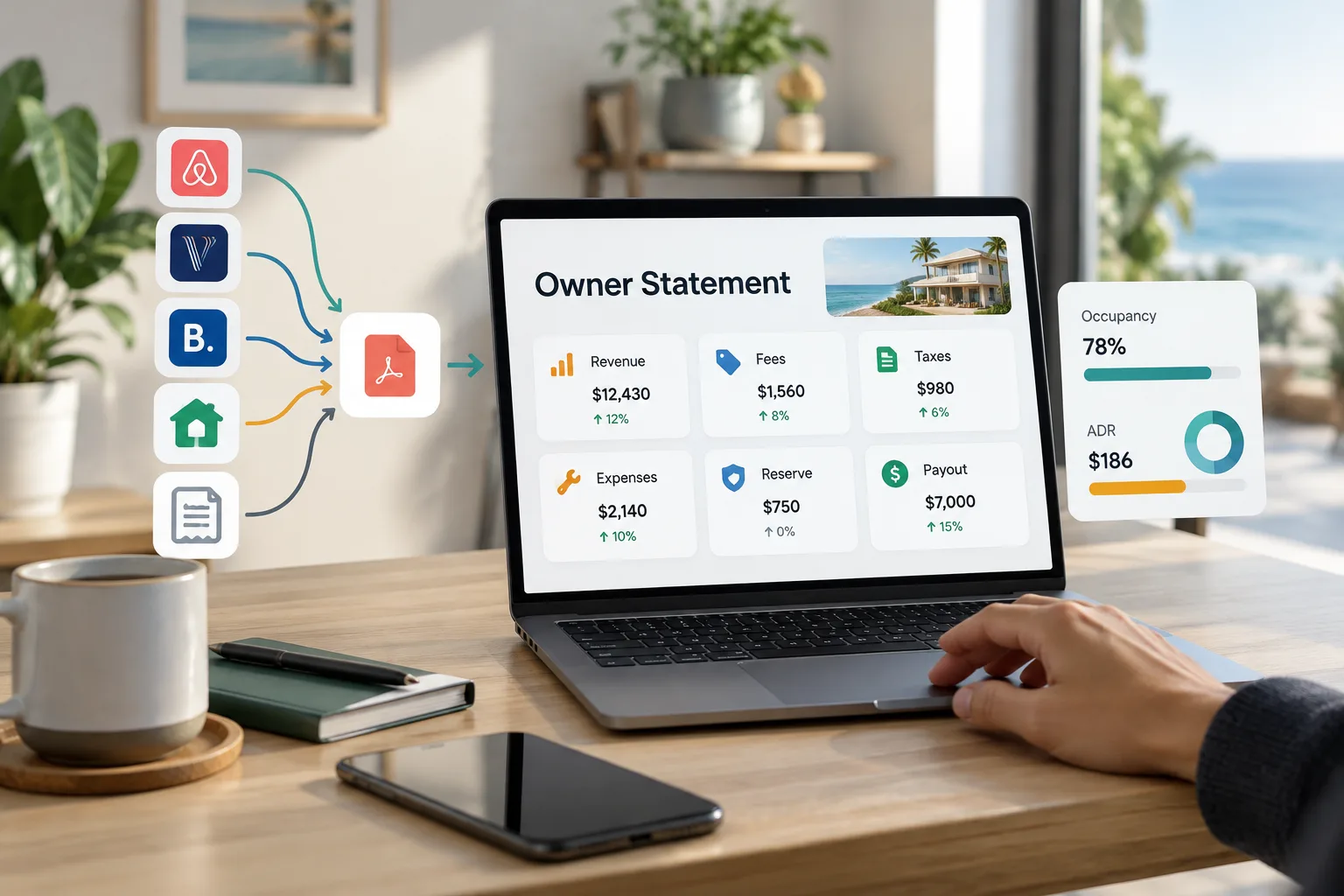
Use this practical owner statement template to show owners what came in, what went out and what will be paid. It separates the accounting statement from the owner report, then shows how to combine both into one monthly PDF.
The short version
- A vacation rental owner statement proves the money, while the owner report explains performance, issues and next actions.
- Use one statement per property, with a portfolio summary when an owner has several units.
- Show commission base, channel fees, taxes, expenses, reserves and payout timing as separate lines to reduce owner disputes.
- Choose one reporting date rule, such as check out date or stay date, then use it every month.
- Before sending, reconcile bookings, payouts, expenses, reserves and agreement rules for every property.
A vacation rental owner statement template should show every booking, fee, tax, commission, expense, reserve movement and owner payout for one property in one statement period. The best version also adds a short performance page, so the owner can see whether the property is healthy, not just whether the maths balances.
For a manager running 5 to 200 short let units, the goal is repeatable trust. The owner should be able to answer, in two minutes: what came in, what went out, what am I being paid, what changed, and what needs my decision.
What is a vacation rental owner statement
A vacation rental owner statement is the monthly property level accounting statement sent by a short let manager to the owner. It lists revenue, deductions, owner expenses, management fees, prior balance, reserves, payments already made and the closing balance.
Do not confuse it with the wider owner report. The statement proves the money. The report explains the result. Owners usually need both, especially when a month includes cancellations, refunds, damage claims, owner stays, large repairs or a platform payout hold.
The professional package is one PDF or portal view per property each month. It should include:
- Statement summary
- Booking detail
- Expense detail with receipt references
- Fee, tax and commission breakdown
- Performance snapshot
- Notes, decisions and open issues
Airbnb now gives hosts monthly and annual earnings reports, custom reports by listing and date range, plus gross earnings, deductions and net pay, so use those exports as source data rather than guessing platform lines from memory: Airbnb earnings reports and dashboard.
The owner statement is not a design exercise, it is a monthly reconciliation that must survive an owner question line by line.
Owner statement template at a glance
A good vacation rental owner statement includes bookings, guest fees, channel fees, taxes, management commission, owner expenses, reserves, net payout, occupancy and notes for exceptions.
Use this layout as your top page:
| Section | Line item | Formula or source | Owner note |
|---|---|---|---|
| Header | Owner, property, period, issue date | Owner record and property ID | Confirms this statement is for one unit |
| Opening | Prior balance | Last closing balance | Brings forward unpaid amounts |
| Revenue | Accommodation revenue | Sum of rent for included stays | Keep separate from taxes |
| Guest fees | Cleaning, pet, extra guest, early check in, late checkout | Booking detail by fee type | State who keeps each fee |
| Channel costs | OTA fee, host service fee, card fee | Platform or payment report | Never hard code one rate |
| Taxes | Lodging tax, occupancy tax, VAT, sales tax | Tax report or platform field | Separate owner income from tax money |
| Manager fees | Commission, flat fees, co host fee | Agreement rule | Show the base, not only the result |
| Expenses | Repairs, linen, supplies, utilities | Paid bills and receipt links | Mark approved items |
| Reserves | Reserve held, used, released | Owner reserve ledger | Explains cash not paid out |
| Payout | Net owner distribution | Revenue less deductions plus balance | Should reconcile to payment run |
| Performance | Occupancy, ADR, RevPAR, channel mix | Booking system | Explains whether the month was good |
Header and property details
The header seems boring until you run 80 statements and an owner owns 4 units in the same building. Use a property ID on every booking, expense, receipt, payout and note. That ID is what lets your team reconcile the month without relying on memory.
Include:
- Owner name and entity name
- Property name, unit ID and legal address
- Statement period
- Issue date
- Manager name
- Payment date
- Payout method and currency
- Tax or entity identifiers where needed
- Agreement version or fee rule name
Use one statement per property. If an owner has several units, add a portfolio summary page before the unit statements. The portfolio page should show total accommodation revenue, total costs, owner distribution, occupancy, ADR and open decisions by property.
For performance context, link owners to a simple benchmark explanation such as Airbnb occupancy rate benchmarks, but do not bury accounting lines inside marketing commentary.
Booking detail lines
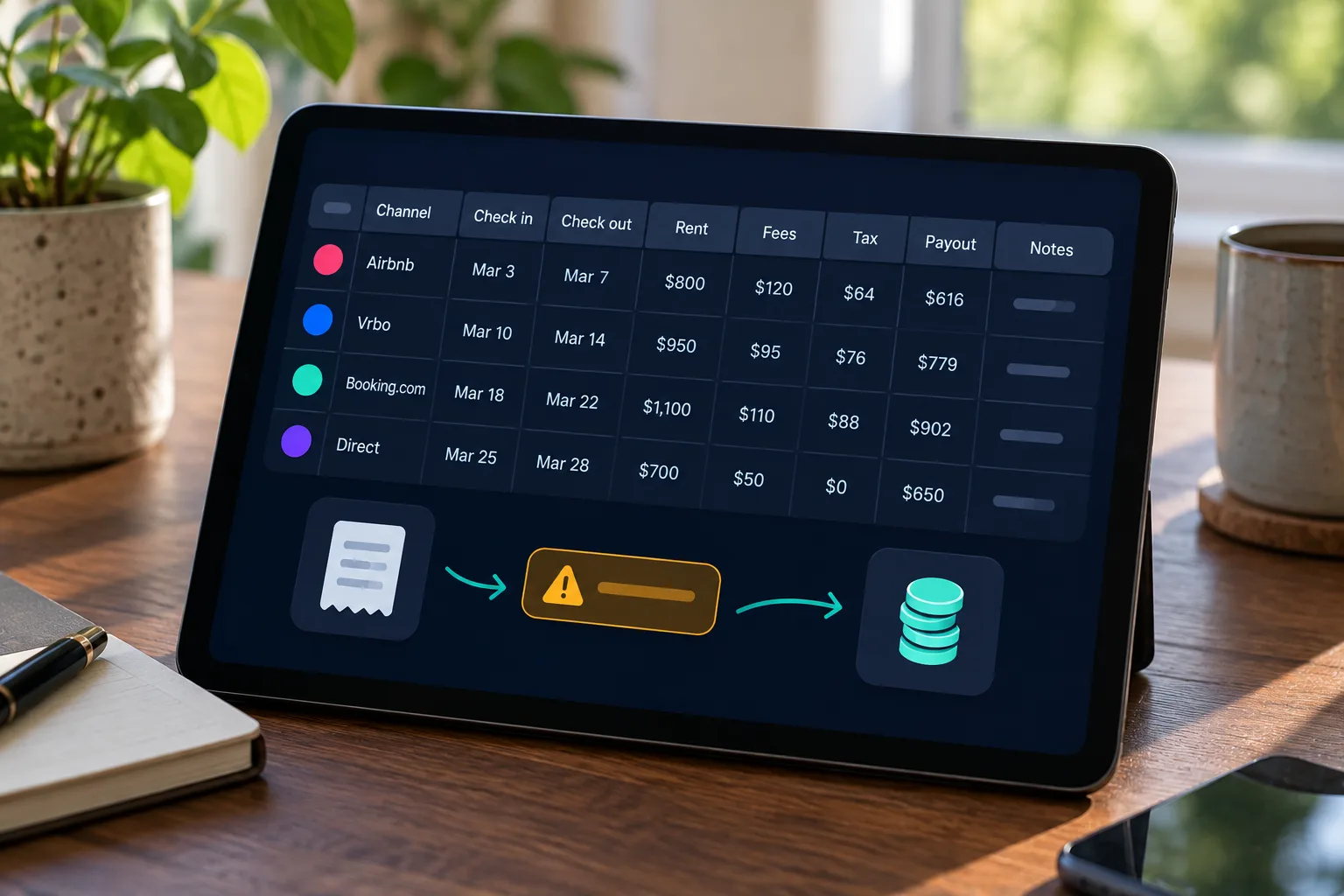
The booking detail is where most owner questions start. Use exact columns and keep them stable month after month.
Recommended booking columns:
- Reservation ID
- Guest name or masked guest name
- Channel
- Booking status
- Check in
- Check out
- Nights
- Rentable nights affected
- Owner stay flag
- Maintenance block flag
- Accommodation revenue
- Cleaning fee
- Pet fee
- Extra guest fee
- Early check in fee
- Late checkout fee
- Discount
- Refund
- Cancellation payout
- Gross booking total
- Channel fee
- Net platform payout
- Notes
Pick one date rule. Many managers report by check out date because the stay is complete and expenses are easier to match. Others use stay date for cleaner monthly performance reporting. Payout date is useful for cash reconciliation, but it can distort operating performance when platforms release money after the stay.
Here is a copyable spreadsheet structure.
Statement month, Property ID, Owner ID, Reservation ID, Channel, Guest name, Status, Check in, Check out, Nights, Rentable nights, Owner stay, Maintenance block, Accommodation revenue, Cleaning fee, Pet fee, Extra guest fee, Early check in fee, Late checkout fee, Discount, Refund, Cancellation payout, Gross booking total, Channel fee, Payment processing fee, Tax collected by channel, Tax paid to manager, Net platform payout, Commission base, Management commission, Notes
Mini examples by channel:
| Channel | Date rule | Fee fields to import | Note to owner |
|---|---|---|---|
| Airbnb | Check out date or stay date | Gross earnings, host service fee, taxes withheld, net pay | Airbnb reports can include gross earnings, deductions, host service fees, taxes withheld and net pay |
| Vrbo | Check out date plus payout date for cash | Gross booking, deductions, lodging tax owner remits, payout | Vrbo payout reports separate taxes remitted by the owner from taxes not included in payout |
| Booking.com | Departure month | Room price, extras, commission, invoice | Booking.com commission is invoiced after the scheduled departure month under its partner terms |
| Direct | Payment receipt date plus stay date | Rent, fees, card processing, refunds | Card fees should come from the payment processor export |
Airbnb says hosts can see nightly price, optional fees such as cleaning or pet fees, occupancy taxes, service fee, co host payout and total payout in the reservation earning details: Airbnb host payout itemisation.
Fees, taxes and deductions
Do not blend fees and taxes into one revenue number. It makes the statement look simpler, then creates arguments later.
Show separate rows for:
- Airbnb host service fee
- Vrbo commission or booking fee
- Booking.com commission
- Direct booking card fee
- Payment processing fee
- Co host fee
- Platform adjustments
- Chargebacks
- Refunds after payout
Airbnb is moving home hosts to a single host service fee structure, with most hosts paying 15.5 percent after migration, while bookings made before migration keep the fee structure that applied at booking: Airbnb service fees. This is exactly why your owner statement needs flexible channel fee columns, not a fixed Airbnb fee assumption.
Vrbo has more than one fee model. Its help pages describe pay per booking fees, including commission and payment processing in some cases, and separate rules for software connected managers and merchant of record setups: Vrbo pay per booking fees. Use the rate shown in the owner dashboard or payout report for that property.
For Booking.com, the partner terms say commission is based on the agreed commission percentage and includes room price plus certain extras and surcharges accepted before check in, with invoices processed monthly after the guest departure month: Booking.com accommodation partner terms.
For direct bookings, card fees should come from the processor. Stripe lists standard United States card pricing as 2.9 percent plus 30 cents per successful domestic card transaction, but your account or country may differ: Stripe pricing.
Management commission and owner agreement rules
Most disputes about owner statements are not arithmetic mistakes. They are rule mistakes. The manager calculated commission on one base while the owner expected another.
Use a formula table in your internal template:
| Commission base | Formula | Common dispute risk |
|---|---|---|
| Rent only | Accommodation revenue times commission rate | Owner asks why cleaning is excluded or included elsewhere |
| Rent plus selected guest fees | Accommodation revenue plus agreed guest fees, times rate | Pet fees and late checkout fees are often missed |
| Gross before channel fees | Gross booking revenue times rate | Owner feels charged on money not received |
| Net after channel fees | Accommodation revenue less channel fee, times rate | Manager margin changes by channel mix |
| Flat monthly fee | Agreed fixed amount per property | Needs treatment in empty months |
| Hybrid or minimum fee | Greater of percentage fee or minimum fee | Must be clear before low season |
On the statement, show the commission base and the percentage or flat rule. Do not show only the final commission. If the agreement says commission is on rent only, name the line “Commission base, accommodation revenue only”. If it says rent plus cleaning, name that base.
Expenses, reimbursements and reserves
Owner expenses need detail, not drama. If you charge an owner for a repair, show the date, vendor, category, description, receipt link, amount, tax, reimbursable status and approval status.
Common owner chargebacks include cleaning where the owner pays it, laundry, linens, guest supplies, repairs, maintenance, utilities, inspections, permits, insurance, pest control, gardening, pool or spa service, replacement items and emergency callouts.
Security deposits and damage claims need separate treatment. A refundable deposit is not owner income when it is held. If part is retained after a claim, show the claim date, reason, evidence status, amount retained, platform decision if relevant and where the money landed.
Reserves are the other common source of questions. Show:
- Opening reserve
- Reserve held this month
- Reserve used this month
- Reserve released this month
- Ending reserve
If you advance money to an owner, record it as an owner advance, not a negative expense. If you make a partial owner payment, show both payment made and remaining closing balance.
Net owner payout calculation
Use one visible calculation. Owners should not need to reverse engineer their payout from ten pages.
Basic formula:
Accommodation revenue
+ Owner paid guest fees
+ Tax paid to manager for owner remittance if applicable
* Channel fees
* Payment processing fees
* Management commission
* Reimbursable owner expenses
* Reserve held
+ Reserve released
+ Prior balance
* Owner advances
* Payments already made
= Net owner payout or closing balance
Here is a fictional filled example to show the layout. Replace every amount with your actual ledger values.
| Line | Amount | Source |
|---|---|---|
| Accommodation revenue from completed stays | 3,200 | Booking detail |
| Cleaning fees charged to guests | 360 | Booking detail |
| Airbnb host service fee | 174 | Airbnb earnings export |
| Direct booking card fee | 38 | Payment processor report |
| Management commission | 640 | Agreement rule |
| Plumbing repair | 145 | Receipt |
| Linen replacement | 72 | Receipt |
| Reserve held | 200 | Reserve rule |
| Prior balance | 0 | Last statement |
| Net owner payout | 2,291 | Payment run |
Owner friendly note:
Hi {owner first name},
Your {month} payout is {payout amount}. This may differ from the platform payout because {reason, for example cleaning costs were paid from our account, a reserve was held, a refund was deducted, or a prior balance was carried forward}. The statement shows each adjustment in the booking, expense and reserve sections.
Performance snapshot owners actually read
Add one page after the statement. Keep it short. Owners care about whether the asset is improving, whether the pricing makes sense and whether any decision is waiting on them.
Include:
- Rentable nights
- Booked nights
- Owner blocked nights
- Maintenance blocked nights
- Occupancy rate
- ADR based on accommodation revenue only
- RevPAR or revenue per available night
- Average length of stay
- Cancellation count
- Channel mix
- Review score and review themes
- Year to date revenue and cost totals
Occupancy should use rentable nights. Owner stays and maintenance blocks should be visible but not quietly treated as failed sales nights. Otherwise a month with five owner nights looks worse than it was, and a month with blocked maintenance can hide the real sales pace.
If pricing changes are part of the report, link them to a rule. For example, the pricing engine for short lets uses a floor and ceiling per unit, reads booking pace and gap nights, damps big swings and explains each move.

Monthly notes, issues and decisions
This is the section that stops a cold statement becoming a complaint thread. Keep it factual and brief.
Use this table:
| Issue | Date | Impact | Status | Owner action | Deadline |
|---|---|---|---|---|---|
| {repair needed} | {date} | {cost or revenue impact} | {open or closed} | {approve quote} | {date} |
| {claim or complaint} | {date} | {refund risk} | {waiting on platform} | {none} | {date} |
| {low demand period} | {date range} | {pricing change} | {active} | {review reserve} | {date} |
Owner friendly wording for confusing items:
- Cleaning fee kept by manager: “The guest paid this fee, and it is retained to cover the cleaning operation under the management agreement.”
- Owner stay: “These nights were blocked for owner use, so they are shown outside sold occupancy.”
- Maintenance block: “These nights were removed from sale to complete approved works.”
- Linen replacement: “This is a property cost because the items remain with the unit.”
- Payout hold: “The platform has not released these funds yet, so the booking is shown but cash is not included in this payment run.”
How to generate owner statements automatically for 5 to 200 units
Manual statements can work for a few listings. At 20 units, they start to bend. At 100 units, the exception handling becomes the job.
A practical workflow:
- Connect every channel and direct booking source to one calendar
- Map each listing to owner, property ID and agreement rule
- Import bookings, status changes and fee fields
- Import platform payouts and direct card payments
- Import expenses, cleaner invoices and maintenance receipts
- Match payouts to reservations
- Separate taxes by remitter
- Calculate commission by agreement rule
- Update reserves, advances and prior balances
- Generate one PDF per property
- Review exceptions
- Send statements
- Log owner questions
- Lock the period
Automation rules to set before month end:
- Property ID is required on every transaction
- Channel fee must be mapped
- Tax handling rule must be set per channel and location
- Commission rule must be attached to each property
- Reserve rule must be active or marked not applicable
- Recurring expenses must have a category
- Payout schedule must be documented
- Exception alerts must flag missing receipts, negative payouts and unmatched deposits
For teams that want one operating layer rather than another spreadsheet, YourFrontDesk for hosts and property managers puts Airbnb, Booking.com, Expedia, Vrbo and direct bookings on one calendar, builds housekeeping lists from checkouts and shows owner reports with revenue after commission and costs per unit.
Free copy and paste templates
Use this PDF layout for every property.
Property: {property name}
Unit ID: {unit ID}
Owner: {owner name}
Statement period: {start date} to {end date}
Issue date: {issue date}
Payment date: {payment date}

1. Summary
Opening balance: {amount}
Accommodation revenue: {amount}
Guest fees payable to owner: {amount}
Taxes payable to owner for remittance: {amount}
Channel and payment fees: {amount}
Management commission: {amount}
Owner expenses: {amount}
Reserve movement: {amount}
Owner payout: {amount}
Closing balance: {amount}

2. Booking detail
Attach booking table for all included stays.

3. Expense detail
Attach expense table with receipt references.

4. Performance snapshot
Rentable nights: {nights}
Booked nights: {nights}
Owner blocked nights: {nights}
Maintenance blocked nights: {nights}
Occupancy: {percent}
ADR: {amount}
RevPAR: {amount}
Channel mix: {summary}

5. Notes and decisions
{plain English notes}
And use this email when sending.
Subject: {property name} owner statement for {month}

Hi {owner first name},

Your {month} owner statement for {property name} is attached.

The net payout is {payout amount}, scheduled for {payment date}. The main items to note are {short note one}, {short note two} and {short note three}.

Please reply if you want us to walk through any line. Any items needing approval are listed in the notes section with the requested deadline.

Thanks,
{manager name}
QA checklist before sending
Use this checklist before statements leave your office:
- All completed stays for the period are included
- Cancelled bookings, no shows and refunds are handled
- Platform payouts match bank deposits or expected settlement reports
- Channel fees match platform exports
- Taxes are separated by who remits them
- Commission base matches the management agreement
- Expenses have receipts or clear references
- Owner approvals are recorded where required
- Reserve opening balance matches last month
- Reserve closing balance agrees to the ledger
- Security deposits and damage claims are not treated as rent
- Occupancy uses rentable nights
- Owner and maintenance blocks are visible
- Notes explain unusual items
- PDF total matches the payment run
- Period is locked after sending
Next steps
Start with the template above, then remove every manual judgement you can. If you manage more than a handful of properties, the statement should be generated from bookings, payouts, expenses, reserves and agreement rules, not rebuilt from scratch each month.
You can see an instant demo of automated short let operations, or check simple pricing for property managers before you rebuild another owner spreadsheet.
What people ask next
What should be included in a vacation rental owner statement?
It should include the statement period, property details, bookings, accommodation revenue, guest fees, channel fees, taxes, management commission, owner expenses, reserve movements, prior balance and final payout. Add notes for anything unusual, such as refunds, claims, owner stays or payout holds.
What is the difference between an owner statement and an owner report?
An owner statement is the accounting record that proves the payout. An owner report is the performance explanation, usually showing occupancy, ADR, channel mix, reviews, maintenance notes and next actions.
How do you calculate the owner payout for a vacation rental?
Start with accommodation revenue and owner payable guest fees, then subtract channel fees, payment fees, management commission, reimbursable owner expenses and reserve holds. Add reserve releases or prior balances, then subtract any owner advances or payments already made.
Should cleaning fees be included in an owner statement?
Yes, cleaning fees should appear on the statement if they were charged to the guest or affect payout. The statement should also say whether the owner keeps the fee, the manager keeps it, or it is passed through to cleaners.
Should lodging taxes appear on an owner statement?
Yes, but they should be separate from owner income. Show which taxes were collected and remitted by the platform, which were paid to the manager, and which the owner is responsible for remitting.
Should owner stays count in occupancy?
Owner stays should be visible, but they should not be mixed silently with sold nights. Show booked nights, owner blocked nights, maintenance blocked nights and rentable nights so the owner can understand true sales performance.
Can owner statements be automated for multiple vacation rental properties?
Yes. Automation works best when every booking, payout, expense, receipt and reserve entry carries a property ID and owner ID. The system still needs human review for exceptions, missing receipts, refunds, claims and agreement edge cases.