Airbnb Guest Check In Late Guide
Late arrivals are not the problem. The problem is having no clear code policy, backup entry method or midnight support plan.
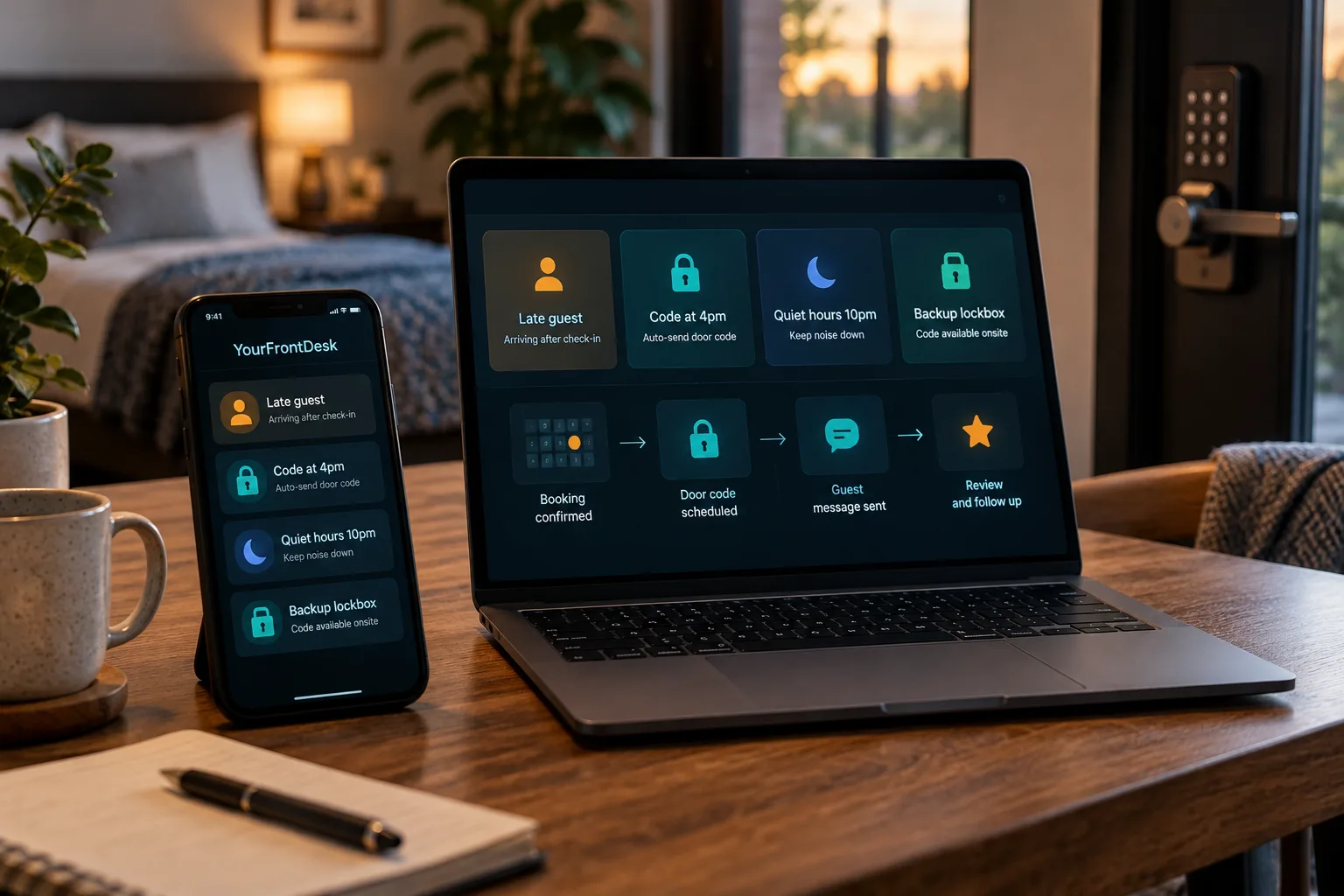
The short version
- Guests can usually arrive late after the booked check in start time, but only inside the listing rules, building rules and access method you have set.
- A guest arriving at 1am after the booked check in start time is different from a guest trying to enter before the booked arrival date has started.
- Small hosts should send non sensitive arrival guidance early, then release live access details only when the reservation is eligible and close enough to arrival.
- Every late arrival setup needs a primary access method, a backup entry method, quiet hours wording and a next morning check in message.
- If you cannot personally answer at midnight, build a simple assistant or escalation process before the first delayed flight happens.
airbnb guest check in late requests are usually fine when the guest arrives after the check in start time, uses an approved access method and follows your house rules. The risk for a host with 1 to 10 units is not the late hour itself, it is a tired guest, a dark entrance, a code that is not active and no one awake to help.
This guide gives you a practical late arrival system: what to say before booking, when to release codes, what to do when a guest says they will arrive at 1am, and how to protect neighbours, reviews and sleep.
Can Airbnb guests check in late at night?
Usually, yes. Airbnb describes self check in as access without the host being there, using a key lockbox, smart lock, keypad or key access through building staff who are available all the time, after the designated check in time on the arrival date. Read Airbnb's own wording in its self check in guide. (airbnb.com)
That does not mean every late arrival airbnb request must be accepted. Airbnb lets hosts set a check in window of at least 2 hours or choose flexible check in, and says guests must be able to check in by 4pm. See Airbnb's host settings page on changing check in and checkout times. (airbnb.com)
The important distinction is late arrival versus early check in. If a booking starts on Friday and your check in time is from 4pm, a guest arriving Friday at 11:45pm is arriving late. A guest arriving Friday at 1am, before the Friday 4pm start time, is not arriving late. They are arriving before the stay is ready, and should normally book Thursday night as well.
For hosts, write this plainly: check in is from 4pm. Self check in is available any time after 4pm. Quiet hours begin at 10pm. Arrivals before 4pm need written approval.
Why late check in is risky for small hosts
A hotel can absorb a confused midnight arrival because there may be a staffed desk. A small host often has one owner, one cleaner, a shared entrance and neighbours who know exactly which flat makes noise.
The common failures are predictable. Guests cannot find the correct entrance. The building gate code is separate from the flat door code. The guest goes to the wrong door. The smart lock battery is low. A phone loses signal in a rural lane or basement car park. The front desk or concierge is not open. The fob is inside the property but the guest needs it outside the property.
Check in is also a review moment. A guest who opens the door at 12:30am without needing you will often see the whole stay as professional. A guest locked outside at 12:30am may remember nothing else.
The late arrival system is not finished until a tired guest can find the right door in the dark without waking you or your neighbours.
Keep your instructions short, visual and ordered. Address first, parking second, building entry third, unit entry fourth, WiFi after entry. If several guests ask the same question, that question belongs in the arrival guide, not in your head.
The late arrival playbook at a glance
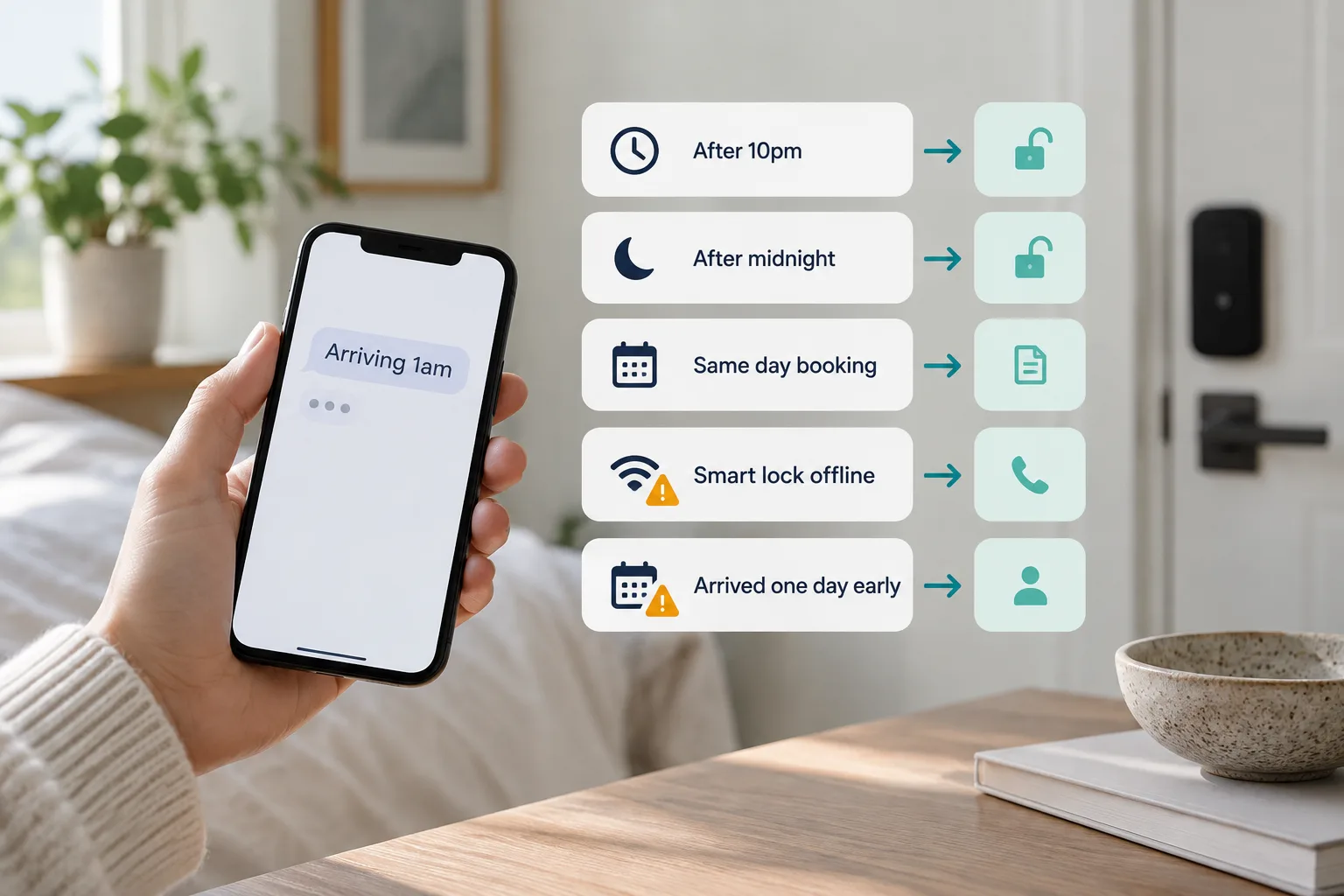
Use this table as your operator checklist when an airbnb guest arriving late messages you.
| Situation | Allow it | Access method | Message to send | Risk | Backup plan |
|---|---|---|---|---|---|
| Arrival after 10pm | Yes, if self check in is ready | Smart lock, keypad or lockbox | Confirm quiet arrival and parking | Noise, wrong entrance | Exterior photo and emergency contact |
| Arrival after midnight | Yes, if code is active and rules allow | Unique guest code | Send final route and quiet hours | Host asleep, guest tired | Assistant answers first questions |
| Same day booking late evening | Maybe | Manual approval first | Confirm ID, payment and ETA | Fraud, rushed code release | Delay code until checks pass |
| Missed in person window | Only if approved | Staff handoff or backup box | Explain fee or next available handoff | Guest dispute | Written rule in listing |
| Smart lock offline | Yes, if safe | Backup lockbox | Give backup steps only to eligible guest | Shared code exposure | Rotate backup code next day |
| Building gate plus flat door | Yes | Gate code plus door code | Send both in exact order | Guest stuck outside building | Neighbour safe escalation contact |
| Guest arrives one day early | No, unless booked | No access | Explain previous night is required | Occupied unit, cleaner not done | Offer booking change if available |
| Flight delay | Usually yes | Self check in | Reassure and repeat steps | Panic messages | Next morning check in |
Set your check in window before the guest books
Your listing should tell guests what kind of arrival you actually run. Choose one of three models.
Flexible check in suits a property with reliable self check in, clear exterior lighting and no shared home noise issue. A fixed window suits flats with building rules, reception hours or more complicated access. In person only check in suits homes where the host must meet the guest, collect a key deposit where allowed, explain shared spaces or comply with local rules.
Airbnb says guests should respect the host check in window and should not check in before or after that window without prior host approval. It also includes noise and quiet hours in guest ground rules. See Airbnb's guest ground rules. (airbnb.com)
Use house rules wording like this:
Check in is from {check in time}. Self check in is available any time after {check in time}. Quiet hours are {quiet hours}. If you expect to arrive after {late hour}, please tell us your ETA so we can make sure you have the correct arrival details.For more rule wording, use this Airbnb house rules template for quiet hours and check in rules.
Choose the right access method
Airbnb's official self check in options are lockbox, smart lock, keypad or round the clock building staff. For a small operator, the decision is less about looking modern and more about what fails at midnight. Airbnb also says guests can usually find check in details about 48 hours before arrival in Trips, and to message the host if details are not available less than 48 hours before check in. See Airbnb's page on where guests find check in instructions. (airbnb.com)
A lockbox is simple and cheap, but shared codes must be rotated. A keypad is easy for guests, but you need a code process. A smart lock can create unique codes, but batteries, WiFi and app connections need checking. Building staff reduce your burden only if they are truly available all the time.
For 1 unit, a lockbox plus spare key can be enough if the code changes often. For 3 to 10 units, unique codes and a written backup process become more important. Smart lock makers also warn that electronic locks need backup access when batteries or electronics fail. Schlage says a backup key helps if batteries die or the electronic system fails, in its keypad and smart lock support note. (schlage res.zendesk.com)
Code release rules that keep guests happy and secure
Do not confuse arrival instructions with sensitive access data. At booking, send the address area, parking overview, check in start time and reminder that final access details arrive closer to arrival. At 24 to 48 hours before check in, send the full route, photos and general entry sequence. Release live access codes only when the stay is eligible under your policy.
A sensible low risk policy is: send general instructions 48 hours before arrival, release the live door code on the morning of arrival, make the code active from the check in start time and expire it after checkout. Airbnb's connected smart lock guidance says compatible locks can automatically create and send unique door codes that are only active during the stay. See Airbnb's smart lock connection guidance. (airbnb.com)
For same day bookings after dinner, be stricter. Confirm the guest has completed platform requirements, payment is settled, the cleaner has marked the unit ready and the guest has acknowledged quiet hours. Then release the code.
For in person handoff, do not publish a fake flexible arrival promise. State the final staff arrival time before booking.
Worked example: check in is Friday 4pm. The guest lands at 11:40pm and expects to reach the flat at 12:30am Saturday. Send full instructions Friday morning. Make the unique code active from Friday 4pm. Send a quiet arrival reminder Friday evening. Saturday morning, ask if they got in all right.
Message templates for late arriving guests
Keep the tone warm, but remove ambiguity. Use times, dates and unit names.
Hi {first name}, thanks for booking {property name}. Check in is from {check in time} on {arrival date}. Please send your expected arrival time when you know it, especially if you expect to arrive after {late hour}. Self check in is available after the check in time, and final access details will be sent closer to arrival.Hi {first name}, arriving at {ETA} is approved. Your stay starts on {arrival date} and access is available from {check in time}. Please use {parking space or entrance} and keep noise low after {quiet hours}. If your plans change, message us in this thread.Hi {first name}, I will help you get in. Please confirm you are at {property address} and outside Unit {unit}. Enter {code format reminder}, then press {button if needed}. If the lock shows {error light or sound}, send a photo of the keypad and the door so I can check you are at the right entrance.Good morning {first name}, just checking you got in safely last night and found everything you needed. If anything in the arrival instructions was unclear, please tell me so I can fix it for future guests.Do not send this if it is not true: we are available personally all night for anything you need. Say what is actually covered. For more wording, use these Airbnb check in message templates and this guide to Airbnb automated messages from booking to review.
What your midnight assistant should answer automatically
The questions at midnight are repetitive: where is the lockbox, what is the door code, which entrance is ours, where do we park, the code does not work, the gate is closed, where is the WiFi, how do we turn on heating, what time is checkout.
This is where a virtual front desk or AI guest assistant can help, provided it only answers from your property information and has clear escalation rules. YourFrontDesk runs a night desk that answers guests at any hour, in the language they wrote in, from that property's own information. When unsure, it drafts a reply for the host instead of guessing.
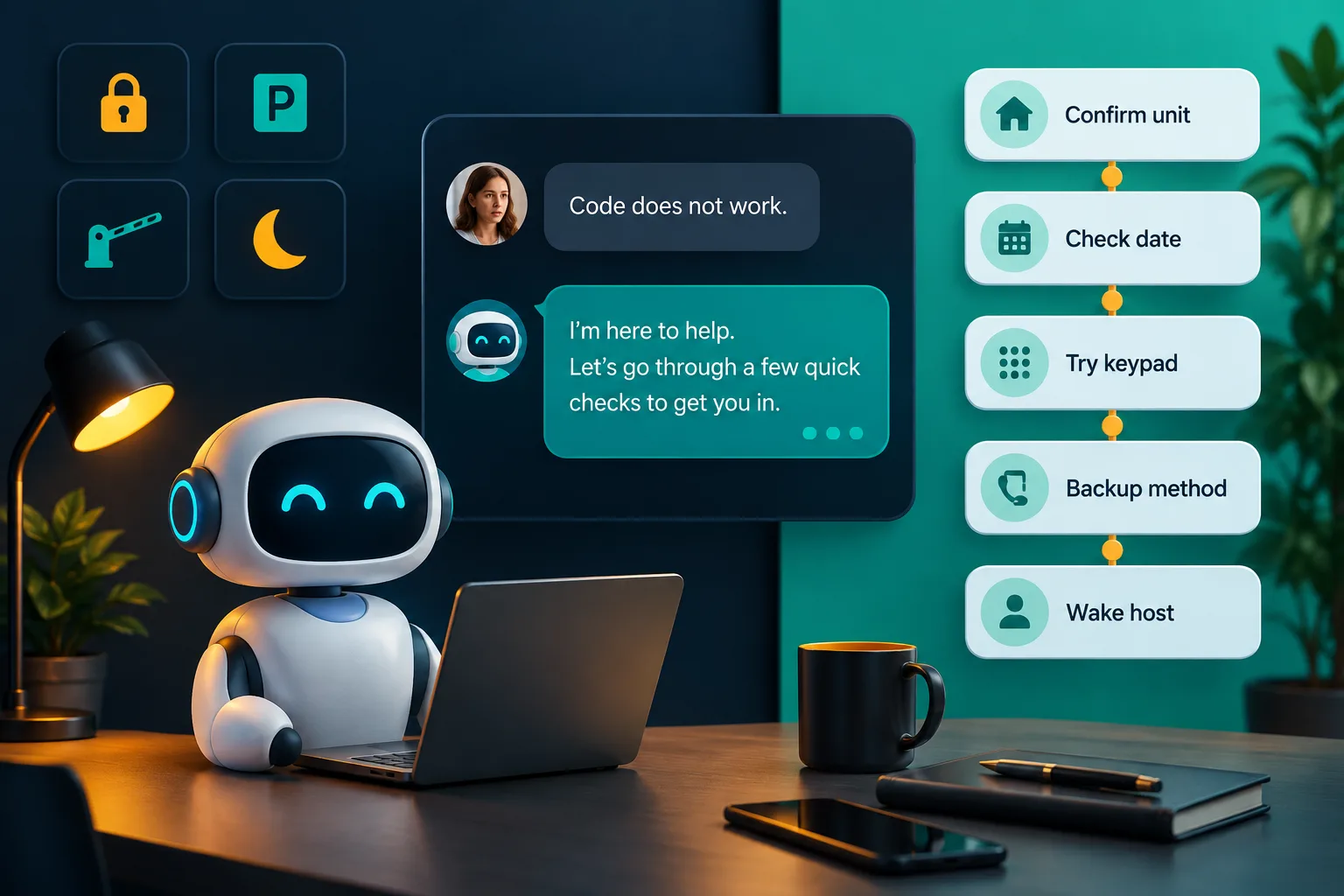
A simple code problem decision tree is enough for most hosts. Confirm the booking date, then the unit, then the entrance. Ask what the lock shows. Remind the guest of the final button press if your lock needs one. If the guest is eligible, share the backup method. If they are still outside, wake the host or co host.
Escalate immediately for lockout, safety concern, leak, medical emergency, police matter, fire alarm, noise complaint or any sign the wrong person is at the property. For hosts and short let managers, see guest messaging for hosts and short let managers.
How to handle late arrival fees and cutoffs fairly
Avoid late fees for true self check in unless there is a real extra cost. If the code works without a staff member, a fee feels like a penalty and creates friction before the stay begins.
Late arrival fees make more sense for staff meet and greet, building concierge callouts or local processes that genuinely cost money. The rule is simple: disclose before booking, keep it consistent across channels and do not surprise the guest at midnight.
Airbnb's pricing and payment transparency policy says mandatory fees must be fully disclosed before booking and payments for Airbnb reservations should usually stay on platform, with limited exceptions. See Airbnb's pricing and payment transparency policy. (airbnb.com) In the United States, the FTC's rule on unfair or deceptive fees covers short term lodging and requires clear disclosure of total price for mandatory fees, explained in the FTC fee rule FAQ. (ftc.gov) In the UK, CMA guidance describes drip pricing as showing an initial price and adding fees later, covered in GOV.UK unfair commercial practices guidance. (gov.uk)
Template wording:
In person check in is available until {latest free time}. Arrivals after {latest free time} require advance approval and a {fee amount} staff callout fee, where allowed by the booking platform and local law. Self check in is not available for this property.Troubleshooting late night check in problems
Use the same order every time. First, confirm the reservation date. Many disputes start because the guest is trying to arrive before the booked night. Second, confirm the address and unit. Third, confirm the check in start time. Fourth, confirm the code is active. Fifth, confirm they are at the correct entrance.
If the message says code invalid, check date, code, keypad sequence and whether the guest is at the wrong unit. If the guest cannot find the lockbox, send the exterior photo and a landmark, not a long paragraph. If the gate is closed, give the gate code before the flat code. If the front desk says there is no booking, give the exact name the desk has on file. If the parking permit is missing, tell them where to park tonight and fix the permit in the morning.
Keep communication in the Airbnb message thread where possible. Airbnb's ground rules page tells hosts to document issues, including through the message thread, when reporting a rule problem. That same habit helps with late arrival disputes. (airbnb.com)
House rules and neighbour protection after 10pm
Quiet arrivals need more than a quiet hours line. Tell the guest exactly where to roll luggage, which entrance to use, where to park, which floor to go to and which door is theirs. Wrong door knocks are one of the easiest ways to annoy neighbours.
Use this wording:
Hi {first name}, as you are arriving after {quiet hours start}, please enter quietly through {entrance}, use {parking space}, and avoid knocking on other doors. Your unit is {unit name}, on {floor}, with {door marker}. Message us in this thread if anything is unclear.For apartments, add photos of the building entrance, lift, stairwell and door. Do not rely on a guest reading a long PDF at 1am. Use short steps and labels that match the building.
The final late check in SOP for 1 to 10 units
Here is the complete operating procedure.
Set the listing check in window. Add house rules for quiet hours, late arrival approval and any in person cutoff. Choose a primary access method and a backup entry method. Use unique codes per reservation where possible. Rotate shared lockbox codes. Never put sensitive access details in public listing copy.
At booking, ask for ETA. At 48 hours, send the route, parking and arrival overview. On arrival day, release the live code according to your policy. In the evening, send a quiet arrival reminder to late guests. Overnight, let your assistant answer known questions and wake a person only for defined issues. Next morning, check in and repair any confusing instruction.
Example for a 3 unit host: Unit A has a smart lock, Unit B has a lockbox, Unit C needs a building fob from a coded cabinet. A guest in Unit C lands at 11:40pm. At booking, you ask for ETA. At 48 hours, you send parking and building photos. At 9am on arrival day, you send the fob cabinet location but not the code. At 4pm, after eligibility checks, you release the cabinet code. At 8pm, you send the quiet arrival reminder. At 8am next morning, you ask whether they got in all right.
Next steps
Late check in is not a favour you improvise at midnight. It is a small system: check in window, code policy, backup access, quiet arrival wording, assistant coverage and next morning review protection.
To test how a night desk answers late check in questions from your own property information, try the instant demo to see how a midnight check in assistant answers guest questions.
What people ask next
Can you check in late at an Airbnb?
Usually yes, if you arrive after the booked check in start time and the host has approved or enabled late arrival. It depends on the listing check in window, access method, building rules and house rules.
What happens if I arrive after the Airbnb check in window?
You should message the host before arrival and ask for approval. Guests are expected to respect the stated check in window, so arriving outside it without approval can cause access problems or a dispute.
Does Airbnb allow self check in?
Yes. Airbnb recognises self check in using options such as a lockbox, smart lock, keypad or building staff who can provide access.
Where do I find Airbnb check in instructions?
Guests usually find check in instructions in their trip details before the stay begins. Hosts can also send messages with directions, parking details and any extra arrival guidance.
When does Airbnb send check in instructions?
Airbnb says guests usually get check in details about 48 hours before check in. Hosts may also send their own reminder message, especially for late arrivals.
Can an Airbnb host charge a late check in fee?
A host should only charge a late arrival fee if it is allowed, disclosed before booking and handled through the proper platform process. It is fairest when there is a real cost, such as staff attending after hours.
What should I do if my Airbnb door code does not work?
First confirm you are at the right address, entrance and unit, and that your stay has already started. Then message the host with a photo of the keypad or lock and describe any light, sound or error message.
What is the difference between late check in and early check in?
Late check in means arriving after the check in start time on your booked arrival date. Early check in means arriving before the booked access time, and may require approval, an extra fee or booking the previous night.