Airbnb Monthly Stays Host Guide
A practical guide for small hosts deciding when a 28 to 30 night booking beats normal nightly bookings. Includes pricing maths, cleaning plans, guest scripts and a small portfolio SOP.

The short version
- Airbnb monthly stays are 28 nights or more on the platform, but many local rules use a 30 day threshold, so check both before changing your calendar.
- A monthly discount should be based on expected nightly occupancy, turnover savings, utilities, cleaning and seasonal demand, not on a suggested percentage alone.
- Monthly stays are best used in low season, weekday heavy gaps and regulated markets, while nightly stays protect peak weekend upside.
- Hosts should disclose mid stay cleaning frequency, fees, access permission and supply policy before booking.
- For 1 to 10 units, the winning system is simple: seasonal calendar rules, guest scripts, cleaner instructions, utility checks and a monthly revenue review.
Airbnb monthly stays can be excellent for a host with 1 to 10 units, but only when the monthly price beats the realistic nightly alternative. The job is to use 28 to 30 night bookings to smooth quiet periods, not to sell your best weekends too cheaply.
This guide gives you the pricing formula, cleaning plan, message scripts and calendar rules to handle an Airbnb monthly discount without guessing.
What counts as an Airbnb monthly stay
Airbnb defines a monthly stay as a reservation of 28 nights or more, and says the long term cancellation policy applies automatically to those reservations. Guests also see monthly stay features such as discounted rates, monthly instalments, a locked in price, kitchen, wifi, laundry and a dedicated workspace in Airbnb search and listing pages, according to Airbnb help on monthly stays. (airbnb.com)
That 28 night platform definition is not the same as every legal or tax threshold. Many city rules use 30 days. New York City defines a short term rental as fewer than 30 consecutive days in its official short term rental registration guidance, and Austin says short term rentals are residences rented for less than 30 consecutive days in its official short term rental page. (nyc.gov)
In practice, Airbnb monthly rentals, a 30 day minimum stay, a mid term rental Airbnb listing, furnished rental, corporate housing and relocation housing overlap. They are not identical. A monthly Airbnb booking still runs through Airbnb rules. A lease can create different duties. A furnished rental outside Airbnb may have different deposits, notices and local requirements.
The usual guests are remote workers, travel nurses, contractors, interns, relocating families, insurance displacement guests, digital nomads and people between homes. They need a place that works for ordinary life, not just a weekend.
When monthly stays make sense
Monthly stays work when your alternative is empty weekdays, expensive turnovers or weak low season demand. They are a poor fit when your calendar normally sells at high weekend rates, for example peak events, school holidays, summer beach demand or ski weeks.
A 30 night booking only wins if it beats the nights you would probably sell, not the nights you wish you would sell.
| Situation | Fit | Host action |
|---|---|---|
| Low season with weak weekdays | Good fit | Open 28 to 60 night stays and test a monthly discount |
| Shoulder season with strong weekends | Maybe fit | Protect Friday and Saturday prices, then fill longer gaps |
| Peak event month | Poor fit | Limit monthly discounts or turn them off |
| Regulation pushes you to 30 nights | Good fit with legal review | Use a 30 day minimum stay and check tenant risk |
| High utility risk or fragile home | Maybe fit | Add clear rules, access checks and fair use language where allowed |
For small hosts, one strong monthly unit can steady cash flow while another unit stays nightly to catch higher value weekends. If you run several units, do not make the whole portfolio monthly by default. Choose the units with less weekend premium, reliable workspaces, parking, laundry and lower wear risk.
How Airbnb monthly discounts work
Airbnb lets hosts offer weekly discounts for stays of 7 nights or more and monthly discounts for stays of 28 nights or more. Airbnb says discounts of 10 percent or more display in search results, and all discounts appear next to the original price in the price breakdown. Airbnb also says the price after discount must be at least $10 per day in its weekly and monthly discount guidance. (airbnb.com)
Important detail: Airbnb Monthly Stay Savings are separate from your host funded discount. Airbnb says these savings may be added automatically to 28 night or longer stays, can combine with a discount or promotion, are paid for by Airbnb and are not deducted from your payout. That means the guest may see a saving that does not all come from you. (airbnb.com)
Before you publish a large Airbnb monthly discount, preview the guest facing total for 28, 30, 45 and 60 nights. Check whether a weekly discount, monthly discount, custom promotion and any Airbnb funded saving are changing the final price perception.
The pricing formula for 30 night stays
Use this comparison before accepting a long booking.
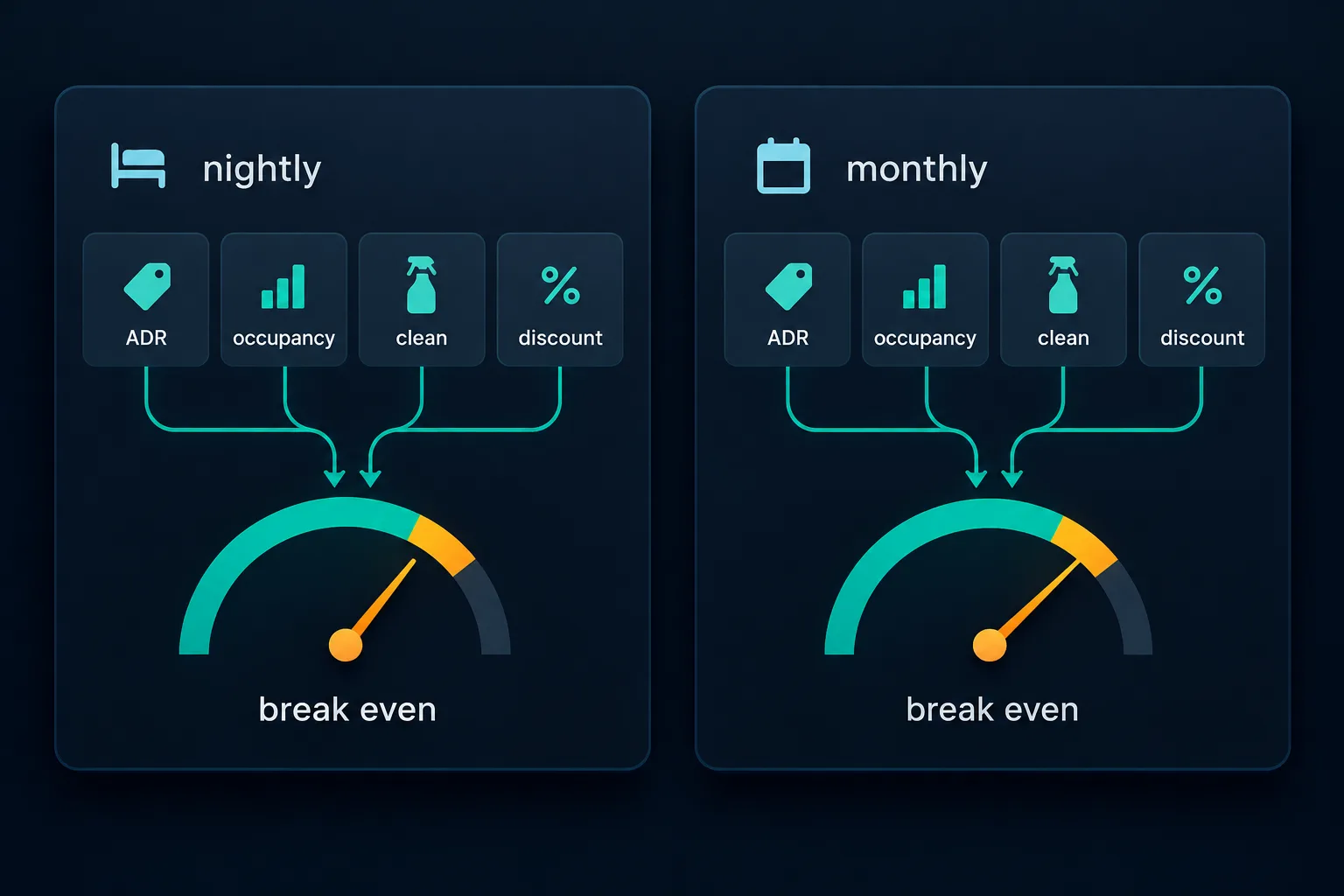
Expected short stay revenue = nightly ADR × expected occupancy nights + cleaning fees collected minus turnover costs.
Monthly revenue = discounted nightly ADR × nights + cleaning fee minus included mid stay cleaning, utilities uplift, extra wear and final cleaning cost.
Do not compare a 30 night booking with 30 fully booked nights unless you truly sell 30 nights in that month. If your usual February occupancy is low, a discount can win. If your August weekends sell out at premium ADR, the same discount can lose.
Worked assumption:
Nightly ADR: $180. Expected monthly occupancy: 60 percent, so 18 sold nights in a 30 night month. Turnovers avoided: 5. Cleaner cost per turnover: $120. Cleaning fee collected per short stay: $90. Final clean for a monthly stay: $120. Included mid stay clean: $120.
Nightly net before platform fees = $180 × 18 + $90 × 5 minus $120 × 5 = $3,090.
At a 25 percent monthly discount, rent is $180 × 75 percent × 30 = $4,050. Add one $90 cleaning fee and subtract $240 of cleaning. Net before platform fees is $3,900.
Break even discount = 1 minus ((short stay net minus monthly cleaning fee plus monthly cleaning costs plus extra utility and wear allowance) ÷ full monthly rent at ADR).
Using the assumptions above and no extra utility allowance, break even discount is 40 percent. If occupancy rises to 65 percent, the break even discount falls to about 35 percent. That is why the same Airbnb monthly discount can be sensible in one month and reckless in another.
As working bands, start with 10 to 15 percent where demand is strong, 15 to 25 percent in shoulder season, 25 to 35 percent in slow season, and deeper only when the alternative is vacancy or furnished monthly comps require it. Never let a suggested discount replace your own maths.
Worked example: monthly versus nightly revenue
| Scenario | Nights sold | Gross rent | Cleaning fees collected | Cleaning cost | Mid stay clean | Net before platform fees | Pros and cons |
|---|---|---|---|---|---|---|---|
| Nightly at 60 percent occupancy | 18 | $3,240 | $450 | $600 | $0 | $3,090 | Keeps weekends open, more messages and turnovers |
| Monthly at 20 percent off | 30 | $4,320 | $90 | $120 | $120 | $4,170 | Strong win in quiet months, calendar fully blocked |
| Monthly at 25 percent off | 30 | $4,050 | $90 | $120 | $120 | $3,900 | Still wins with fewer turnovers |
| Monthly at 30 percent off | 30 | $3,780 | $90 | $120 | $120 | $3,630 | Wins in this low occupancy example, may lose in peak demand |
The rule is simple: open monthly discounts only inside date ranges where expected nightly occupancy is below the break even point. If a period usually sells well, use minimum stay controls instead of discounting the whole month.
If you want a tool to test monthly discounts against normal booking pace and gap nights, use a pricing engine to test monthly discounts against nightly revenue. For background on occupancy inputs, read good Airbnb occupancy rate benchmarks.
How to mix monthly and nightly bookings
The best small hosts use both. Monthly bookings smooth occupancy, nightly bookings protect upside.
In low season, open monthly stays 60 to 120 days out and allow 28 to 60 night enquiries. In peak season, reduce the Airbnb monthly discount, set a shorter maximum stay, or block monthly arrival dates that would consume premium weekends.
Use gap rules. If you have a 21 night orphan gap between two strong bookings, a mid term rental Airbnb strategy may be better than chasing three separate stays. If the gap includes a major Friday and Saturday, price the long stay so it pays for those nights properly.
For 1 to 10 units, split inventory. Keep your best weekend unit on nightly pricing. Make one quieter unit monthly friendly with a desk, faster wifi, laundry, parking and more storage. Review this monthly, not once a year.
Calendar hygiene matters. Check minimum stay, maximum stay, preparation time, advance notice, maintenance days and calendar sync across your booking system. Airbnb says hosts enabling monthly stays can edit minimum and maximum nights, advance notice, preparation time and availability window in the calendar, according to Airbnb host monthly stay guidance. (airbnb.com)
Cleaning plan for a 30 night stay
There are three workable models.
First, no included mid stay clean. This suits lower priced units, but you still need clear supply and damage reporting expectations. Second, optional paid mid stay cleaning. This is flexible and usually fair for 30 to 45 nights. Third, included scheduled cleaning. This suits higher priced corporate, insurance or relocation stays.
Airbnb says hosts who offer mid stay cleaning should add the frequency, day, time and any additional fee before booking. Airbnb also says hosts should message guests before each clean and get permission before the cleaner enters. If the guest has not confirmed, the cleaner should not enter, according to Airbnb guidance for hosting monthly stays. (airbnb.com)
A sensible default for many small hosts is one inspection style light clean for stays of 30 nights or more, or biweekly paid cleans for stays of 45 nights or more. Price it into the rate if your market expects it.
A mid stay clean should cover bathrooms, kitchen surfaces, floors, bin and recycling check, linen or towel swap if agreed, filter checks, appliance scan and a maintenance note. It should not include guest dishes, personal laundry, moving guest belongings or deep cleaning an excessive mess unless your price and rules clearly cover that.
For your turnover plan, use how much to charge Airbnb cleaning fee and Airbnb cleaning checklist for cleaners.
Supplies, linens and utilities
A monthly guest needs enough to start living normally. That does not mean unlimited hotel style restocking unless you promise it.
State a starter supply policy: We provide enough toilet paper, soap, bin bags, dish soap and basic consumables to begin your stay. For longer stays, guests buy their own replacements unless agreed in writing.
Monthly stay basics include a vacuum, broom, mop, bin bags, dish soap, a laundry detergent starter, extra towels, extra sheets, basic cookware, reliable wifi, clear bin instructions, a desk and a proper chair. Airbnb says monthly stay guests typically want a well equipped kitchen, laundry, stable wifi and enough essentials in its host setup guidance. (airbnb.com)
Utilities create risk. Heat, air conditioning, EV charging, long showers, streaming and laundry volume can change the economics. Include normal utilities, but add a fair use clause only where local law and platform rules allow it, and disclose it before booking. Airbnb’s updated house rule guidance says hosts may ask guests to turn off air conditioning when leaving, but should not ask guests to avoid using a listed amenity. (airbnb.com)
Move in readiness checklist: test wifi speed, photograph meter readings if useful, check drains, clean filters, leave spare linen, confirm bin day, confirm parking, check desk lighting and label the fuse box or breaker panel location.
Guest communication templates
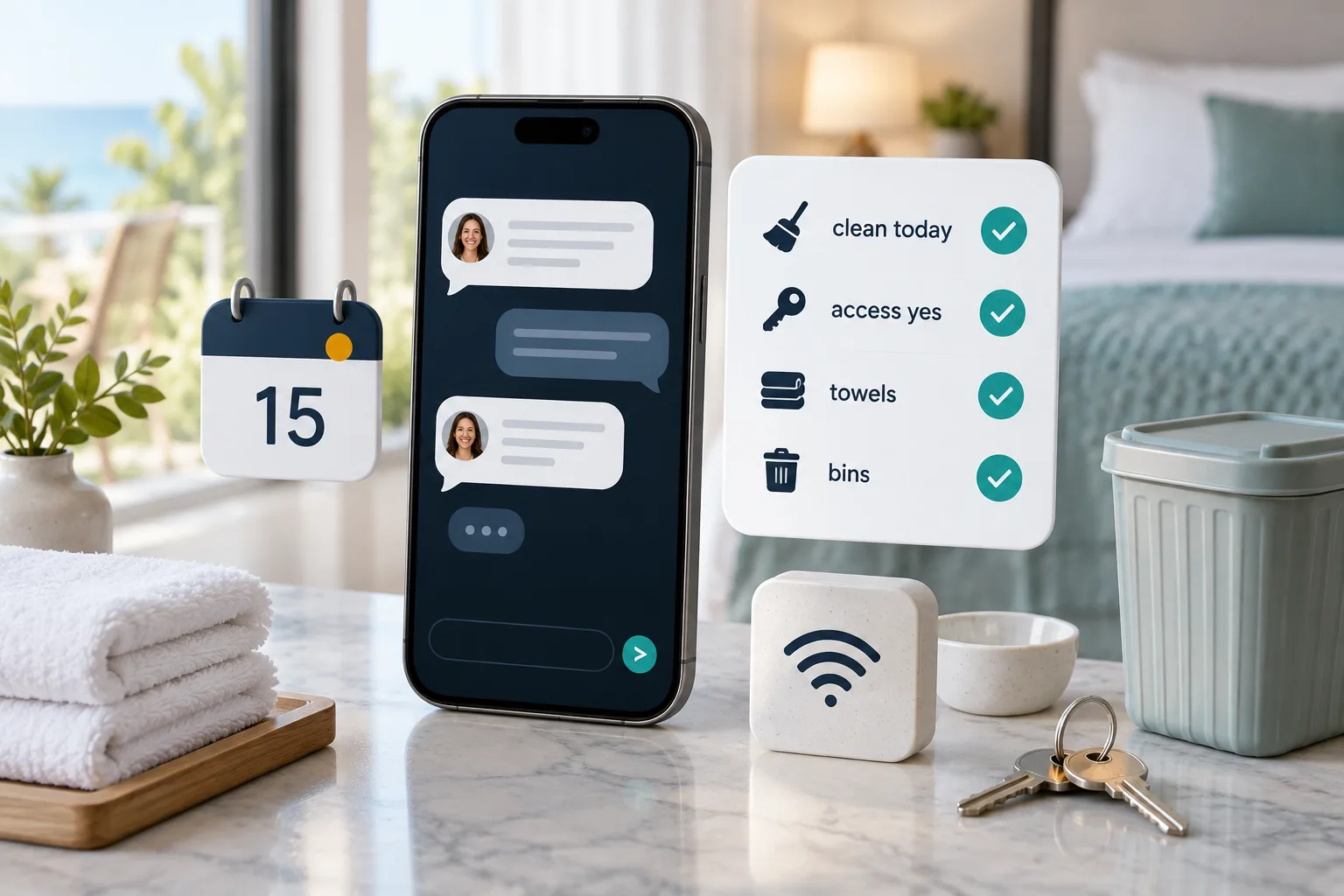
Monthly stays fail quietly. The guest lives with a weak pan, noisy boiler or slow wifi for weeks, then leaves a poor review. Message early and keep it practical.
Hi {first name}, thanks for your interest in {property name} for {dates}.

Before I confirm, can you please tell me:
1. The reason for the stay, for example work, relocation, insurance, study or between homes
2. Total occupants and any regular visitors
3. Whether anyone will work from home and needs desk space or video call quality wifi
4. Any pets, parking needs or accessibility needs
5. Whether you want optional mid stay cleaning at {price} on {day and time}

For stays of {minimum nights} or more, our listing rules, supply policy and any local requirements apply as shown on the listing. Happy to answer questions before you book.Hi {first name}, I hope you are settling in well at {property name}.
Quick check: is the wifi, heating or cooling, hot water, kitchen equipment and workspace all working as expected?
If anything needs attention, please tell me today so I can fix it early in the stay rather than leave it until checkout.Hi {first name}, your scheduled mid stay clean is planned for {date} at {time}.
Please reply Yes if our cleaner may enter during that time. The clean covers bathrooms, kitchen surfaces, floors, bins, agreed linen swap and a quick maintenance check. It does not include personal laundry, guest dishes or moving personal belongings.
If the time does not work, send two alternatives and I will try to move it.Hi {first name}, your checkout is currently {date}. If you need extra nights, I can check availability before we open the dates to other guests.
If you would like to extend, please send your preferred new checkout date and I will reply with the total and next step through Airbnb.For more message timing ideas, use Airbnb automated messages from booking to review.
Rules, cancellations, contracts and risk
Airbnb has separate long term cancellation policies for monthly stays. Under the Firm long term policy, Airbnb says guests must cancel at least 30 days before check in for a full refund, and after that the host is paid for nights spent plus 30 additional nights, or all remaining nights if fewer than 30 remain. Under Strict, Airbnb says guests must cancel within 48 hours of booking and at least 28 days before check in for a full refund, otherwise the host is paid for nights already spent plus the next 30 nights, or all remaining nights if fewer than 30 remain, according to Airbnb cancellation policy guidance. (airbnb.com)
Airbnb also says some monthly stay changes need host approval, including changes less than a month before the end date, changes after the trip has started and extensions. Other alterations can happen automatically when the stay remains 28 nights or longer and the guest gives a month of notice, according to Airbnb monthly stay alteration guidance. (airbnb.com)
Tenant rights are the serious part. Airbnb warns that in many US states and localities, a guest staying one month or longer may establish tenant rights, and gives California, Illinois and New York as examples where a residential tenancy may be created after 30 consecutive days. Airbnb advises hosts to review local rules and contact a landlord and tenant attorney or local county courts if needed in its monthly stay risk guidance. (airbnb.com)
Contracts need care. Airbnb’s updated policy says hosts generally cannot ask guests to sign a separate contract unless an exception applies, and one exception is a monthly stay of 28 nights or more. The contract terms must be disclosed in the designated listing section, and Airbnb says it does not require guests to sign host imposed contracts and does not help enforce them, according to Airbnb host contract policy. (airbnb.com)
Checklist before you turn on Airbnb minimum stay 30 days: local STR threshold, HOA or lease rules, insurance, taxes, contract disclosure, maximum stay, ID policy, utility wording, cancellation policy and who handles an overstay.
Listing changes that attract better monthly guests
Rewrite the listing for real life. Mention desk size, chair quality, wifi speed, parking, laundry, kitchen equipment, quiet hours, grocery distance, gym options, hospital access, business districts, pet policy and storage.
Add photos of the desk, wardrobe, washer and dryer, kitchen drawers, cookware, parking space, outside bins and entry path. Long stay guests look for friction.
Update the guidebook with grocery stores, pharmacies, gyms, transit, coworking spaces, parks, dog parks and local services. Airbnb specifically suggests adding grocery, gym and dog park tips for longer stays in its host guidance. (airbnb.com)
Checkout rules need an update too. AP reported that Airbnb announced new rules limiting checkout chores from 20 November 2026, with hosts required to disclose house rules and requests in the correct listing section before booking. Airbnb’s own Resource Centre says the new house rules policy takes effect on 20 November 2026, and gives examples: guests can be asked to put used dishes in the sink, gather used towels and separate rubbish indoors, but should not be asked to wash and put away dishes, remove sheets or take rubbish off site. (apnews.com)
For monthly guests, keep checkout simple: keys, bins in the right indoor place, thermostat, windows, doors and damage reporting.
Monthly stay SOP for small hosts
A small portfolio does not need a heavy system. It needs the same steps every time.
Before enabling: check rules, decide maximum stay, set monthly discount ranges by season, write supply policy, choose cleaning model and preview guest totals.
Before accepting: qualify purpose, occupants, pets, parking, work needs, cleaning expectations and contract needs. Avoid taking a 30 night stay from a poor fit just to fill a hole.
After booking: send guidebook, house manual, bin day, wifi, supply policy, maintenance reporting and cleaning schedule. For operators with several channels, YourFrontDesk for hosts and managers keeps every channel on one calendar, with guest questions answered from that property’s own information and uncertain replies drafted for the host.
Week one: send the day 3 check in. Mid stay: confirm cleaner access, scan maintenance and note utility concerns. Before checkout: offer an extension 7 to 10 days before departure if the calendar allows. Post checkout: inspect, deep clean, review utility cost, note wear, update templates and adjust pricing.
Track a few numbers: occupancy rate, ADR, monthly net revenue, cleaner hours per occupied night, guest message volume, review rating and maintenance cost per stay. If those numbers improve, monthly stays are helping. If not, tighten the dates, discount or guest qualification.
Next steps
Start with one unit and one quiet season. Set a monthly discount only where the maths works, write the cleaning and supply terms before bookings arrive, and use templates so every long stay gets the same clear treatment.
If you want the front desk, calendar, guest replies, arrivals, pricing and housekeeping list to run from one place, try the instant YourFrontDesk demo.
What people ask next
What is considered a monthly stay on Airbnb?
Airbnb treats a monthly stay as a reservation of 28 nights or more. Many local short term rental and tenancy rules use 30 days, so hosts should check both Airbnb rules and their local law before enabling long stays.
How much monthly discount should I offer on Airbnb?
There is no fixed correct discount. Calculate what you would likely earn from nightly stays after occupancy, cleaning fees and turnover costs, then compare it with the discounted monthly booking after cleaning, utilities and wear. Many hosts start lower in strong demand and only use deeper discounts in slow months.
Can I set a 30 day minimum stay on Airbnb?
Yes, hosts can adjust minimum and maximum nights in their Airbnb availability settings. A 30 day minimum stay can help in regulated markets, but it may also create tenant rights or different legal obligations in some places.
Do Airbnb guests pay monthly for long stays?
For Airbnb monthly stays, guests usually pay the first month when they book, then the rest in monthly instalments. Hosts should still check the payout schedule for their account and market.
Should I offer cleaning during a month long Airbnb stay?
You can offer no included clean, an optional paid clean or an included scheduled clean. Whatever you choose, disclose the frequency, fee, day and access process before booking, and get guest permission before a cleaner enters.
Can an Airbnb guest become a tenant after 30 days?
In some jurisdictions, yes. The exact point depends on local law, and Airbnb warns that month long stays may create tenant rights in some places. Speak to a local landlord and tenant attorney before using 30 night bookings as a regulatory workaround.
Can Airbnb hosts require a lease for monthly stays?
Airbnb allows host imposed contracts in limited situations, including monthly stays of 28 nights or more. The terms must be disclosed in the correct listing section before booking, and Airbnb says it does not enforce those contracts for the host.