How to Get Direct Bookings as Airbnb Host
A practical guide for hosts with one flat, one cabin, or a small short let portfolio. Learn how to build a direct booking route without breaking platform rules or creating calendar chaos.
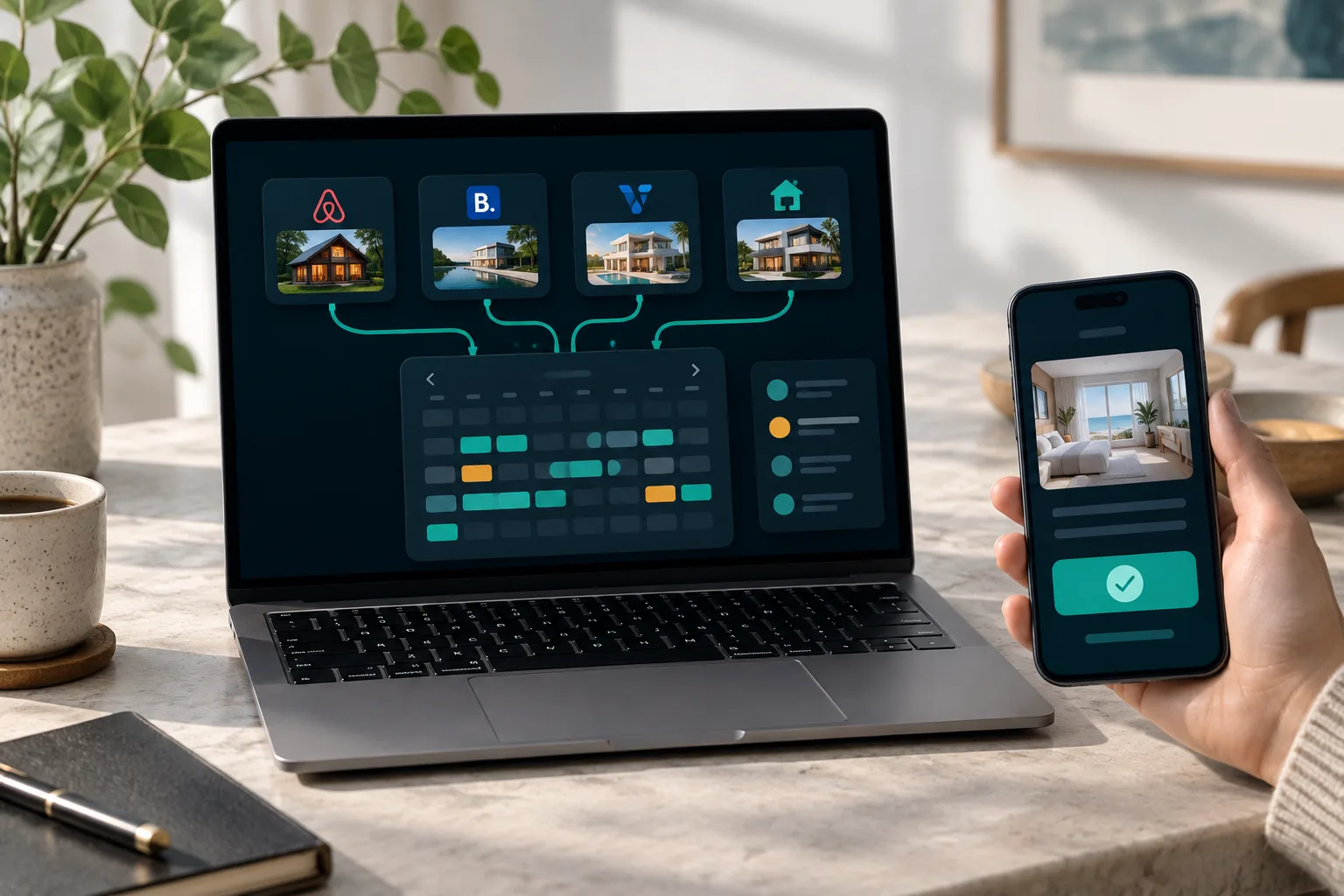
The short version
- Airbnb should usually stay as an acquisition channel while direct bookings grow from repeat guests, referrals, brand searches, local demand and longer stays.
- A direct booking website must show live availability, total price, trust signals, policies and a clear booking or request path, not just photos and a contact form.
- Do not use Airbnb messages or Airbnb provided contact details to move bookings away from Airbnb, and collect marketing consent on your own channels.
- The calendar is the operational risk, so test two way sync, payment holds, owner blocks and weekly audits before you accept instant direct bookings.
- Direct bookings can improve net revenue, but they still carry card processing, software, insurance, tax, admin and guest risk costs.
If you are wondering how to get direct bookings as Airbnb host, the realistic answer is this: build a trustworthy direct booking route, connect it to the same calendar as your Airbnb and other channels, then send repeat guests, referrals, local searchers and niche stays there. For a host with 1 to 10 units, direct bookings are not a magic replacement for Airbnb. They are a second channel that you build deliberately.
Airbnb, Vrbo and Booking.com are still useful places for guests to discover you. Your own site is where you capture the guests who already know your property name, stayed before, found you through a local partner, or need a longer, more specific stay.
The realistic way small hosts get direct bookings
For one apartment, one cabin, two city flats or a small serviced apartment block, the winning order is simple. First, create a bookable direct booking website. Second, connect it to your central calendar. Third, follow up with guests you are allowed to contact.
That means you do not need to become a large vacation rental brand. You need a page that proves the property is real, shows live availability, explains the price clearly and lets a guest book or request dates without confusion.
Direct bookings usually start with guests who already trust you, not strangers who have never heard of you.
If you only do 3 things, do these. Publish a direct booking page with clear policies and payment details. Set up two way calendar sync so every booking blocks every channel. Build a consent based repeat guest list from your own website, direct stays, welcome materials and referrals.
Airbnb remains useful because it brings new demand. Direct booking grows when you convert some of that demand into repeat stays, local demand and brand search. If a guest searches your property name after seeing you on an online travel agency, your own website should be the result they find.
What changes when a booking is direct
A direct booking is any reservation made through your own website, booking engine, email request, invoice, or payment link instead of an online travel agency. The guest may still have discovered you elsewhere, but the contract, payment and communication sit with you.
You gain control over the guest relationship, repeat marketing, pricing, house rules and stay terms. You also avoid some platform fees, although direct bookings still have costs. You must pay for card processing, software, insurance, tax handling, fraud checks and your own admin.
You also lose parts of the platform trust layer. Airbnb says communication and booking on Airbnb give access to secure payments, support and host damage protection, and its messaging systems may detect external links or contact details under its rules Airbnb help on off platform communication. With direct bookings, you replace that with your own payment processor, rental agreement, cancellation policy, guest screening and support workflow.
| Area | Airbnb booking | Direct booking |
|---|---|---|
| Guest source | Airbnb search and ranking | Your website, past guests, referrals, local search |
| Fees | Airbnb service fee model | Card fee, software, admin, insurance, marketing |
| Payment | Platform collects and pays out | You collect by card, bank transfer or payment link |
| Calendar | Airbnb calendar | Central calendar or booking system |
| Guest data | Limited by platform rules | Your own data, with consent and privacy rules |
| Support | Platform support process | Your process and response time |
| Damages | Platform damage process may apply | Deposit, waiver, insurance or agreement |
| Reviews | Airbnb reviews | Testimonials, email feedback and repeat signals |
| Taxes | Platform may collect in some places | You must check and reconcile |
| Marketing | Airbnb owns the audience | You own the follow up if consent is valid |
The Airbnb rules you must not ignore
This is operational guidance, not legal advice. Before you start, read Airbnb rules yourself and check your local law, tax and data protection duties.
Airbnb’s current Off Platform Policy says hosts must not ask for guest contact information before booking, must keep pre booking communication on Airbnb, must not solicit guest email or other communication channels through Airbnb messages after booking, and must not use Airbnb provided contact information for unrelated purposes. It also says repeated or severe violations may lead to listing or account suspension or deactivation Airbnb Off Platform Policy.
The safe principle is plain. Do not use your Airbnb listing, Airbnb messages, Airbnb email aliases, or Airbnb provided details to move current, future or repeat Airbnb bookings away from Airbnb.
Consent matters. If you collect marketing emails, collect them on your own channel with a clear opt in or a lawful soft opt in where it applies. In the UK, the ICO says electronic marketing needs consent or all soft opt in conditions, and every message must give a clear way to opt out ICO electronic mail marketing guidance.
| Scenario | Safer approach | Risky approach |
|---|---|---|
| Current Airbnb enquiry | Answer on Airbnb, do not mention direct booking | Send your direct booking site in Airbnb messages |
| Confirmed Airbnb stay | Use Airbnb details only for the stay | Add the guest to a newsletter without consent |
| Past Airbnb guest | Let them find you independently or book again on Airbnb | Email them direct offers using Airbnb supplied details |
| Direct guest | Offer opt in during your own booking flow | Hide marketing consent in terms |
| Social follower | Link to your own site from your own profile | Ask them to cancel an Airbnb booking |
| Local search visitor | Let them book or enquire on your site | Claim Airbnb protection applies to direct stays |
The minimum viable direct booking website
A direct booking website is not a brochure page. It must let guests check dates, understand the total price, trust the host and take the next step.
For one unit, the page can be simple: property name, area, strong photos, bedroom setup, maximum occupancy, parking, pet policy, house rules, cancellation policy, fees, taxes, reviews, accessibility notes, local highlights and a visible Book Now button. For several units, add a search box so guests can enter dates and see available units.
Trust details matter. Use a real host or business name, a proper domain, SSL, a business email, clear refund terms, card payment information, a rental agreement, privacy policy and a plain explanation of deposits or damage waivers.
If you are deciding how to make a direct booking website, start with copy like this.
Stay at {property name} in {area}
A {bedroom count} bedroom {property type} for {guest type}, {minutes} from {landmark}.
Check live availability, see the full price before you book and message {host name} if you have a question.
Why guests book direct:
{benefit one}
{benefit two}
{benefit three}
Book your dates or send a request below.Short lets in {area} for work, family visits and longer stays
Choose from {number of units} apartments, all managed by {host or business name}.
Enter your dates to see live availability across our homes.
Every stay includes {key amenity}, clear arrival instructions and support from our local team.
Best for {guest type one}, {guest type two} and {guest type three}.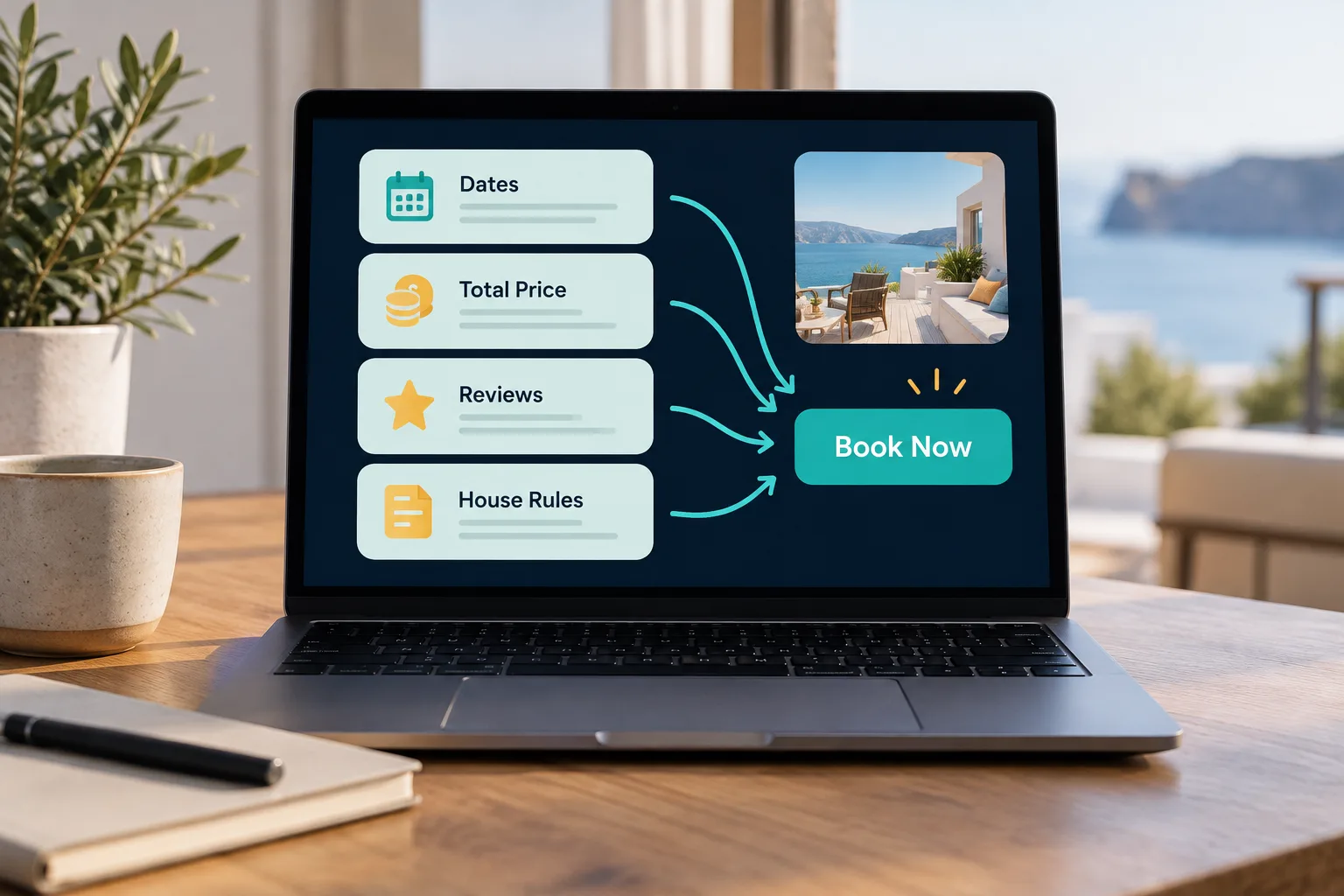
Choose the right build route
For most hosts with 1 to 10 units, the best direct booking website is the one you can keep accurate. Pretty design is less important than live availability, clear pricing, safe payments and fewer manual steps.
| Build route | Best for | Setup effort | Calendar reliability | Payment capability | SEO flexibility | Cost pattern | When to upgrade |
|---|---|---|---|---|---|---|---|
| Simple site plus enquiry form | One unit testing demand | Low | Manual or basic iCal | Usually manual link or invoice | Basic | Domain and site fee | When enquiries become real bookings |
| Dedicated direct booking website | One to a few units | Low to medium | Usually booking engine plus iCal | Often card ready | Medium | Monthly or yearly tool fee | When you need stronger automation |
| PMS or channel manager site | Several channels or units | Medium | Stronger central calendar | Usually card ready | Medium | Monthly fee per unit or account | When instant booking and more channels matter |
| WordPress or custom site with booking widget | Hosts investing in content | Medium to high | Depends on widget | Depends on booking engine | High | Build fee plus plugins and hosting | When local SEO is producing traffic |
| Full custom build | Larger brand or unusual flow | High | Only as good as the integration | Custom | High | Build and maintenance | Rarely needed for 1 to 10 units |
If your booking route cannot keep rates and availability manageable, it is the wrong route. A host with 2 flats and a busy summer can get into trouble faster than a host with 20 units and a good central calendar.
Put every booking on the same calendar
The target architecture is simple. Airbnb, Vrbo, Booking.com and your direct site should feed one central calendar. Owner stays, maintenance blocks, cleaning gaps and direct payment holds should also live there.
Airbnb supports calendar import and export using an iCal URL, says imported calendar links normally need to end in .ics, and says its calendar automatically updates every 3 hours. It also warns that nights blocked on another calendar may or may not be blocked on Airbnb, depending on the details Airbnb calendar sync help. Vrbo says it accepts iCal links, can import calendars in its owner dashboard and imported events may take up to 20 minutes to appear Vrbo calendar sync help.
That is why iCal is fine for lower volume hosts, but weaker for instant booking on several channels. It usually shares blocked dates, not full rate rules, cleaning rules, payment status or guest tasks.
A practical example: you have 2 apartments. A guest requests Friday to Sunday on your direct site. If you use iCal only, hold the dates while payment is pending, manually refresh Airbnb, check Booking.com and Vrbo, then confirm. If you use a central system with stronger channel connections, the direct booking should block the same dates across channels from the middle.
Use this anti double booking checklist:
- Test two way sync for each unit, not just one.
- Block owner stays in the central calendar, not one channel.
- Hold dates while payment is pending.
- Avoid instant direct confirmation if sync is unreliable.
- Use preparation gaps where same day turnovers are risky.
- Audit every unit weekly in peak season.
- Read our guides to sync Airbnb and Booking.com calendars and prevent Airbnb double bookings.
Price direct bookings without undercutting yourself
Direct should be better value for the guest and better net for the host. It does not have to mean 20 per cent cheaper.
Airbnb’s 2026 service fee article says some hosts using property management or channel management software moved to a single host paid fee, with an example where a $115 guest visible price leaves a $97 host payout after a 15.5 per cent service fee Airbnb service fee update. Stripe’s United States pricing page lists 2.9 per cent plus 30 cents per successful domestic card transaction Stripe pricing.
Using only those public figures, a $115 direct card payment would have a Stripe fee of $3.64, leaving $111.36 before your other costs. That is not pure profit. You still need to allow for your booking system, insurance, fraud risk, chargebacks, payment admin, tax admin and time.
Good direct offers are often about value rather than raw discount. Use the same nightly rate but no guest service fee. Offer a repeat guest code. Add free early arrival where your cleaning schedule allows. Create weekly or monthly pricing for contractors, travel nurses or relocation stays. Fill awkward gap nights with a direct only minimum stay.
Do not train guests to wait for discounts. Keep your pricing easy to explain across channels.
Turn warm guests into repeat stays
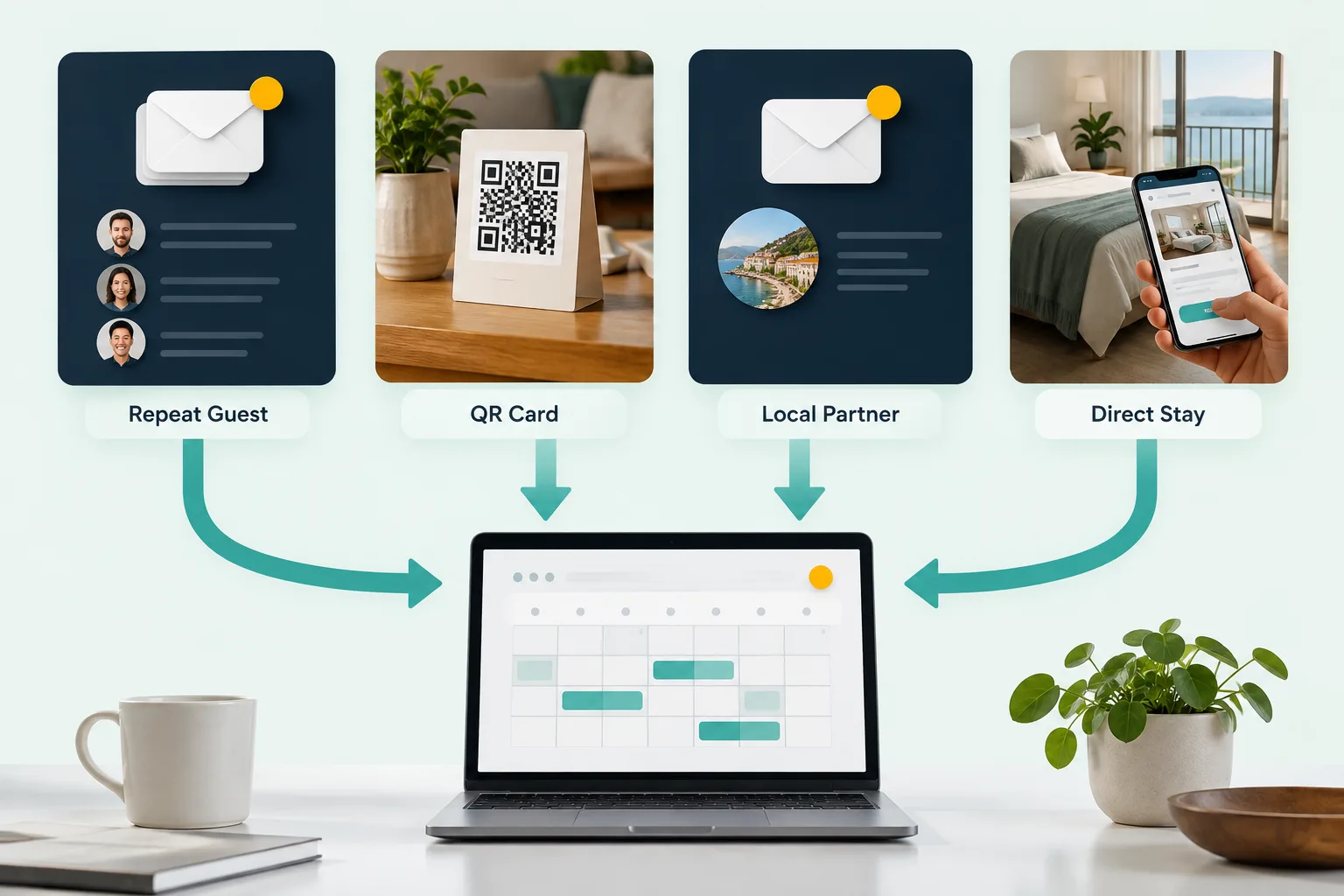
Past guests are warmer than cold search traffic, but the rules matter. Build your list from your own booking form, direct stay checkout form, guidebook download, Wi Fi card, QR code, referral card and local updates list, where allowed.
Segment the list by reason for stay. Families care about school holidays, parking and beds. Contractors care about invoices, weekly rates and parking vans. Nurses care about hospital distance, washing facilities and quiet sleep. Wedding guests care about venue distance and flexible arrival.
Hi {first name},
Thank you for staying at {property name}. I hope the journey home was easy.
If you plan to return to {area}, you can book direct at {direct booking website} or reply to this email with your dates.
Direct returning guests get {return guest benefit}, subject to availability.
You can unsubscribe from stay offers at any time by replying unsubscribe.
Best,
{host name}Book this place again
Scan to check live dates and direct prices for {property name}.
Best for return visits, family stays and longer work trips.
Questions about a future stay? Message {host email}.Add a simple cadence. Send a thank you after checkout for direct guests. Send seasonal reminders 60 to 90 days before peak dates. Send local event notes when demand is likely. Send slow season offers only when you need them.
Local search and referral channels that work
Just building a website fails because nobody knows the domain exists. You need pages and partners that match real guest intent.
Create a property name page so brand searchers find you. Add an area page for your town or neighbourhood. Then create pages for searches such as where to stay near {hospital}, accommodation near {wedding venue}, pet friendly short let in {area}, monthly stays in {area}, contractor accommodation near {business park} and family apartment near {university}.
Be careful with Google advice. Google says individual homeowners, peer to peer rentals, individual rooms and partial homes are currently ineligible for Google vacation rental search results, and that individual homeowners are not eligible for a Google Business Profile for their physical home Google vacation rental eligibility. Google Business Profile guidance also lists rental or for sale properties such as vacation homes, model homes and vacant apartments as ineligible Google Business Profile eligibility.
So for many small hosts, local SEO means normal website pages, not a Google Business Profile for the property address. Professional managers may have other routes through approved connectivity providers, but do not build your plan on a profile you may not be allowed to keep.
Subject: Accommodation for guests visiting {venue or company name}
Hi {first name},
I run {property name or business name}, a small short let in {area} suitable for {guest type}.
We often host people visiting {reason}, and I wondered if a simple rate sheet would be useful for your team or guests.
The property includes {amenity one}, {amenity two} and {parking or transport detail}.
You can see live availability at {direct booking website}.
Best,
{host name}
Direct booking operations checklist
Direct bookings shift responsibility to you, so write the process before the first payment arrives.
Payments: choose a card processor, set payment timing, explain deposits, issue receipts, record taxes and decide how refunds are approved. If you use Stripe or another processor, know how disputes and chargebacks work before you need them.
Guest protection: use a rental agreement, disclosed house rules, ID verification where lawful, a security deposit or damage waiver if you choose one, suitable insurance, fraud checks and clear arrival instructions. Watch for mismatched names, rushed same day bookings, unusual payment behaviour and guests refusing the agreement.
Guest experience: automate confirmation, arrival instructions, door code timing, check in messages, checkout messages and testimonial requests for direct guests. If you manage for owners, keep owner reports, cleaning schedules, tax records, occupancy reports and maintenance notes.
Hi {first name},
Your stay at {property name} is confirmed for {arrival date} to {departure date}.
Total paid: {amount paid}
Balance due: {balance amount} by {due date}
Before arrival, please complete {payment or ID or agreement link}.
Arrival details and the guidebook will be sent at {release time} once the required steps are complete.
Cancellation terms: {short cancellation policy}
Best,
{host name}To confirm your booking, we collect {payment amount} by secure card payment.
A {deposit or damage waiver} of {amount or description} applies because this is a direct booking rather than a platform booking.
It covers {plain explanation}. It does not replace our house rules or rental agreement.
Refund timing and cancellation terms are shown before you pay.Your 30 60 90 day plan
Days 1 to 30: choose your booking route, publish the site, connect the calendar, test a booking, test a cancellation, test a payment hold, add analytics, write policies, prepare templates and check every unit’s calendar. If you want to see how one front desk layer can sit between Airbnb, Booking.com, Expedia, Vrbo and direct bookings, try the instant direct booking demo.
Days 31 to 60: email direct guests who gave valid consent, add a QR code to owned materials, update your email signature, link your site from your social profiles, publish 2 local pages, contact 5 local partners and review inquiry sources.
Days 61 to 90: publish 2 more local pages, test a return stay offer, build a referral offer, audit calendar sync, improve photos and FAQs based on questions, then compare direct revenue, repeat rate, average stay length, cancellation rate and double booking incidents.
Track direct booking conversion rate, source of inquiry, repeat guest rate, direct revenue, estimated avoided platform fee, occupancy by channel and average length of stay. A handful of repeat direct bookings can justify the setup, but direct booking only becomes meaningful when you treat it as a channel, not a one time website task.
Next steps
If you run 1 to 10 units, start small: a bookable site, one central calendar, clear policies and consent based follow up. Then improve the channel every month.
See how this can work in practice with the YourFrontDesk instant demo.
What people ask next
How do I get direct bookings as an Airbnb host?
Create a direct booking website with live availability, clear prices and trustworthy policies. Connect it to the same calendar as Airbnb, then promote it to repeat guests, referrals, local searchers and niche stay groups such as contractors or wedding guests.
Can I make my own website for my Airbnb?
Yes, you can make your own website for your property, but it should be more than a brochure. It needs live dates, a booking or request flow, payment details, cancellation terms, house rules, reviews and a way to avoid double bookings.
Can Airbnb hosts take direct bookings?
Hosts can usually take bookings through their own channels, but they must not use Airbnb messages, Airbnb listings or Airbnb provided contact information to move Airbnb guests off platform in ways that breach Airbnb rules. Always check platform terms, local law, tax rules and insurance before accepting direct stays.
Can I ask Airbnb guests to book directly next time?
Do not ask through Airbnb messages or use Airbnb supplied contact details for marketing. The safer route is to build your own audience through direct bookings, your own website, social profiles, QR cards in owned materials where allowed and guests who give proper marketing consent.
How do I sync Airbnb with my direct booking website?
Most small hosts either use iCal links or a booking system with a central calendar. iCal can work for simple setups, but you should test both directions, hold dates while payment is pending and avoid instant direct confirmation if sync delays could cause a double booking.
Is a direct booking website worth it for one Airbnb property?
It can be worth it if you use it to capture repeat guests, referrals, brand searches and longer stays. It is less likely to work if you publish a site once and do nothing to send traffic to it.
Do vacation rentals qualify for Google Business Profile?
Individual vacation homes and similar rental properties are often not eligible for a Google Business Profile for the property address. Small hosts should focus on normal website SEO, property name searches, area pages and local referrals unless they qualify as a professional manager with the right setup.
How much should I discount direct bookings compared with Airbnb?
Do not automatically discount heavily. Aim for better value for the guest and better net revenue for you, using options such as repeat guest codes, longer stay rates, included extras, or lower total fees where your costs allow.