Airbnb Gap Nights Guide
Airbnb gap nights are not just empty dates, they are often open dates that your minimum stay rules make impossible to book. This guide gives small hosts a practical rule set for filling them without inviting bad one night stays.

The short version
- Make a gap bookable before you discount it, because a two night gap cannot sell while the minimum stay is three nights.
- Use date specific minimum stays so you fill the orphan nights without lowering the whole listing minimum.
- Price gap nights from net contribution, including host fee, cleaning cost, linen, supplies and cleaner capacity.
- One night stays need stricter operational safeguards than two or three night stays.
- Review gap nights weekly, then automate only the rules that have proved safe for your property.
Airbnb gap nights are empty nights between two bookings that are too short for your normal minimum stay. The fix is simple in principle: make the gap bookable for those dates only, then decide whether to discount, hold price, or charge more for the extra turnover risk.
For a host with 1 to 10 units, the best approach is not to chase every orphan night. It is to know which gaps are worth selling, protect your cleaner and house rules, and use automation only where the numbers and operations make sense.
What are Airbnb gap nights or orphan nights?
Airbnb gap nights, also called orphan nights, orphan gaps or stranded nights, are open nights trapped between confirmed reservations.
Example: booking A checks out on Monday morning. Booking B checks in on Wednesday afternoon. Monday night is a one night gap.
The gap only becomes a revenue problem if it is shorter than your usual minimum stay. If your listing has a three night minimum, that single Monday night might appear open on your calendar, but a guest searching for one night may not be able to book it. That is why hosts often say the date is available but not really sellable.
Gap nights are different from preparation time, owner blocked dates or maintenance blocks. A preparation block is there because you have chosen to keep time between stays. A gap night is sellable in theory, but blocked in practice by trip length, check in rules, advance notice, cleaning capacity or synced calendar settings.
The aim is not always to fill every gap between bookings. Sometimes the empty night is the right choice. The aim is to make a deliberate decision before the date passes.
A discount cannot sell an orphan night if your minimum stay still makes that night impossible to book.
Why gap nights happen even when your calendar looks open
Minimum stay rules are the usual cause. Airbnb says hosts can set minimum and maximum nights, customise minimum nights by check in day, and use rule sets that override existing minimum night rules while they are active in its minimum nights help page. (airbnb.com)
That flexibility is useful, but overlapping rules can create holes. A long weekend booking can leave a Tuesday to Thursday gap. A guest can book a stay that meets your minimum, while the remaining open dates on either side no longer meet it.
Other hidden causes include check in day rules, checkout restrictions, advance notice, same day notice, preparation time and calendar sync. Airbnb lists trip length, advance notice, preparation time, availability windows, check in restrictions, checkout restrictions and calendar sync as availability controls in its availability guide for hosts. (airbnb.com)
Use this quick diagnostic when a date looks open but does not book:
- Is the date actually open on Airbnb?
- Is the gap shorter than your default minimum stay?
- Is a rule set or custom trip length overriding the listing rule?
- Is preparation time blocking the date?
- Is advance notice or same day notice blocking late bookings?
- Is a check in or checkout restriction stopping the stay?
- Is a synced calendar or owner block sitting over the night?
- Does the calendar look bookable when you search like a guest?
The quick rule: make the gap bookable before you discount it
The first rule of fill gaps between bookings work is this: trip length first, price second.
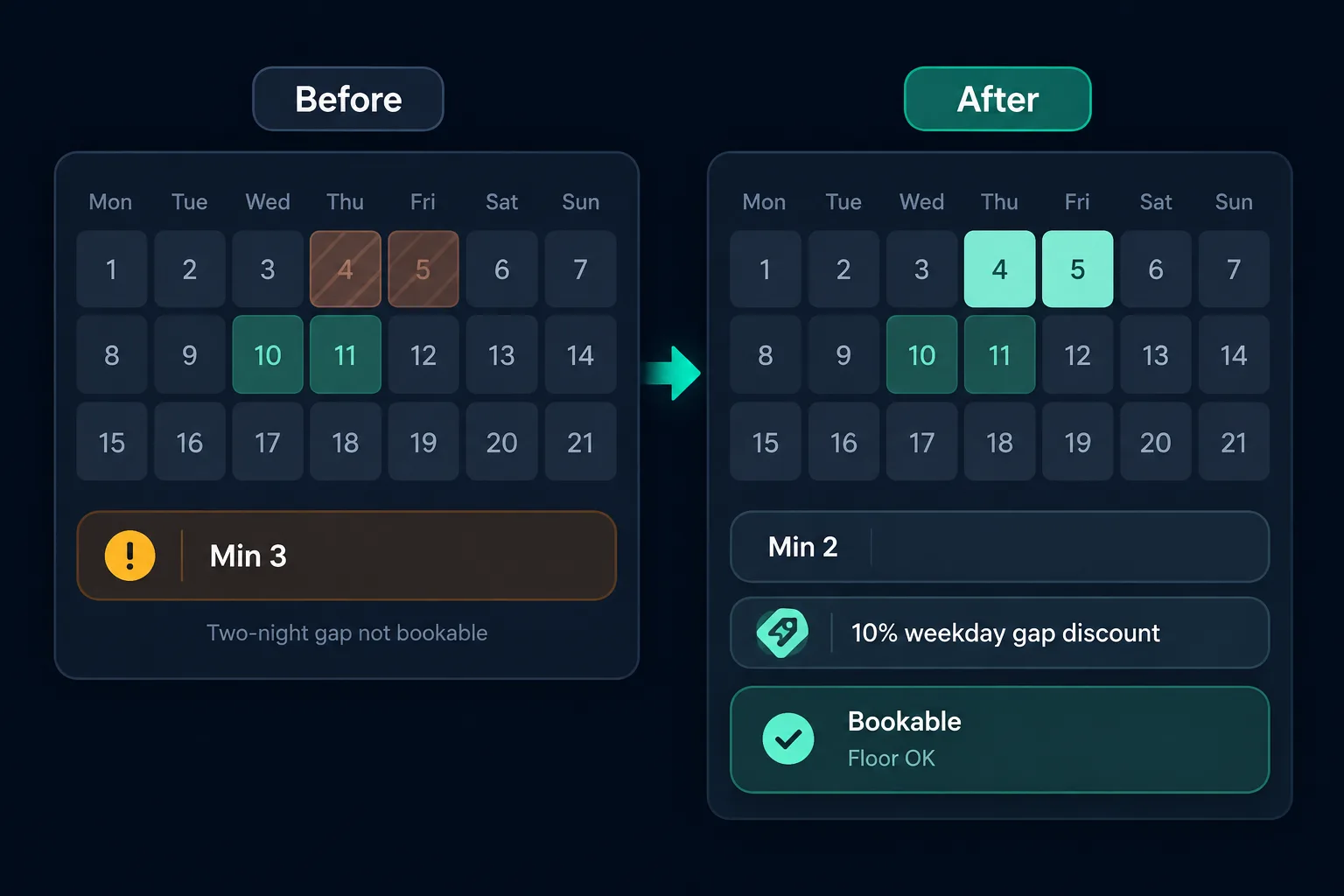
If you have a three night minimum and a two night gap, a 20% discount will not help unless the minimum stay for those dates is also two nights or less. If you have a one night gap, the same applies. The night must be bookable before the price matters.
For a one night gap, set the minimum to one for that date only if a one night stay is operationally safe. That means cleaner availability, self check in, door code control, a sensible cut off time, clear house rules and no local rule that prevents it.
For a two night gap, set the minimum to two. Only drop it to one close to arrival if you are comfortable with the extra turnover and guest risk.
Do not lower the whole listing minimum just to fix one gap. Use date specific rules, custom trip lengths or your booking system so the exception only applies inside the gap.
If you are new to this, start with two night gaps. They are usually less risky than one night stays and easier for cleaners to absorb.
Recommended gap night rules for small Airbnb hosts
Use the table below as a starting point, then adjust from your own booking pace, cleaner capacity and guest quality. These are operator settings to test, not market statistics.
| Gap type | Default minimum | Suggested gap minimum | Suggested price action | Lead time trigger | Notes |
|---|---|---|---|---|---|
| 1 night weekday | 2 to 4 nights | 1 night | 0% to 15% discount, or hold price | 0 to 14 days | Good if cleaning is easy and party risk is low |
| 1 night weekend | 2 to 4 nights | 1 night only if safe | Hold price or add a premium | 0 to 7 days | Use a price floor and tighter screening |
| 2 night weekday | 3 to 5 nights | 2 nights | 5% to 15% discount | 7 to 21 days | Often the best low risk gap rule |
| 2 night weekend | 3 to 5 nights | 2 nights | Hold price first, then small discount | 7 to 14 days | Protect high demand Fridays and Saturdays |
| 3 night gap | 4 to 7 nights | 3 nights | No discount at first | 14 to 30 days | Discount only if booking pace is weak |
| Low season midweek gap | 2 to 5 nights | Gap length | 10% to 20% discount if floor is safe | 0 to 21 days | Pair with your Airbnb slow season booking playbook |
| Event gap | 2 to 5 nights | Gap length | Hold price or premium | 0 to 30 days | Do not cheapen scarce event dates |
| Last minute cancellation gap | Normal rule | Gap length or 1 night | Discount only after costs are covered | 0 to 72 hours | Message previous enquirers and adjacent guests |
Airbnb itself notes that adding a custom trip length shorter than your minimum for certain dates can help fill gaps, giving an example where four open nights sit between reservations while the normal minimum is five nights in its availability guide. (airbnb.com)
Worked example: should you sell a one night gap?
Use your own figures, but the calculation is always the same.
Say your normal ADR is $180. A one night gap will otherwise earn $0. Your cleaning cost is $65, linen and supplies are $15, and you use a 3% host fee for the example. Airbnb says most hosts pay a 3% host service fee, although some pay more, and the fee is deducted from the total price and host charged fees excluding taxes and guest service fees in its service fee help page. (airbnb.com)
Scenario A, discount to $150:
Gross nightly price: $150
Example host fee at 3%: $4.50
Cleaning cost: $65
Linen and supplies: $15
Net contribution before tax and fixed costs: $65.50
Scenario B, premium to $220:
Gross nightly price: $220
Example host fee at 3%: $6.60
Cleaning cost: $65
Linen and supplies: $15
Net contribution before tax and fixed costs: $133.40
If your actual fee structure is higher, replace the 3% with the figure shown in your Airbnb payout screen. If you charge a separate cleaning fee, include both the guest paid fee and your real cleaner cost.
A one night stay is usually worth it when the cleaner can manage it, check in is automated, the property is robust, neighbours are not sensitive and the guest quality is acceptable. Leave it empty when the cleaner is stretched, the property is fragile, the night might be used by an adjacent guest, or the booking risk is not worth the contribution.
For a deeper look at cost recovery, use this guide to work out your Airbnb cleaning fee.
Worked example: two night gap between longer stays
Now take a two night Tuesday to Thursday gap with a normal three night minimum and a normal ADR of $160.
Step 1: lower the minimum to two nights for Tuesday and Wednesday only. Do not change the whole listing.
Step 2: if the gap is more than seven days away, apply a 10% weekday gap discount only if your price floor is still safe. That makes the example nightly price $144.
Step 3: if the gap is inside 72 hours and still empty, consider 15% to 20%, but only if the cleaner and net contribution still work.
Step 4: message the departing guest and arriving guest before you keep reducing the public price. An extension from an existing guest is often simpler than a fresh booking, because they already know the property and may reduce turnover pressure.
Even discounted revenue beats an unbookable gap when variable costs are covered and the operational risk is acceptable. But do not let a cheap two night stay block a better adjacent extension.
How to set Airbnb minimum stays for specific dates
The native Airbnb route is high level, but the principle is clear. Go to Calendar, choose the listing, open Availability, then adjust minimum and maximum nights. Airbnb says custom minimum night rules can also be created by day of week, and rule sets can customise minimum stays by check in day in its minimum night settings help. (airbnb.com)
For hosts with several units, professional hosting tools can help update more than one listing. Airbnb says professional hosting tools include a multi calendar for managing several listings and that decreasing minimum trip length can help listings appear in searches for shorter stays and fill gaps in its settings and availability guide. (airbnb.com)
Always check the final result like a guest. Search the exact dates, guest count and minimum stay you expect to sell. Overlapping rule sets, custom trip lengths, preparation time and your booking system can conflict.
How a pricing engine should automate gap nights
A good pricing engine should do four jobs.
First, scan the calendar daily and identify gaps shorter than the normal minimum stay. Second, apply a date specific minimum equal to the gap length, or lower if the host allows it. Third, apply a price adjustment based on lead time, day of week, floor price and demand. Fourth, remove or update the rule when the gap changes.
A simple automation recipe looks like this:
IF gap length equals 1 AND days to arrival is 14 or less THEN minimum stay equals 1 AND price equals the higher of floor price or base price multiplied by the adjustment.
Use lead time tiers:
30 plus days: protect ADR and do not rush to discount.
14 to 30 days: open two night gaps where safe.
0 to 14 days: open one night gaps only on properties that can handle them.
0 to 72 hours: recheck cleaner capacity before lowering price again.
This is where automate gap night pricing rules can save time. YourFrontDesk reads booking pace and gap nights, uses a floor and ceiling per unit, damps big swings, explains every move and reprices through the day.
Discounts, premiums and price floors for orphan nights
There is no universal orphan nights Airbnb discount. A cheap one night stay in a large house can lose money after cleaning, linen, guest messages, wear and risk. A one night stay in a small studio with a regular cleaner and self check in may be easy profit.
Set a hard floor. The floor should include host fee, variable cleaning cost, linen, supplies, payment or admin cost, and a risk margin. If the public price drops below the floor, leave the night empty or sell it only to an adjacent guest.
Use percentage adjustments where possible because they move with seasonal ADR. A 10% discount behaves differently in low season than during a big event.
Price up instead of down when the date is scarce. One night Saturday gaps, event gaps, expensive same day turnovers and weeks where cleaner capacity is tight should often carry a premium. The Airbnb Community often shows hosts discussing both discounting and increasing one night gap prices, but you do not need anecdotes to make the decision. Your own net contribution and cleaner capacity are better guides.
For demand building outside weekends, see get more weekday Airbnb bookings.
Message templates to fill gaps with adjacent guests
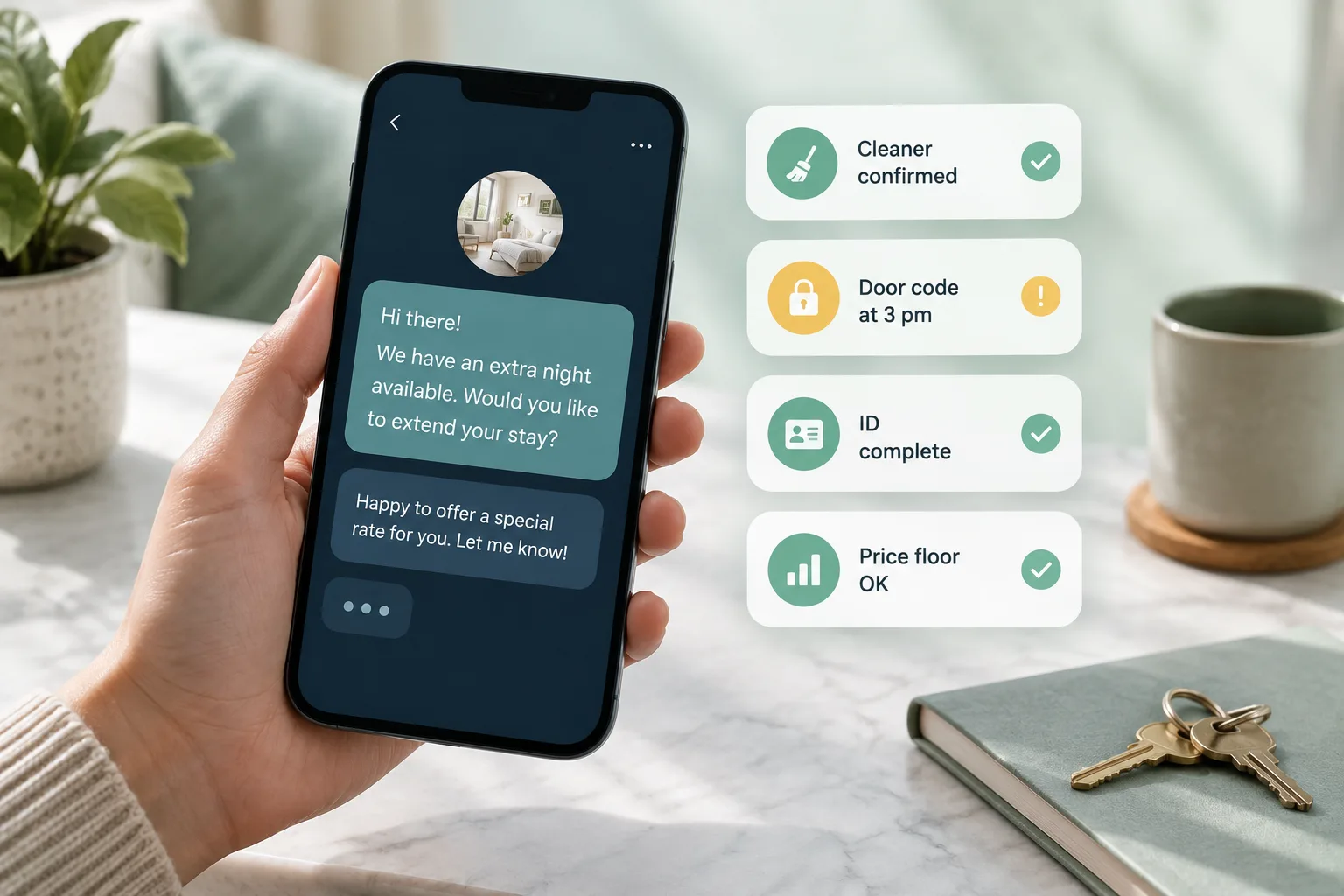
Adjacent guests are the cleanest way to fill gaps. You avoid a new party risk, you may reduce a turnover, and the guest already understands the property.
Hi {first name}, I hope you are looking forward to your stay at {property name}. We have the night after your checkout open on {date}. If it helps your plans, I can offer that extra night for {price}, with checkout on {new checkout date} at {checkout time}. No pressure at all. The offer is only available while the calendar stays open.Hi {first name}, a quick note in case it helps. The night before your arrival, {date}, is currently open. If you would like to arrive a day early, I can add it for {price}. Check in would be from {check in time}, subject to the usual house rules. If you want it, reply here and I will send the change request.Hi {first name}, you previously asked about {property name}. We have just had {dates} open up because of a cancellation. The stay is available for {price} and the calendar may book quickly. If the dates still suit you, reply and I can help you complete the booking through Airbnb.Keep the message friendly, clear and low pressure. State the price, timing and expiry. If using pre approval, remember Airbnb says a host can pre approve an enquiry and that the payout breakdown may show pricing as a special offer in its pre approval help. (airbnb.com)
Operational safeguards before allowing one night stays
One night gap rules need stricter controls than ordinary stays.
Check these before switching them on:
- Cleaner confirmed for the checkout day.
- Door code ready and time limited.
- Self check in instructions tested.
- Same day booking cut off set to a time you can actually manage.
- House rules clear before booking.
- Quiet hours set where relevant.
- Maximum guest count correct.
- Identity and payment process completed before code release.
- No party language visible in the listing rules.
- Minimum price floor active.
Airbnb says every primary host, new co host and booking guest must complete identity verification in its identity verification help. (airbnb.com) Airbnb also says disruptive parties and events are prohibited, and recommends using house rules to set maximum overnight guests and quiet hours in its party prevention guide. (airbnb.com)
Local rules matter. New York City requires registration for many short term rentals and bars platforms from processing unregistered short term rental transactions in its short term rental registration law. (nyc.gov) The City of Orange says all short term rental bookings require a minimum two night stay in its short term rental rules. (cityoforange.org) Houston says a short term rental for less than one day or night is prohibited in its host guide. (houstontx.gov)
Also keep current with platform rule changes. AP reported that Airbnb rules for checkout requests apply to reservations booked on or after 20 November 2026, and that hosts must disclose house rules and requests in the designated listing section before booking in its report on Airbnb checkout requests. (apnews.com)
A 15 minute weekly gap night routine for 1 to 10 units
Do this every Monday.
Scan the next 30 days for one and two night gaps. Then scan the next 60 days for three night gaps that sit inside high demand periods. For each gap, write one decision: sell, hold, message adjacent guest, or leave empty.
For each sell decision, check the minimum stay, price floor, cleaner availability and rule conflicts. If it is a weekday gap, consider a controlled discount. If it is a weekend or event gap, protect price first.
Every Friday, recheck the next seven days. Turn on last minute one night rules only where safe. Confirm cleaner coverage before you lower price.
Every month, review which gaps sold, what net contribution they made, whether any reviews or complaints suffered, and whether the cleaner had issues. Adjust the rules by season. Low season may need earlier opening. Peak season may need fewer discounts and more patience.
If you want the operating model around it, read how YourFrontDesk works for hosts and managers.
Next steps
Start with the next 30 days. Find every one and two night gap, make only the safe ones bookable, and calculate the net contribution before you discount.
If you want this handled automatically with a floor, ceiling, gap night logic and clear explanations for every price move, see an instant demo.
What people ask next
How do I set a minimum stay for specific dates on Airbnb?
Open your Airbnb calendar, choose the listing, go to availability settings and adjust minimum nights or custom trip length for the relevant dates. Always check the dates as a guest afterwards, because rule sets, preparation time and advance notice can still block a booking.
Can I have different minimum night stays on Airbnb?
Yes. Airbnb lets hosts set minimum nights and create custom minimum night rules, including by check in day and rule set. Use this carefully so you do not accidentally lower the whole listing when you only meant to fix one gap.
What are orphan nights on Airbnb?
Orphan nights are open nights between bookings that are too short for your normal minimum stay. They are also called gap nights, orphan gaps or stranded nights.
How do I fill gaps between Airbnb bookings?
First make the gap bookable by lowering the minimum stay for those dates only. Then decide whether to hold price, discount, add a premium, or message adjacent guests for an extension.
Can Airbnb automatically lower my minimum stay for gap nights?
Airbnb gives hosts custom trip length and rule set controls, but you still need to set the right rules. A pricing engine or booking system can help scan for gaps and apply date specific minimum stays if it supports that logic.
Should I allow one night stays on Airbnb?
Allow one night stays only when the numbers and operations work. Check cleaner availability, guest risk, house rules, local rules, price floor and same day stress before switching them on.
Why is my Airbnb available but not bookable?
The most common reasons are minimum stay rules, preparation time, advance notice, check in restrictions, checkout restrictions or a synced calendar block. Search the exact dates as a guest to see which rule is likely blocking the stay.