Airbnb Slow Season Booking Playbook
A practical playbook for hosts with 1 to 10 units who want to fill quiet dates without racing to the bottom. Build a seasonal rule set, protect your floor, adjust minimum stays, use extra channels and keep guest quality high.
The short version
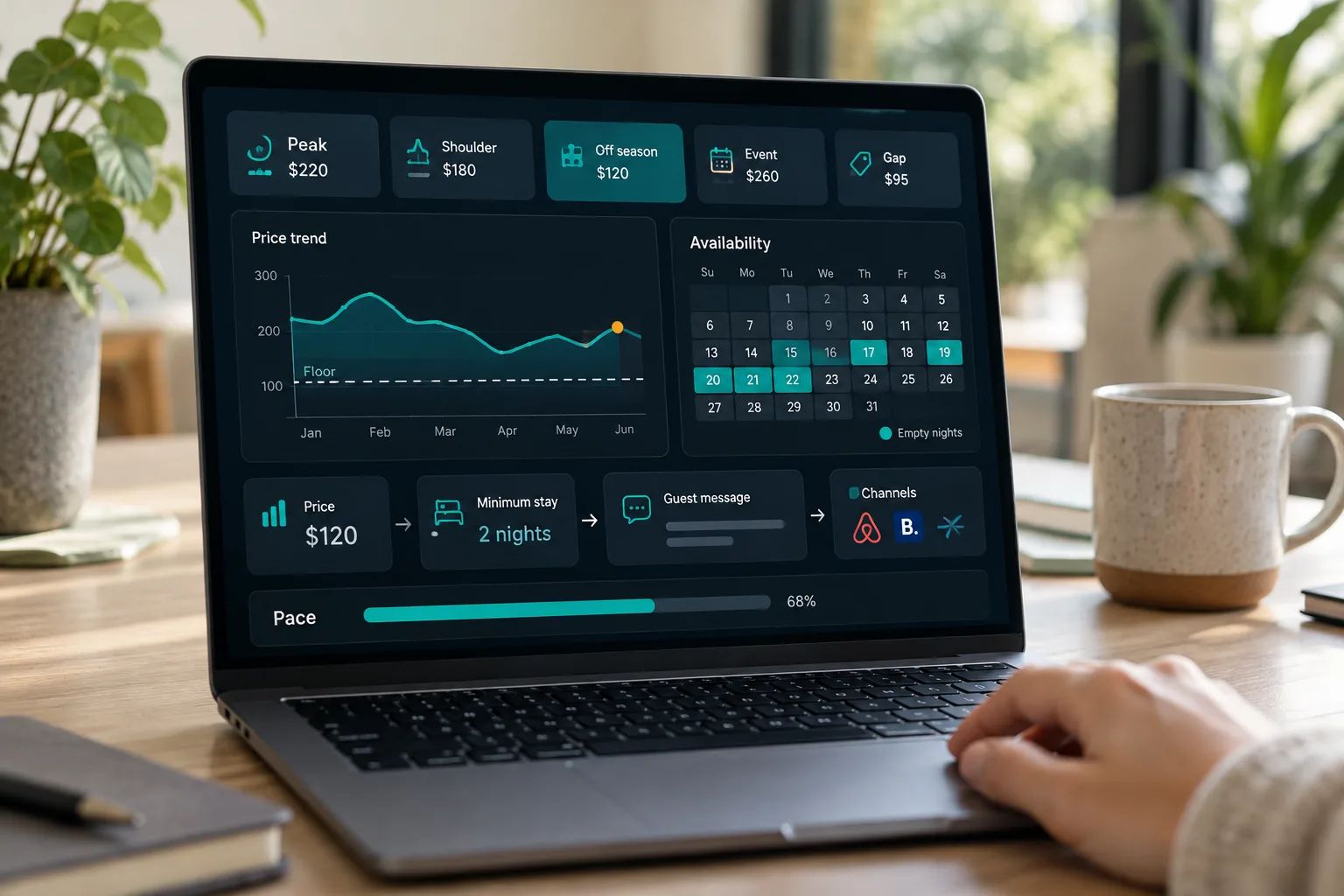
- Treat the Airbnb slow season as a rule set problem, not a blanket discount problem.
- Set a price floor before you use seasonal pricing, last minute discounts or gap rules.
- Change minimum stays by day of week and gap length before you cut every open night.
- Monthly stays can work in the off season, but only if you check utilities, cleaning, rules and guest fit.
- Add channels only when your calendar, pricing, messages and door access can stay under control.
Airbnb slow season is not solved by one large discount across the calendar. The better approach is to find your real low months, set a floor, then use seasonal pricing, minimum stay rules, gap logic, longer stay offers and extra channels in the right order.
For a host with 1 to 10 units, the aim is simple: protect profit first, then make the dates that are genuinely hard to sell easier to book.
What Airbnb slow season really means
Slow season is the period when normal guest demand is lower than usual for your market. Airbnb off season is often used for the same idea, while shoulder season usually means the weeks either side of peak demand. Event spikes are the exception: a quiet month can still contain a concert, graduation, sports weekend or trade show that books like peak season.
That is why slow season is market specific. A beach flat may struggle in winter, a ski condo may struggle in mud season, a city apartment may be quiet in late January but busy during conferences, and a rural cottage may depend on school holidays, wedding venues or walking routes.
Airbnb now treats seasonal pricing and last minute settings as normal host workflow. Its own host guidance says hosts can vary base price by month, use weekend adjustments and apply last minute discounts for arrival windows of 8 to 14 days, 2 to 7 days and 0 to 1 days. Airbnb seasonal price settings (airbnb.com)
Do not discount the season. Discount the problem night, with a floor underneath it.
Find your actual low season before changing prices
Start with your own data, not a feeling from last week. Pull 12 to 24 months if you have it. If you are new, use Airbnb similar listings, local event calendars and your closest comp set until your own history is useful. Airbnb says hosts can compare prices with similar listings nearby, and its performance tools can show occupancy across relevant listings when professional hosting tools are enabled. Airbnb pricing guidance (airbnb.com) Airbnb occupancy definition (airbnb.com.mt)
Track these columns every month:
| Month | Occupancy | ADR | RevPAR | Average lead time | Most common stay length | Season label |
|---|---|---|---|---|---|---|
| January | { } | { } | { } | { } | { } | Off season |
| April | { } | { } | { } | { } | { } | Shoulder |
| August | { } | { } | { } | { } | { } | Peak |
| Event week | { } | { } | { } | { } | { } | Event |
Use simple hotel style measures. Occupancy tells you how many available nights sold. ADR is the average daily rate for booked nights. RevPAR links rate and occupancy, so it shows whether a lower price actually produced more revenue per available night. CoStar describes RevPAR as a function of occupancy and ADR. CoStar performance glossary (costar.com)
Set a low season price floor before discounting
Lowering price without a floor is how hosts fill calendars and still lose money. Cleaning, laundry, utilities, payment fees, supplies, maintenance, mortgage or rent contribution, taxes and risk do not vanish just because it is February. Airbnb also tells hosts to factor in expenses such as mortgage, utilities, maintenance and taxes when setting price. Airbnb pricing guidance (airbnb.com)
Use this floor formula:
Nightly floor = variable cost per stay divided by minimum nights, plus nightly operating cost, plus required margin.
Copyable example, using your own inputs:
Variable turnover cost: 95 Nightly utilities and supplies: 35 Minimum stay: 2 nights Required margin per night: 25 Floor = 95 divided by 2, plus 35, plus 25 Floor = 107.50
That floor is not your target price. It is the line your pricing engine, manual rules and promotions should not cross. In the off season, you may accept a lower profit per night than peak season, but you should know the number before you start.
Build seasonal pricing rules once
Seasonal pricing works best as a matrix. You are not trying to guess every date by hand. You are creating guardrails.
| Season | Base rate band | Weekend premium | Minimum stay | Last minute rule | Length of stay discount | Floor | Channel rule |
|---|---|---|---|---|---|---|---|
| Peak | 100 to 120 percent of comp median | Strong | 2 to 4 nights | None unless behind pace | Small weekly only | High | Main channels |
| Shoulder | 85 to 100 percent | Moderate | 1 to 3 nights | Small inside 14 days | Weekly offer | Protected | Add family or city channel if fit |
| Off season | 70 to 90 percent | Selective | 1 midweek, 2 weekend | Ladder inside 14 days | Weekly and monthly | Never below | Add direct and longer stay sources |
| Event | Event comp based | Strong | 3 nights if demand supports | None | Usually none | High | Hold inventory carefully |
| Orphan gap | Gap value based | Not relevant | Match gap length | Stronger close in | None | Never below | Open wherever synced |
This is where seasonal rules in the pricing engine belong. YourFrontDesk lets each unit have a floor and ceiling, reads booking pace and gap nights, damps big swings, explains every move and reprices through the day. That matters in slow months because a panicked discount on a good weekend is just as expensive as an empty Tuesday.
Set monthly base prices, weekend modifiers, orphan gap rules, event overrides and a last minute ladder. Airbnb supports monthly base variation, weekend percentage adjustments and last minute minimum night settings, so the platform direction is clear even if you run your rules outside Airbnb too. Airbnb seasonal price settings (airbnb.com)
Change minimum stays before you slash every night
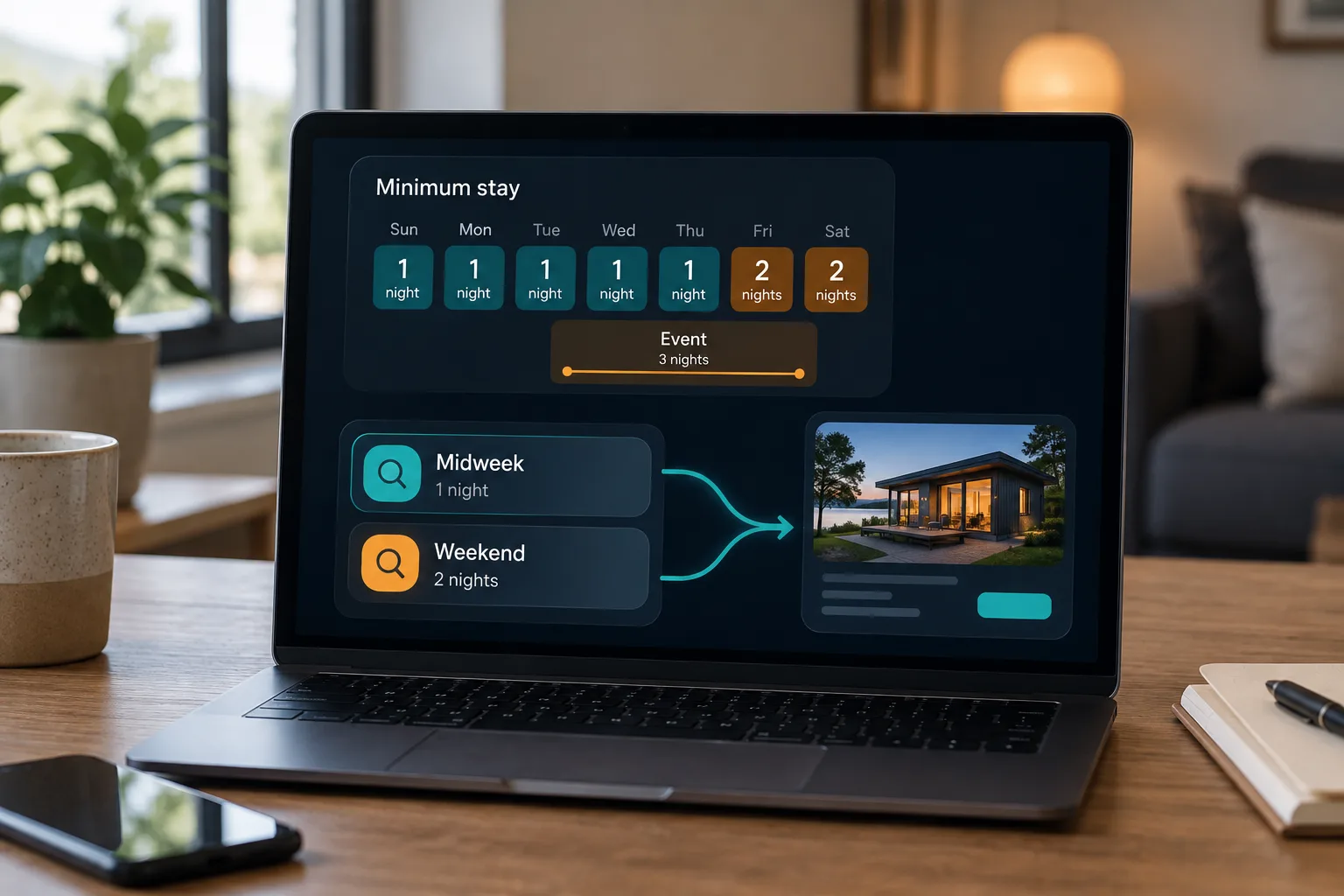
Minimum stay is often the hidden reason for low season bookings being weak. If your listing has a 3 night minimum, it will not appear for a 1 night business trip or a 2 night couple break. Airbnb specifically says lowering minimum trip length can appeal to short stay guests and help fill gaps, and hosts can customise minimums by day of week. Airbnb low season guidance (airbnb.com)
Practical rules:
1 night midweek only if cleaning, access and messaging can cope. 2 nights for most weekends. 3 nights for holidays and event weekends where demand is real. 28 nights or more only when you want a monthly stay strategy.
A simple example: your city flat has Tuesday and Wednesday empty. A 3 night minimum blocks the common 1 night hospital visit, interview, theatre trip or work stay. Lower Sunday to Thursday to 1 night inside 14 days, keep Friday and Saturday at 2 nights, and you improve search fit without giving away the whole month.
For more detail on weekday demand, see the guide to get more weekday Airbnb bookings.
Use last minute rules without training guests to wait
Last minute discounts are useful, but they should be sequenced. If guests learn that every weekend drops by 20 percent on Wednesday, you have trained your best demand to wait.
Use this ladder:
30 days out: hold rate if booking pace is normal. 14 days out: small adjustment for weak weekdays. 7 days out: meaningful adjustment for unsold low demand dates. 48 hours out: final gap fill discount, never below floor.
Airbnb lets hosts add last minute discounts for bookings made 1 to 28 days before arrival and says discounts of 10 percent or more off the 60 day median price may receive a search and listing callout. Airbnb low season guidance (airbnb.com)
A floor safe rule might be: 5 percent from 8 to 14 days, 10 percent from 2 to 7 days, 15 percent from 0 to 1 days. Do not apply it to event weekends, holidays or dates already booking ahead of pace.
Fill gaps and orphan nights deliberately
Orphan nights are stranded nights between bookings. Gap nights are short open spaces that are hard to sell under your normal minimum stay. Slow season creates more of them because stays are shorter, booking lead time is shorter and the calendar is patchier.
Example: you have a 2 night gap between reservations. Normal rate is 160. If it stays empty, revenue is 0. If you set the minimum to 2 nights and reduce only those dates to 135, the gap can sell for 270. The point is not that 135 is always right. The point is that the discount is attached to stranded inventory, not sprayed across the month.
Rules for gap nights:
Match minimum stay to the gap length. Discount only the stranded dates. Use copy that names the trip, such as quick midweek work stay or quiet winter weekend. Do not open a 1 night gap if your turnover cost destroys the margin.
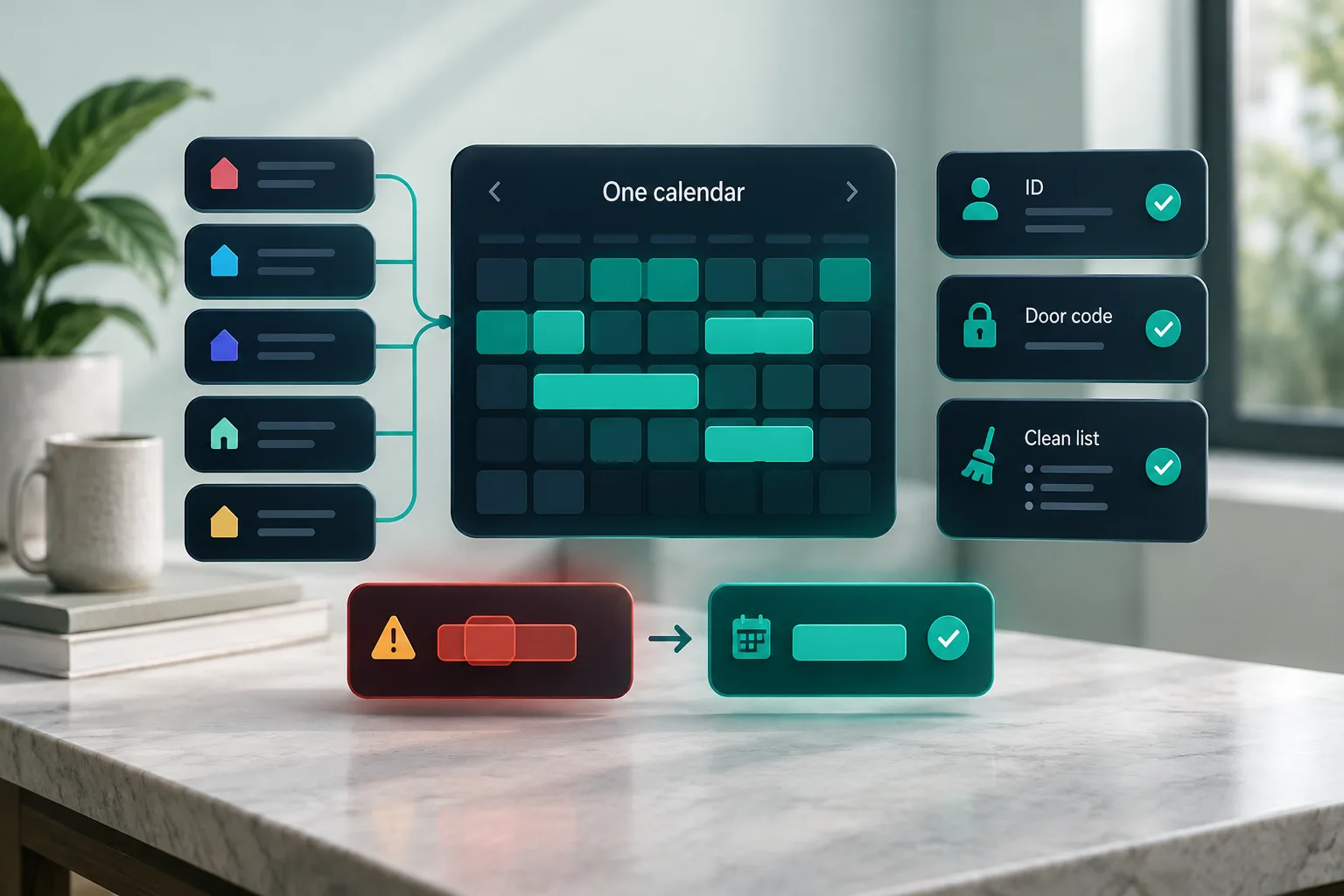
YourFrontDesk reads gap nights inside its pricing engine, and because every channel sits on one calendar, the same gap is not accidentally sold twice.
Package longer stays for the Airbnb off season
Monthly stays can beat short stays when winter demand is weak, events are scarce or your market has relocation, medical, corporate, renovation or remote work demand. Airbnb defines monthly stay search as at least 28 nights and says hosts can enable monthly stays, set weekly and monthly discounts, update guidebooks and offer cleaning during longer stays. Airbnb monthly stays for hosts (airbnb.com)
Run the trade off before you switch strategy. Suppose January short stays are expected to sell 11 nights at 120, giving 1,320 before costs. A 28 night stay at 65 gives 1,820 before costs and fewer turnovers. But it may add utilities, wear, linen planning, mail questions and local tenancy risk. Check your local rules before accepting longer stays.
Monthly stay copy:
Stay for {number of nights} nights in a furnished {property type} with fast Wi Fi, a proper desk, kitchen, laundry, parking and flexible arrival. Weekly cleaning is available for {price or included}. The space suits {remote workers, relocation guests, travel nurses or project teams} who need a quiet base near {hospital, office area, campus or transport}.For a full breakdown, read Airbnb monthly stays for hosts.
Refresh the listing for low season guests
Do not sell a winter stay with summer photos. If the guest is now a remote worker, hospital visitor, indoor weekend traveller or relocation guest, your first image and first lines should prove the fit.
Update:
Hero image: warm living space, workspace, view or parking. Title: match the current guest segment. First 200 characters: name the reason to stay now. Amenities: heating, cooling, workspace, Wi Fi, laundry, parking, pet policy. Guidebook: indoor food, rainy day plans, gyms, hospitals, campuses, transport. Photos: seasonal, not misleading.
Title formulas:
Quiet winter work stay near hospital Cozy weekend base near downtown restaurants Monthly stay with desk, parking and fast Wi Fi Beach flat for winter walks and remote work
Airbnb suggests guidebooks geared towards monthly stays for longer stay guests, which is a useful reminder: listing content should match the guest, not just the property. Airbnb monthly stay setup (airbnb.com)
Add channels when Airbnb demand is thin
If Airbnb demand is thin, add channels carefully. Do not add every channel on a Friday night with manual calendars and hope for the best.
Channel fit:
Families and larger homes: Vrbo can be useful. City apartments and international guests: Booking.com can be useful. Repeat guests: direct bookings can be useful. Corporate, nurses and relocation: mid term sources can be useful. Search visibility: Google Vacation Rentals can be useful when you have a direct booking route.
Vrbo says importing calendars helps prevent double bookings, and Google says vacation rental listings can show rates, availability and booking link redirects for eligible partners. Vrbo calendar sync guidance (help.vrbo.com) Google Vacation Rentals overview (support.google.com) Booking.com also publishes partner guidance on syncing calendars to help prevent double bookings. Booking.com partner calendar video (youtube.com)
Before you add channels, read the guide to sync Airbnb and Booking.com calendars. If you want a single operational layer for Airbnb, Booking.com, Expedia, Vrbo and direct, YourFrontDesk puts every channel on one calendar with the front desk in the middle.
Protect guest quality while being flexible
Low price does not automatically mean bad guest, but weak screening plus low price is risky. Keep flexibility for stay length, lead time and offer structure. Do not relax safety, occupancy or house rules.
Use verified ID where available. Airbnb says Instant Book guests must complete identity verification, agree to house rules and meet guest requirements. Use clear maximum occupancy, quiet hours, no party language, visitor rules, parking rules and pet rules. Airbnb ground rules require guests to follow house rules, and its party prevention guidance tells hosts to set maximum overnight guests and quiet hours. Airbnb Instant Book guidance (airbnb.com) Airbnb party prevention guidance (airbnb.com)
Security deposits vary by platform and setup. Airbnb says some hosts, including select software connected hosts, may collect a security deposit off platform if it is disclosed in the correct fee field before booking. Check the current platform rule before using one. Airbnb fee and security deposit rule (airbnb.com)
Hi {first name}, thanks for booking {property name}. To make sure the space is a good fit, please confirm who is staying, your planned arrival time and that you have read the house rules, including quiet hours, maximum occupancy and no parties. Once confirmed, I will send the arrival details for {check in date}.30 day low season action plan
90 days out: label peak, shoulder, off season and event dates. Set seasonal rate bands, floors, weekend adjustments and minimum stay rules.
60 days out: update photos, title, first lines, amenities and guidebook. Build your monthly stay version if relevant.
30 days out: add extra channels only after calendar sync is safe. Email past guests. Contact local businesses, hospitals, universities and relocation contacts.
14 days out: activate gap rules and review weak weekdays.
7 days out: apply floor safe last minute discounts only where booking pace is behind.
After each stay: request the review, log guest type, lead time, stay length, channel and profit per booked night.
Hi {first name}, I hope you are well. We have a few quiet dates at {property name} between {date range}. If you need a work base, family visit or short break near {local area}, I can offer {offer details} for returning guests. Reply with your preferred dates and I will check the calendar.Hi {name}, I host {number} furnished {property type} near {area}. In the quieter season we can support project staff, relocation guests and visiting teams with fast Wi Fi, workspace, laundry, parking and flexible arrival. If you ever need stays from {minimum length} to {maximum length}, I can send availability and a simple monthly rate.Track occupancy, ADR, RevPAR, booking pace, lead time, channel mix, review count and profit per booked night. Revenue without profit is noise.
Next steps
Build the rules once: season labels, price floor, minimum stays, gap logic, last minute ladder, longer stay offer, channel plan and guest screening. Then review every week during the slow months, not every hour.
If you want the operational layer around this, see how YourFrontDesk works, review pricing for short let hosts, or try the instant demo.
What people ask next
What are the slowest months for Airbnb bookings?
The slowest months depend on the market. Beach areas often slow after summer, ski areas often slow in mud season, and cities may dip between major events, conferences and holidays. Use your own occupancy, ADR, RevPAR and lead time by month before changing prices.
How do I get more Airbnb bookings in the off season?
Start by lowering the barriers that block real demand: rigid minimum stays, weak listing copy, no longer stay offer and poor gap pricing. Then use last minute discounts, past guest outreach, extra channels and monthly stay packaging, but keep a price floor in place.
Should I lower my Airbnb prices in low season?
Often yes, but not with one blanket discount. Set a nightly floor based on turnover cost, operating cost and required margin, then discount only the dates that need help, such as weak weekdays, orphan gaps and close in open nights.
What is shoulder season for short term rentals?
Shoulder season is the period between peak and low demand. It usually has some demand, but guests may book later, stay fewer nights or need a stronger reason to choose your property. It needs flexible rules rather than peak season restrictions.
What minimum stay should I use in slow season?
A common pattern is 1 night midweek if operations allow, 2 nights for most weekends, 3 nights for holidays or events and 28 nights or more only for a deliberate monthly stay strategy. The right setting depends on your cleaning cost, booking lead time and guest type.
Do last minute discounts help Airbnb bookings?
They can help when dates are genuinely at risk of going empty. Use a ladder, such as a small discount inside 14 days, a stronger one inside 7 days and a final gap fill price inside 48 hours, always protected by your floor. Do not discount high demand event or holiday dates just because they are close.
Are monthly stays worth it for Airbnb hosts in winter?
Monthly stays can be worth it when short stay demand is weak and the guest profile is reliable. Compare expected short stay revenue with a 28 night booking, then check utilities, cleaning schedule, wear, local rules, deposits, ID and review velocity before accepting.
Should I list on Vrbo or Booking.com as well as Airbnb?
It can make sense when Airbnb demand is thin, but only if your calendar, pricing and messages stay controlled. Larger leisure homes often suit Vrbo, city apartments may suit Booking.com, repeat guests may suit direct, and monthly demand may come from corporate or relocation sources.