Airbnb Minimum Stay Setting Guide
Set your Airbnb minimum stay by date, not by habit. This guide shows small hosts how to choose minimum nights, protect peak dates, fill gaps and troubleshoot rules.
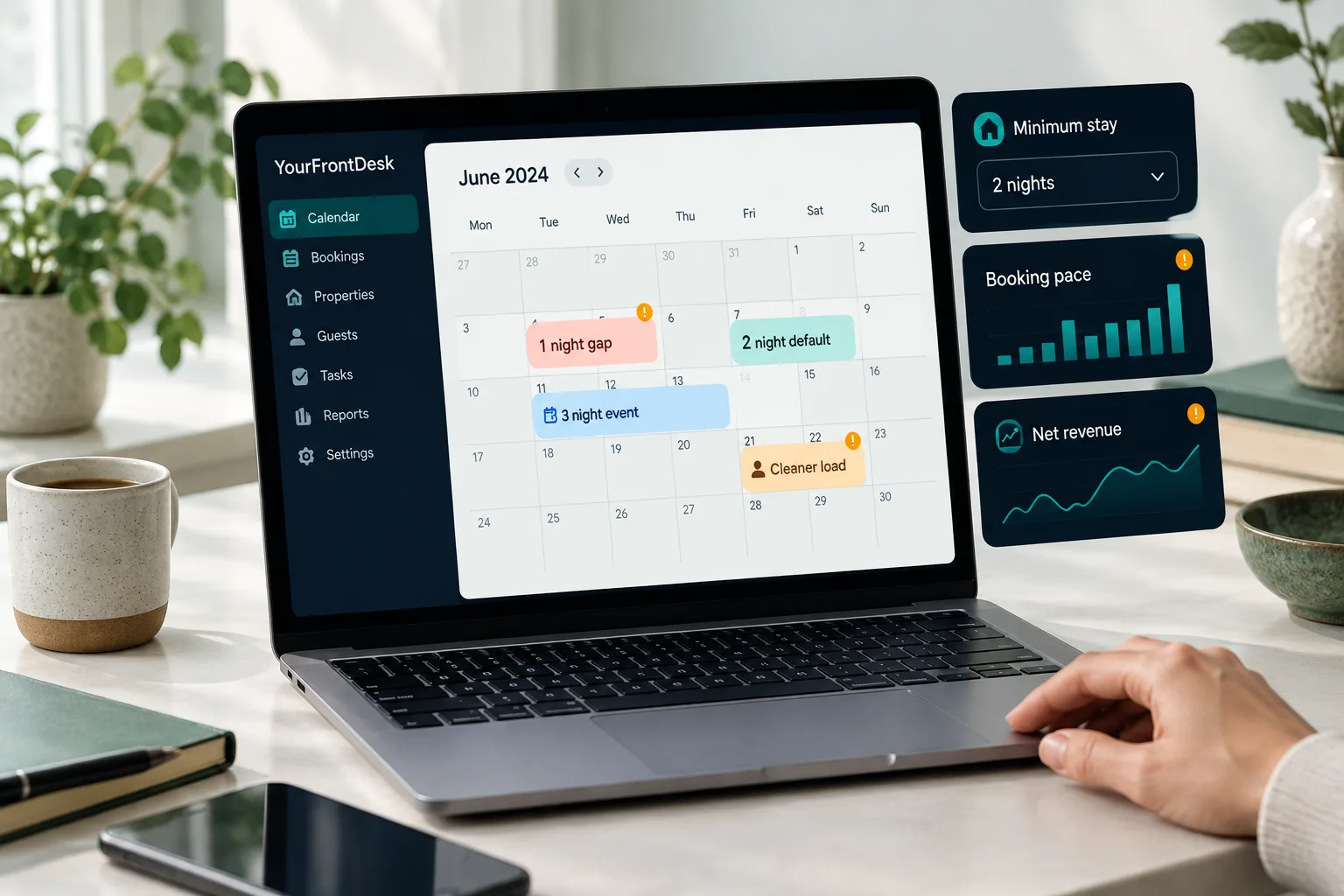
The short version
- A 2 night default is a sensible starting point for many small hosts, but high demand dates and awkward gaps need separate rules.
- Minimum stay rules often apply to the check in day, so protect arrival dates around events, not only the event night itself.
- One night bookings should pass a turnover cost test before you accept them, especially if you pay for cleaning and laundry separately.
- If your Airbnb minimum stay is not working, check custom dates, rule sets, check in day rules, connected software and guest view testing.
- Review the next 21 nights every week and test one minimum stay change at a time for 4 to 6 weeks.
The airbnb minimum stay setting controls the shortest reservation a guest can book for the dates where that rule applies. For most small hosts, the winning approach is not one fixed number. Use a calendar system: a normal rule, a peak rule and a gap rule.
If you run 1 to 10 units, your minimum stay length has to protect margin, cleaner capacity and search eligibility at the same time. Airbnb says hosts can set minimum and maximum nights from Calendar, then Availability, and can also customise minimum nights by check in day in its Airbnb Help article on minimum and maximum nights.
What the setting actually controls
Minimum nights are the shortest stay a guest is allowed to book where your rule applies. Maximum nights are the longest stay you allow. Both sit beside other availability controls, including advance notice, preparation time, availability window, check in days, checkout days and Instant Book.
Airbnb also says changing trip length can affect calendar exposure, because lowering minimum trip length can appeal to short stay guests and help fill calendar gaps in its Airbnb Resource Centre guide to availability. That does not mean every one night booking is good. It means the rule should match the date.
Your base rule is the default. Your custom trip length handles exceptions. Your rule set, if you use professional hosting tools, can override existing minimum night rules while it is in effect, according to Airbnb Help on rule sets.
The best minimum stay is not a number, it is a calendar rule that changes with demand, gaps and cleaning capacity.
Quick answer for most small hosts
Start with a 2 night default if your market has a mix of work trips, weekends and leisure guests. Use 1 night only when it is profitable, when it fills a gap, or when the date is close enough that an empty night is likely. Use 3 nights for peak weekends, events, high cleaning cost homes and properties where a poor turnover risks a bad review. Use 5 to 7 nights only where guests naturally book longer stays, such as school holiday weeks, beach weeks or ski weeks.
Local rules can override strategy. For example, New York City says hosts cannot rent out an entire apartment or home to visitors for fewer than 30 days, in its official short term rental host guidance. Always check your own licence, lease and council rules before setting a short minimum.
Do not make rules longer than needed. Airbnb states that search relevance can consider guest trip duration, availability and host requirements such as minimum or maximum nights in its terms on search ranking. A 4 night minimum may protect you from weak bookings, but it also removes you from searches for 1, 2 and 3 night trips.
How to change the Airbnb minimum stay setting
On desktop, go to Calendar, choose the listing calendar, open Availability, update minimum nights and maximum nights, then save. Airbnb gives that route in its minimum and maximum nights help page. Mobile wording can vary, but the setting is still part of calendar availability and trip length.
For weekend rules, use the check in day customisation. Airbnb gives the example of a 2 night minimum for Friday check in and 1 night for other days in the same help page. A practical version for a city flat could be Friday 2 nights, Saturday 2 nights, Sunday to Thursday 1 night when cleaner cover is available.
After every change, test it like a guest:
| Test | What to search | What you want to see |
|---|---|---|
| Weekday short stay | 1 night Tuesday | Bookable only if you allow it |
| Normal weekend | Friday to Sunday | Meets weekend minimum |
| Event weekend | Thursday to Sunday and Friday to Sunday | Arrival dates are protected |
| Gap night | Single open night between bookings | Bookable only if you want it |
| Longer stay | 7 nights or 28 nights | Not blocked by maximum nights |
How to set minimum stays for specific dates
Use date specific rules for holidays, school breaks, local events, graduation weekends, conferences and peak weekends. The rule must include the arrival dates you want to control, not just the night of the event.
Example: if a Saturday concert is the demand driver, do not only protect Saturday. Protect Thursday, Friday and Saturday arrivals if you do not want a guest checking in Thursday for 2 nights and leaving your best Saturday open. If you want a full weekend, set the correct minimum for each arrival day that could include the event.
Useful starting rules:
| Scenario | Suggested minimum | Reason |
|---|---|---|
| New Year period | 3 nights | High demand and higher guest risk |
| Graduation weekend | 2 or 3 nights | Demand often spans several arrival days |
| Summer changeover week | 5 to 7 nights | Guests expect longer leisure stays |
| Single orphan night | 1 night | Better than leaving a trapped night empty |
| Cancellation gap inside 7 days | 1 or 2 nights | Recover revenue while time is short |
Airbnb says a custom trip length shorter than the normal minimum can help fill calendar gaps in its availability guidance for hosts. That is the cleanest use of 1 night stays: not as your whole strategy, but as a release valve.
The check in date rule many hosts miss
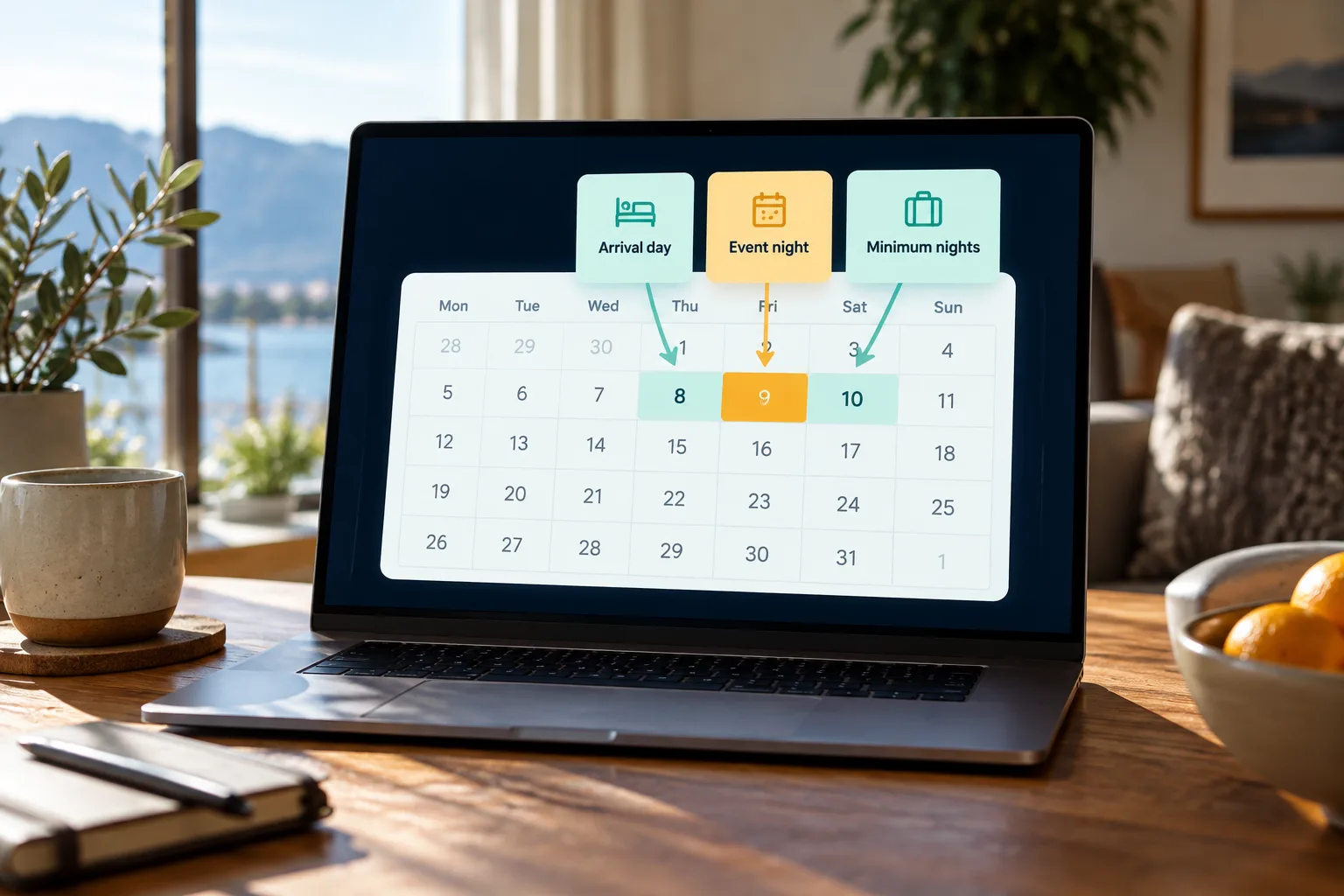
Minimum stay rules are commonly tied to the guest arrival day. Airbnb says hosts can customise minimum stay by check in day in its official trip length instructions. This matters because a Friday rule does not always stop a Thursday arrival from staying across Friday.
Use this mental model:
| Guest arrives | Guest departs | Rule that matters most | Risk |
|---|---|---|---|
| Thursday | Saturday | Thursday minimum | Friday rule may not protect the event |
| Friday | Sunday | Friday minimum | Good for normal weekend control |
| Saturday | Sunday | Saturday minimum | Can fill or create a 1 night gap |
| Sunday | Monday | Sunday minimum | Useful for gap recovery |
If you sell on more than one channel, rules can mean different things. Booking.com connectivity documentation distinguishes a stay through restriction, where the date is included in the stay, from an arrival based length of stay restriction in its official availability restriction documentation. Vrbo also has minimum and maximum stay controls in its Vrbo help page on length of stay.
The operator lesson is simple: protect arrival days around demand, not only the night everyone is talking about.
Minimum stay, cleaning cost and net revenue
A booking is not good just because it fills a night. Work from net revenue after platform fees, cleaning cost, laundry, supplies and your time.
Use this formula before accepting short stays:
Minimum profitable nights = turnover cost ÷ target turnover share ÷ nightly revenue
If your cleaner, laundry, supplies and owner time are high, 1 night bookings will need a strong rate or a guest paid cleaning fee to make sense. Airbnb says the host service fee is calculated as a percentage of the booking amount and deducted from the payout in its Airbnb host service fee help article. It also says cleaning fee and Airbnb service fee are added after rule set price calculations in its rule set pricing guide.
Use your own figures in this table:
| Booking type | Room revenue | Cleaning fee charged | Actual turnover cost | Net before fixed costs | Operational note |
|---|---|---|---|---|---|
| 1 night | {rate} | {fee} | {cost} | {rate plus fee minus cost minus platform fee} | Highest load per pound earned |
| 2 nights | {rate x 2} | {fee} | {cost} | {revenue minus cost minus platform fee} | Often the small host default |
| 3 nights | {rate x 3} | {fee} | {cost} | {revenue minus cost minus platform fee} | Better for weekends and events |
| Gap night | {gap rate} | {fee} | {cost} | {recovered revenue minus cost} | Good only if cleaner cover exists |
For cleaning fee strategy, compare this with our guide on how much to charge for an Airbnb cleaning fee.
Date by date rule system
Use default, protect, relax.
Default is the normal rule for ordinary dates. Protect means longer minimums for dates where demand is strong. Relax means shorter stays for stranded nights, weak weekdays and late unsold dates.
| Timing | Rule to consider | Operator reason |
|---|---|---|
| 60 or more days out | Protect peak dates with 2 to 4 nights | Hold out for the right pattern |
| 30 to 59 days out | Keep demand based rules | Still enough time for quality bookings |
| 14 to 29 days out | Loosen weak weekdays | Capture shorter trips if pace is slow |
| 3 to 13 days out | Open orphan gaps | Empty trapped nights rarely fix themselves |
| 0 to 2 days out | Decide from cleaner capacity | Same day stays are only useful if you can execute |
For 1 unit, be conservative with short stays because every turnover lands on you or your cleaner. For 2 to 4 units, stagger rules so you are not turning every unit on Sunday. For 5 to 10 units, keep one similar unit more flexible for short stays while protecting larger or harder to clean units with longer minimums.
If you want software to help with that, use the pricing engine to manage date by date minimum stay rules. It reads booking pace and gap nights, keeps a floor and ceiling per unit, damps big swings and explains every move.
Recommended rules by property type
These are starting points, not laws. Benchmark 10 to 15 comparable listings by season and unit type, then judge results against occupancy, booked revenue per available night, net revenue after cleaning and cleaner load. For occupancy context, read our guide to good Airbnb occupancy rate benchmarks.
| Property type | Default minimum | Weekend minimum | Peak or event rule | Gap rule |
|---|---|---|---|---|
| Urban studio | 1 or 2 nights | 2 nights | 2 or 3 nights | 1 night if profitable |
| Downtown 1 bed | 2 nights | 2 nights | 3 nights | 1 night inside 14 days |
| Family flat | 2 nights | 3 nights | 3 or 4 nights | 2 nights unless easy clean |
| Beach house | 3 nights | 3 or 4 nights | 5 to 7 nights | 2 nights late only |
| Ski cabin | 3 nights | 3 nights | 5 to 7 nights | 2 nights in soft weeks |
| Event city home | 2 nights | 3 nights | 3 or 4 nights | 1 night after event passes |
| Luxury property | 3 nights | 3 or 4 nights | 4 or more nights | Rarely 1 night |
| Monthly friendly flat | 7 nights | 7 nights | 28 or more where legal | Use monthly logic |
For longer stays, compare your rules with the Airbnb monthly stays host guide.

Why your Airbnb minimum stay is not working
Most problems come from a hidden override, not from Airbnb ignoring you. Check in this order.
First, look for a custom date rule. You may have changed the base setting while a date range still has its own trip length. Second, check the arrival day customisation. A shorter Thursday rule can allow a stay that includes Friday. Third, check rule sets. Airbnb says that while a rule set is in effect, it overrides existing minimum night rules in its minimum nights help page.
Fourth, check professional hosting tools. Airbnb says rule sets can include trip length requirements and check in or checkout requirements, and that Smart Pricing must be turned off if you want to apply a rule set because Smart Pricing overrides rule sets in its rule set help article. Fifth, check any connected booking system. If it is the source of truth, Airbnb may be receiving different restrictions from the ones you typed into Airbnb.
Also check whether the booking was made before your change, whether preparation time or blocked dates are making the stay look unavailable, whether the guest sent an inquiry rather than booking instantly, and whether local rules or your maximum nights are limiting the result.
Multi channel warning
Calendar sync is not the same as rule sync. Airbnb says connecting calendars with a 2 way connection helps prevent double bookings in its availability guide. Vrbo also provides import and export calendar tools in its calendar sync help page.
That does not mean your Airbnb minimum stay setting automatically travels to Booking.com, Vrbo, Expedia or your direct booking page. Set minimum stay rules in every channel, or set them once in your booking system and audit the channels after changes.
This is where YourFrontDesk fits for hosts who sell on several channels. Every channel sits on one calendar, with YourFrontDesk in the middle, so the operator has one place to watch the pattern rather than guessing from several calendars. For a broader view, see how YourFrontDesk works for apartment hosts and managers.
Guest message templates for short stay requests
Keep the tone practical. Explain cleaning quality and availability, not punishment.
Hi {first name}, thanks for your message. We are not able to accept a 1 night stay on {date} because the cleaning and turnover time would not allow us to prepare the property properly for the next guest. If your dates are flexible, we can host you from {alternative dates}.Hi {first name}, thanks for asking. We can accept 1 night on {date} because it fits neatly between two existing bookings. The total will show in Airbnb before you confirm, including the cleaning fee. If that works for you, please send the request and we will review it promptly.Hi {first name}, thanks for your interest. That weekend has a {minimum nights} night minimum because of {event name} and the cleaning schedule around it. If you can stay from {arrival date} to {departure date}, the calendar should allow the booking. Otherwise, I can suggest {alternative dates}.Hi {first name}, the calendar is showing that message because the stay does not meet the trip length settings for those dates. For {date range}, the minimum stay is {minimum nights} nights. If you can adjust the arrival or checkout date, the system should show the available options.Weekly and monthly review rhythm
Do a 20 minute review each week. Scan the next 21 nights. Reduce minimums on stranded nights only where the maths works. Check cleaner capacity. Search your own listing as a guest for the rules you just changed.
Once a month, spend 60 minutes on the wider pattern. Compare booked lead time, average length of stay, occupancy, room revenue, net revenue after cleaning, number of turnovers, cleaner issues, unbooked peak nights, gap nights and declined short stay requests. Add upcoming events before your competitors do. Audit Airbnb, Booking.com, Vrbo, direct and your booking system.
Test one variable for 4 to 6 weeks. Try weekday 1 night stays, a weekend 2 night minimum, a late gap rule, or a 3 night event minimum. Do not change everything at once, or you will not know what worked.
For more on orphan nights, read the Airbnb gap nights guide.
Next steps
For a small host, the practical system is simple: 2 night default, longer rules for strong arrival dates, shorter rules only for gaps and late weak dates, and a cleaning cost check before every 1 night exception. If you manage several similar units, keep one flexible, protect the expensive cleans and review the next 21 nights every week.
If you want this handled in one operating rhythm, try the instant demo of YourFrontDesk.
What people ask next
How do I set a minimum stay on Airbnb?
Open your listing calendar, go to Availability, then update minimum nights and maximum nights. Save the change, then test the listing as a guest for the dates you changed.
Can you set a minimum stay for specific dates on Airbnb?
Yes. You can apply custom trip length rules to selected date ranges, such as holidays, events and orphan gaps. Make sure the rule covers the arrival dates you want to control, not only the event night.
Can I set different minimum nights for weekends on Airbnb?
Yes. Airbnb allows custom minimum night rules by check in day, such as a higher minimum for Friday and Saturday arrivals. This is useful for protecting weekends without making quiet weekdays too restrictive.
Why is my Airbnb minimum stay not working?
The usual cause is an override. Check custom date rules, check in day rules, rule sets, connected booking software, preparation time, blocked dates and whether the booking or inquiry started before you changed the rule.
Does Airbnb minimum stay apply to the check in date or every night?
Airbnb minimum night rules are commonly set by check in day. That means a Friday rule may not stop a Thursday arrival from staying through Friday, so protect the arrival days around high demand dates.
Should I allow one night stays on Airbnb?
Allow them only when they are profitable and operationally safe. They work best for trapped gap nights or late unsold dates, but they can overload cleaners and make the guest price look high once fees are included.
Do minimum stays affect Airbnb search ranking?
They can affect whether your listing is eligible for a guest search and Airbnb says host requirements such as minimum and maximum nights can be considered in search relevance. Overlong minimums may remove you from shorter trip searches.